
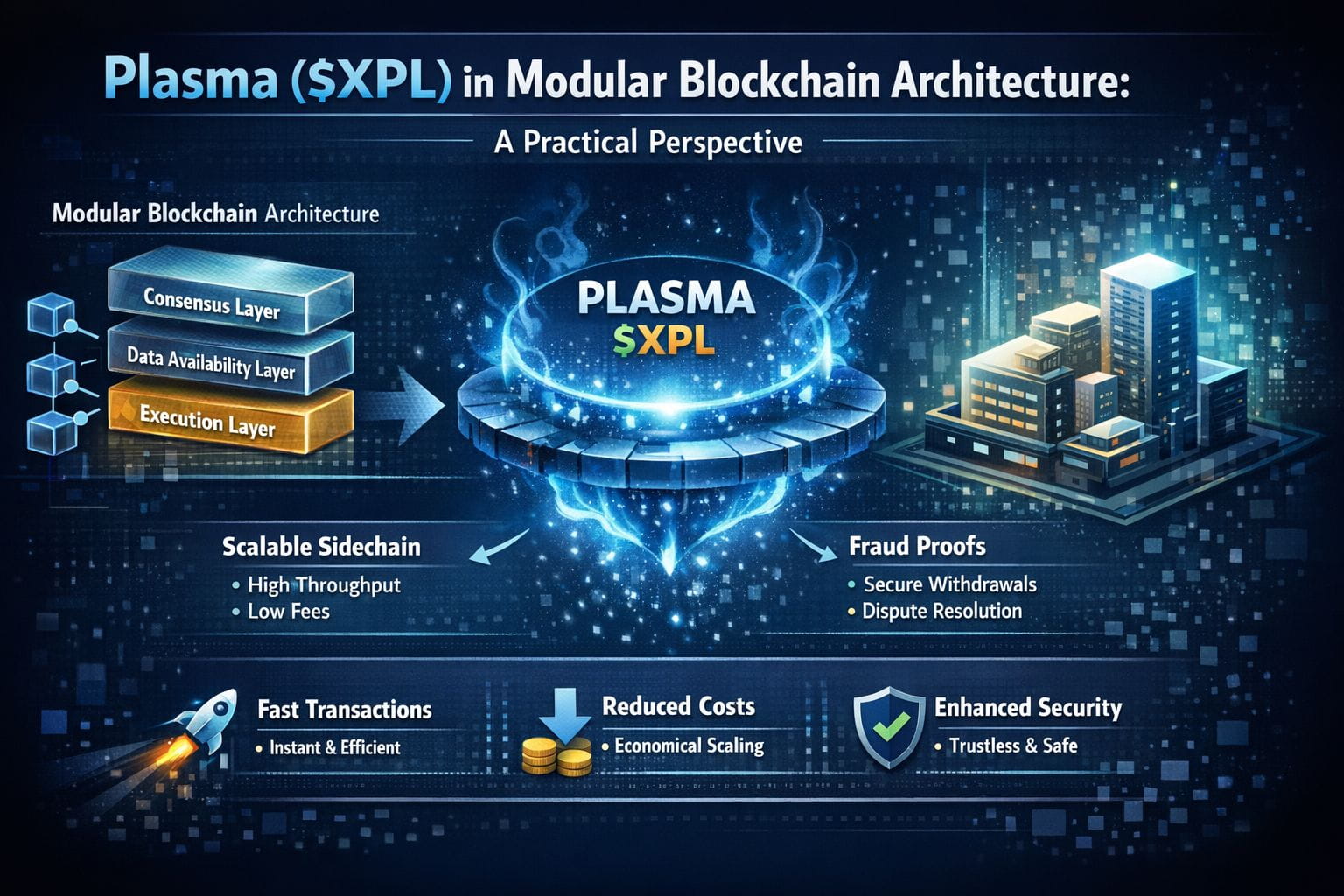
When people talk about modular blockchains, it often sounds abstract, like pieces floating neatly into place. In practice, it’s messier. I’ve seen modular setups where each part worked fine on its own, but the system slowed down once everything had to work together. Execution became the bottleneck, not design.
Plasma ($XPL) fits into modular architecture in a very practical way. It acts as a place where execution can happen without dragging the rest of the stack down. Data comes in from one layer, logic runs, results move on. Simple in theory, but hard to get right at scale.
What makes this perspective relevant now is how many teams are breaking monolithic chains into parts. Storage here, data there, execution somewhere else. That separation brings flexibility, but it also creates coordination problems. Plasma helps reduce friction between those pieces by keeping execution predictable and steady.
I’ve learned that users don’t care how modular a system is. They care if it responds when they click. Infrastructure like Plasma matters because it keeps that promise quietly. No drama, no noise, just systems that work the way people expect.
There’s also a human side to modular design that doesn’t get enough attention. When systems are split into layers, responsibility gets split too. I’ve watched teams spend days arguing about whether a delay came from data, execution, or settlement. Modular architecture makes those conversations unavoidable. Plasma helps by narrowing the problem space. When execution behaves consistently, it removes one big source of uncertainty.
What I find practical about Plasma’s role is that it doesn’t demand perfection from the rest of the stack. It assumes other layers will be slow sometimes, or noisy, or late. Execution still needs to move forward in a controlled way. That mindset feels realistic, especially for teams shipping real products, not just whitepapers.
This is why the topic keeps coming up now. Web3 systems are growing more complex, not simpler. Modular design is the response, but it only works if the connections between layers are reliable. Plasma supports that connective tissue. It doesn’t steal attention, but it carries weight.
Over time, you start to appreciate infrastructure that stays out of the way. If users never notice it, that’s success. Plasma’s place in modular blockchain architecture feels less like a bold statement and more like a sensible choice made by people who’ve learned, sometimes the hard way, where systems usually break.
Another thing experience teaches you is that modular systems age differently. The first version usually holds together. The second one starts to strain. By the third upgrade, every small assumption gets tested. I’ve seen teams regret early execution choices because changing them later meant touching every layer at once. That’s when you wish execution had been treated as a flexible, dependable component from the start.
Plasma’s role here feels preventative rather than reactive. By keeping execution behavior stable as other layers evolve, it reduces the risk that one change ripples through the entire stack. That matters when products are live and users are watching. You don’t always get a clean reset.
There’s also a quieter benefit. When execution is predictable, teams spend less time guessing and more time building. Debugging becomes clearer. Planning feels safer. These aren’t flashy outcomes, but they shape whether a project survives long term.
Modular blockchain architecture promises freedom. Plasma supports that promise by absorbing some of the operational stress that comes with it. In the real world, that kind of support often makes the difference between an architecture that looks good on paper and one that actually lasts.

