
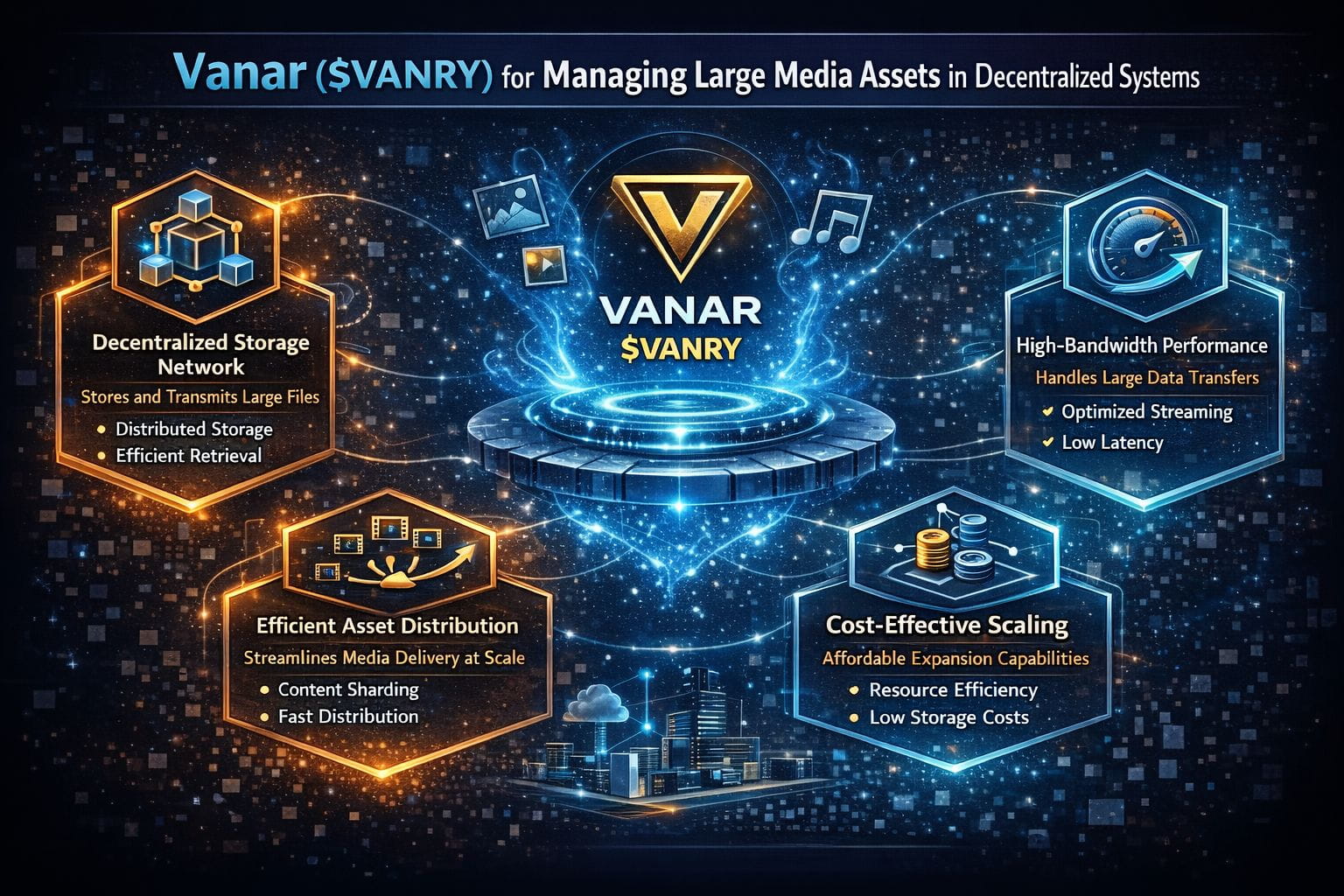
The first time I dealt with large media assets on a decentralized platform, I remember thinking something was wrong with my internet. Files took too long to appear. Images loaded in pieces. Video previews lagged behind clicks. Later I realized the problem wasn’t my connection at all. The system simply wasn’t built to handle heavy media at scale. That experience changed how I look at projects like Vanar ($VANRY), which start by admitting that decentralized systems need to deal with big files in the real world, not just in theory.
Large media assets behave very differently from simple data. A text record can wait. A video, a 3D model, or a game environment cannot. When users interact with media, they expect it to respond instantly. Vanar approaches this by designing its infrastructure around continuous access rather than occasional retrieval. In simple terms, it’s built to keep media flowing instead of stopping and starting all the time.
What makes this relevant now is how much Web3 has shifted toward content. Games, virtual worlds, social platforms, and creator tools all rely on rich media. These applications don’t just store assets, they constantly move them. I’ve seen projects fail not because the idea was weak, but because every interaction felt heavy. Users are patient with new ideas, but not with broken flow.
Vanar’s approach feels grounded in that reality. Instead of forcing large assets through narrow systems, it handles them in a way that reduces stress on the network. The impact is subtle but important. Assets load more predictably. Interactions feel smoother. Developers don’t have to redesign everything when media sizes grow.
From a personal perspective, the best systems are the ones you stop thinking about. When media loads naturally, you focus on the experience, not the mechanics. That’s what Vanar seems to aim for. It doesn’t try to impress users with technical language. It tries to remove the moments where people hesitate, refresh, or lose interest.
This is why the topic is trending now. Decentralized systems are being used for real content, not just experiments. Media sizes are increasing. User expectations are rising. Infrastructure that worked for small files and light usage is starting to show its limits. Vanar appears in these conversations because it was built with heavy assets in mind from the start.
Progress here isn’t flashy. It shows up in fewer complaints, smoother sessions, and users staying longer. That’s the kind of progress that matters in practice. Managing large media assets is not optional anymore. Vanar ($VANRY) feels relevant because it treats that challenge as a core responsibility, not a future problem to solve later.
