
Vanar Chain, powered by its native token $VANRY, represents a rare evolution in blockchain development. What began as a vision rooted in virtual worlds and gaming has steadily transformed into a full-scale Layer 1 blockchain designed for artificial intelligence, real-world assets, and global digital payments. Its journey reflects a broader shift across Web3, where infrastructure is no longer built for speculation alone, but for long-term utility, intelligence, and adoption.
Rather than emerging overnight, Vanar’s progress has unfolded through years of experimentation, adaptation, and refinement. Each phase contributed lessons that shaped its current identity as an AI-native blockchain focused on speed, affordability, and real-world integration.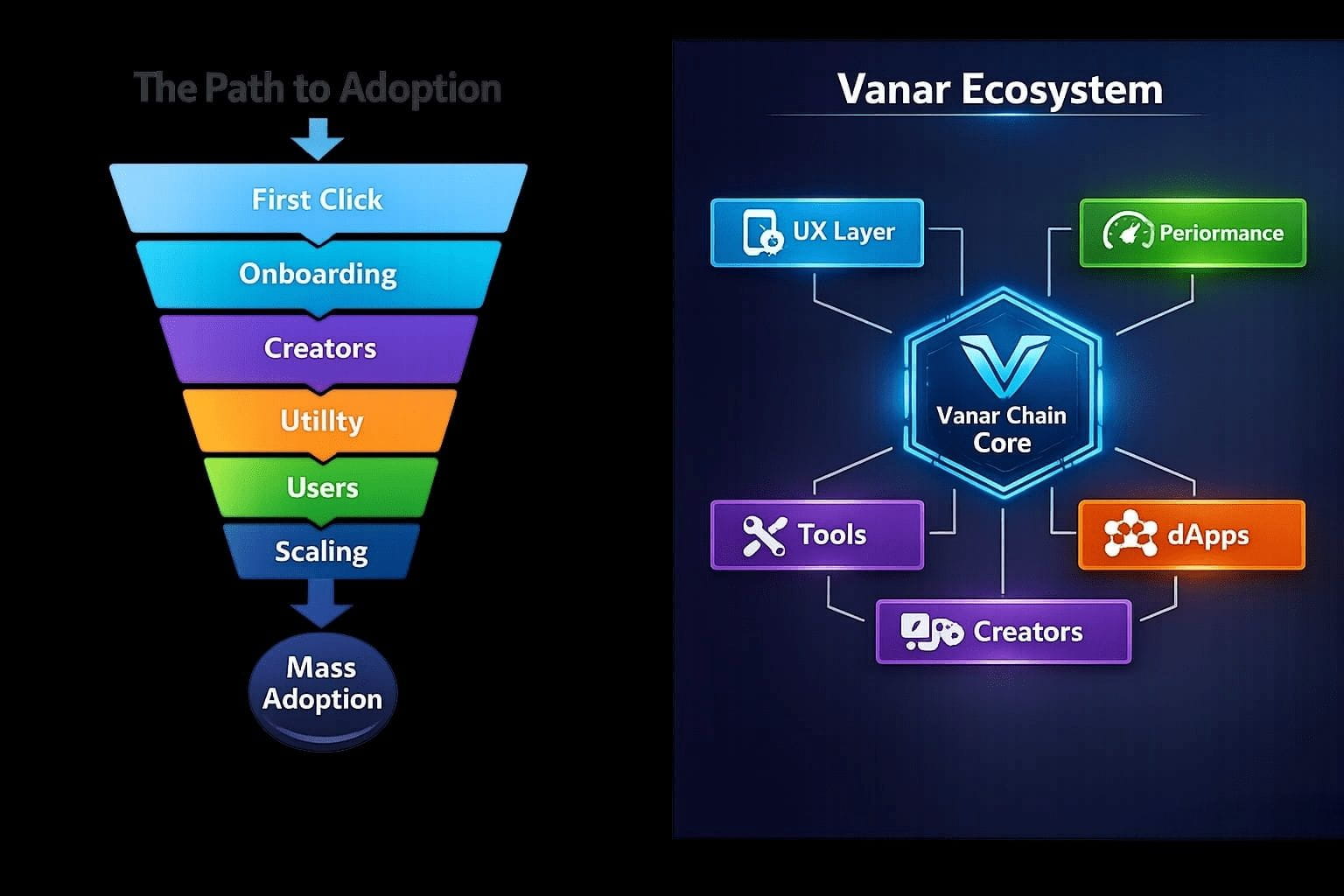
The Origins: A Vision Born in Virtual Experiences
The foundations of Vanar trace back to 2018, during a period when virtual reality, augmented reality, and immersive digital environments were gaining momentum. At the time, many metaverse concepts struggled with fragmented systems, limited scalability, and technological constraints that made large-scale digital economies impractical.
Recognizing these shortcomings, a group of experienced professionals began exploring how immersive environments could evolve if supported by stronger infrastructure.
Jawad Ashraf, a technology entrepreneur with over three decades of experience across cybersecurity, energy trading, mobile gaming, and virtual reality, identified a consistent pattern. Digital experiences were advancing faster than the systems meant to support them. High transaction costs, slow confirmation times, and complex onboarding created friction that prevented mass adoption.
Alongside him stood Gary Bracey, a veteran of the global gaming industry with more than 35 years of experience delivering major titles across console, PC, and emerging platforms. Together with technical leadership from Anis Chohan, the group combined enterprise strategy, creative development, and deep engineering expertise.
This collaboration gave rise to Virtua an early Web3 platform focused on gaming, digital collectibles, and immersive environments. Virtua was not simply a product but a testing ground. It exposed firsthand how blockchain limitations affected real users in interactive environments.
Those early years revealed a fundamental truth: if blockchain technology could not operate invisibly and affordably, it would never support experiences at global scale.
Virtua as a Learning Phase
Virtua’s development highlighted several persistent challenges across Web3. Transaction fees fluctuated unpredictably. Wallet onboarding confused mainstream users. Performance bottlenecks disrupted gameplay and digital commerce.
Rather than accepting these constraints, the team treated Virtua as a laboratory. Every friction point became data. Every failure informed future design decisions.
The conclusion was unavoidable. A dedicated blockchain would be required one built specifically to support high-volume interaction, microtransactions, and real-time applications.
Gaming alone was not the limitation. The infrastructure beneath it was.
This realization marked the turning point that eventually led to Vanar Chain.
Designing a Purpose-Built Layer 1
The transition from Virtua to Vanar was not a pivot away from gaming, but an expansion beyond it.
Vanar’s whitepaper introduced a Layer 1 blockchain built on the proven Go Ethereum codebase, ensuring compatibility with existing tools while allowing deep architectural changes.
Several design principles defined the network from inception.
Transaction fees would be fixed and predictable, denominated in dollar values rather than fluctuating token prices. Standard transfers could cost as little as $0.0005, ensuring long-term affordability regardless of market conditions.
Block times were capped at approximately three seconds, enabling fast confirmations suitable for interactive applications.
Gas limits were expanded significantly to allow high throughput and parallel execution.
Transaction ordering followed a first-come-first-served model, reducing manipulation and mitigating MEV-style behavior.
Ethereum compatibility remained central. Developers could deploy Solidity contracts using familiar tooling without rewriting code.
The $VANRY token was introduced as the network’s native asset, used for gas, staking, governance, and ecosystem participation. Total supply was capped at 2.4 billion tokens. Half was minted at genesis through a one-to-one swap from Virtua’s TVK token, while the remaining supply would be distributed gradually over a twenty-year emission schedule.
Importantly, no team allocation existed at genesis. Emissions were directed primarily toward validators, development funding, and community incentives a structure designed to reinforce decentralization and long-term sustainability.
Consensus and Network Security
Vanar adopted a hybrid consensus approach combining Proof of Authority in its early stages with Proof of Reputation and Delegated Proof of Stake.
Validators are selected based not only on technical capability but also on reputation, operational history, and community trust. Token holders participate directly by delegating stake and voting on validator participation.
This model balances efficiency with decentralization, ensuring high performance without sacrificing network integrity.
Environmental sustainability was addressed from the start. Validator infrastructure operates on carbon-neutral cloud providers, including partnerships with renewable energy platforms. This commitment positioned Vanar as a green blockchain at a time when environmental scrutiny of crypto intensified globally.
The Mainnet Transition and VANRY Migration
The official transformation from Virtua to Vanar Chain occurred in late 2023 through a seamless 1:1 migration from TVK to VANRY.
This moment marked the transition from application-layer experimentation to full blockchain infrastructure.
Mainnet deployment enabled developers to launch decentralized applications across gaming, NFTs, payments, and emerging financial use cases. Low fees and fast finality immediately differentiated the network.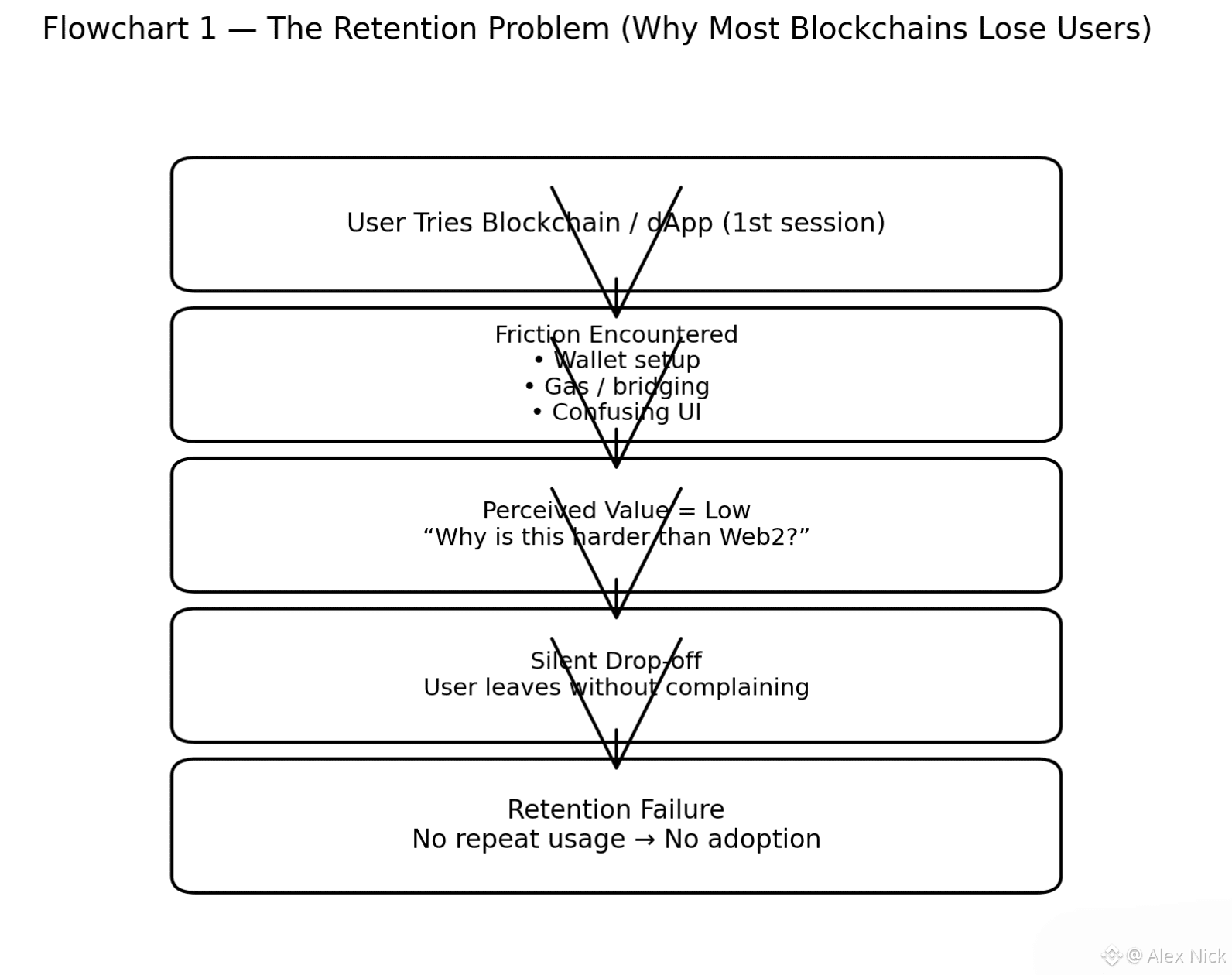
Early ecosystem activity demonstrated practical demand rather than speculative hype. Gaming platforms integrated on-chain economies. NFT projects benefited from predictable minting costs. DeFi primitives operated without congestion.
Staking mechanisms empowered the community to participate directly in governance and network security.
These early months validated the foundational design decisions.
The Evolution Toward AI-Native Architecture
As blockchain adoption matured, attention began shifting toward artificial intelligence and data-driven automation. Vanar’s roadmap adapted accordingly.
Rather than bolting AI onto existing smart contracts, the network introduced a multi-layer architecture known as the Vanar Stack.
At its core lies the base transaction layer handling execution and settlement. Above it sits Neutron, a semantic data layer capable of compressing large datasets into on-chain knowledge objects called Seeds. These compressed structures allow AI systems to reference verifiable information directly on-chain without relying on external oracles.
Above Neutron operates Kayon, an on-chain reasoning engine designed to process structured data and enable autonomous decision-making.
Together, these layers allow applications to move beyond static smart contracts. Documents, invoices, ownership records, and agreements become machine-readable and verifiable within the blockchain itself.
This approach enables intelligent automation across payments, compliance, logistics, and asset management.
The V23 Upgrade and Protocol Expansion
In late 2025, the V23 upgrade represented a major evolution for Vanar Chain.
The upgrade introduced new consensus optimizations inspired by Stellar’s SCP model, improving scalability and coordination for complex applications.
Smart contract capabilities expanded to support richer logic, enabling use cases such as real-time compliance validation, dynamic royalty distribution, and automated financial workflows.
This upgrade positioned Vanar not simply as a faster blockchain, but as programmable infrastructure for intelligent economies.
Strategic Partnerships and Enterprise Integration
Vanar’s ecosystem growth accelerated through strategic partnerships bridging Web2 and Web3.
Collaboration with Worldpay enabled seamless fiat on-ramps, allowing users in over 150 currencies to interact with blockchain assets using traditional payment methods.
Partnerships with NVIDIA’s Inception Program strengthened AI and gaming development pipelines.
The Web3 Brand Accelerator brought major consumer brands into blockchain for product authentication, loyalty systems, and supply chain verification.
These integrations demonstrated how blockchain could operate invisibly beneath existing business models rather than replacing them.
Token Utility and Economic Design
$VANRY serves multiple functions across the ecosystem.
It powers transaction fees, secures the network through staking, governs protocol upgrades, and supports access to AI-based services.
Fixed-fee pricing remains central, with dynamic oracle adjustments ensuring consistent dollar-based costs.
Over time, usage-based burns linked to AI operations introduce deflationary pressure, reinforcing long-term scarcity.
Emission schedules decline predictably, gradually shifting network security toward fee-driven sustainability.
This model aligns economic incentives with real usage rather than speculation.
Vanar in Early 2026
By early 2026, Vanar Chain operates as an AI-native Layer 1 with applications spanning gaming, payments, data verification, brand infrastructure, and emerging real-world asset tokenization.
Network performance remains stable with high throughput and negligible fees.
The community governs through staking participation, while developers benefit from familiar tooling and integrated AI capabilities.
Challenges remain, as with any evolving infrastructure, including market volatility and regulatory uncertainty. Yet continued development focuses on utility rather than hype.
Vanar now occupies a unique position not as a competitor to single-purpose AI networks or gaming chains, but as foundational infrastructure enabling both.
Looking Toward the Future
The roadmap ahead centers on global expansion, deeper AI integration, and enterprise-scale deployment.
Regional programs aim to onboard developers across Asia, the Middle East, and South America. AI-powered applications continue to mature. PayFi gateways and automated asset systems move closer to mainstream adoption.
As tokenized assets expand into trillions of dollars globally, blockchains capable of handling intelligence, compliance, and scale will become increasingly essential.
Vanar positions itself at that intersection.
A Quiet Transformation
Vanar Chain’s journey illustrates how meaningful innovation often unfolds quietly. From its origins in virtual gaming environments to its current role as AI-native blockchain infrastructure, the evolution has been deliberate rather than dramatic.
This is not a story of sudden breakthroughs, but of patient construction.
As digital systems increasingly require trust, intelligence, and efficiency, the role of infrastructure becomes paramount.
Vanar does not seek attention through spectacle. Instead, it focuses on becoming reliable, adaptable, and invisible the kind of technology that powers daily activity without demanding notice.
In a future where economies interact with machines as naturally as with people, blockchains capable of reasoning, verifying, and scaling will define the next era.
Vanar Chain appears determined to be one of them.
