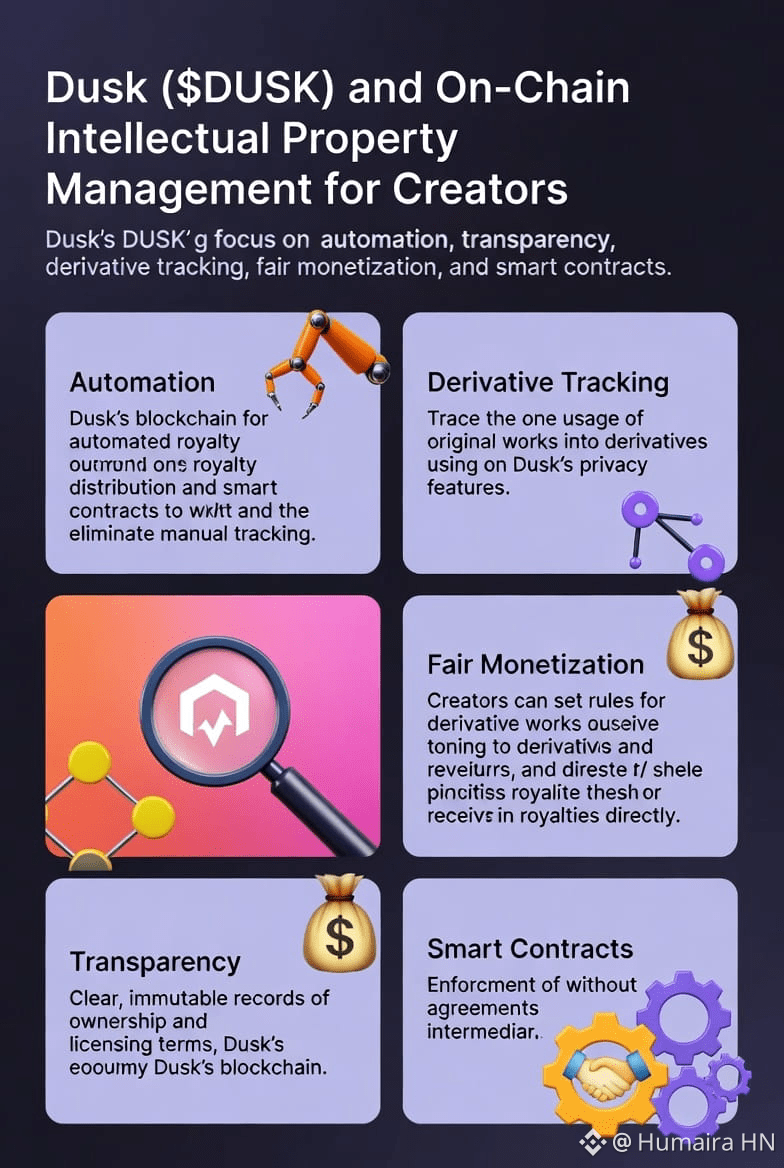
Introduction – Why On-Chain IP Matters for Creators
In my experience exploring @Dusk and $DUSK , one of the most compelling aspects is its potential to redefine how creators manage intellectual property (IP) on chain. As a creator, I’ve often faced the challenge of keeping track of rights, usage permissions, and licensing terms for my digital work. Traditionally, this has relied on manual contracts, legal documents, or centralized platforms, all of which are prone to errors, disputes, or even misuse. With Dusk, I can see a future where creators control IP management directly through decentralized, programmable systems, reducing friction and ensuring transparency.
What excites me the most about Dusk is how it bridges creativity and security in a way that feels intuitive. By using DUSK as the foundation for on chain IP management, I can register original works, define usage permissions, and create verifiable records of ownership. Every creative contribution, whether it’s a design, manuscript, or digital asset, can be tracked on a transparent, immutable ledger. This not only helps me assert ownership but also makes it easier to collaborate with other creators or license my work confidently, knowing that all records are verifiable.
As a creator, I’ve realized that true ownership is more than having a file saved on a computer or hosted on a platform. Ownership is about proof, control, and trust. I want to know that if someone uses my work, it’s verifiably mine, and I have the tools to enforce or grant permissions without relying on intermediaries. Dusk enables this by giving creators the ability to embed IP rights directly into a blockchain-based system, providing permanence and transparency for all interactions. It feels like the first time I can truly separate creative freedom from platform dependency.
Another reason this matters to me is how it changes collaboration dynamics. Creative projects today are rarely solo endeavors; multiple contributors often work on the same project simultaneously. Traditionally, tracking each person’s contribution, assigning rights, and ensuring fair compensation can be chaotic. With Dusk, I can assign ownership percentages, track modifications, and manage licensing rights for each contributor automatically. This transparency prevents conflicts, fosters trust, and encourages more meaningful collaborations. It also allows me to onboard new contributors confidently, knowing that their rights will be respected and recorded permanently.
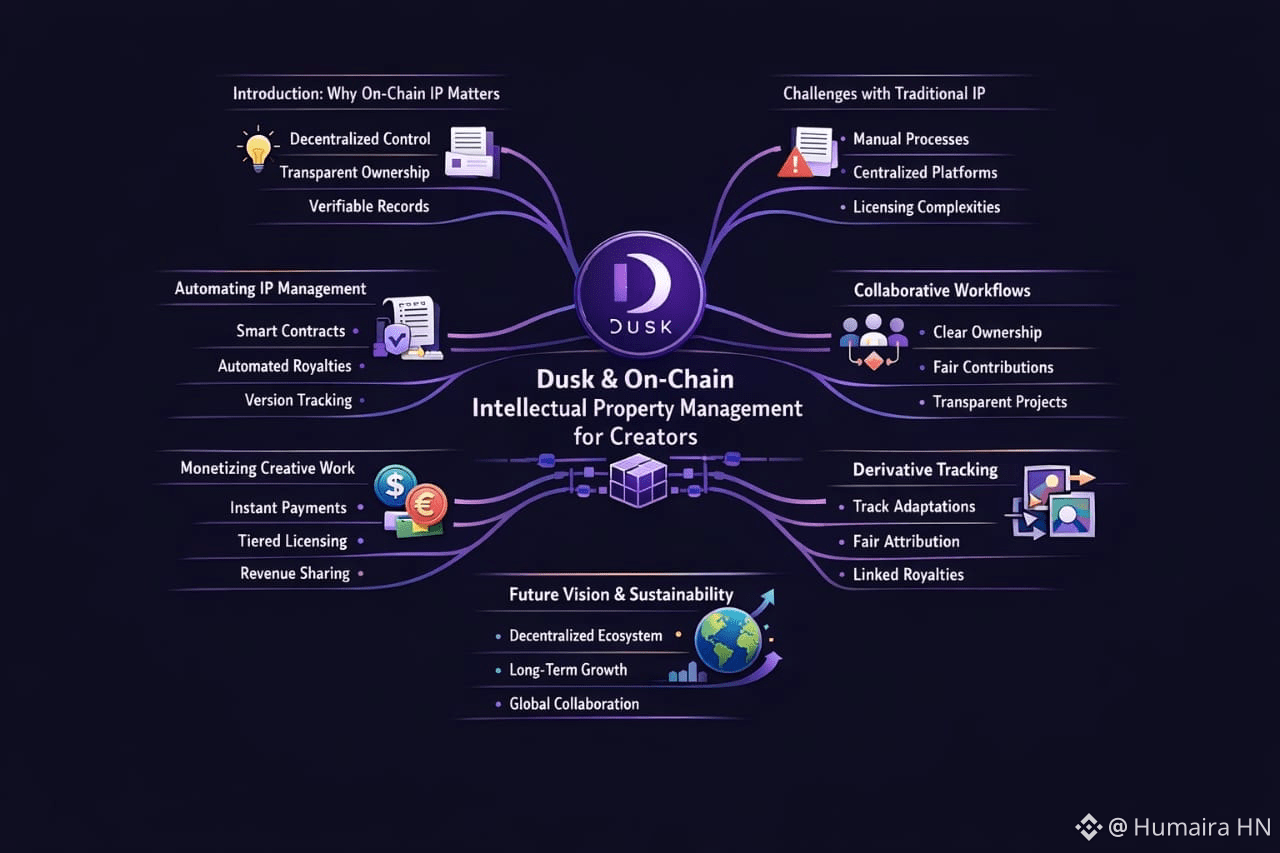
Challenges with Traditional IP Management
Before I started using Dusk, managing intellectual property felt cumbersome and uncertain. I often relied on email threads, shared documents, or private cloud storage to track who created what, when, and under which license. Even with legal contracts, disputes could arise due to misunderstandings, delayed communication, or human error. For instance, I’ve seen cases where multiple collaborators claimed ownership over the same creative asset, and resolving the dispute required lengthy back-and-forths or legal mediation. This not only wasted time but also created stress that interfered with my creative flow.
Traditional platforms also tend to centralize control. When my work is hosted or licensed through a third party service, that platform controls visibility, access, and sometimes even monetization. If the platform experiences downtime, enforces unexpected policy changes, or is compromised, my work is at risk. From my perspective, this centralization contradicts the principles of a creator first ecosystem. I realized I needed a solution where ownership, verification, and control are embedded at the foundational level, rather than depending on external entities.
Another challenge is licensing complexity. Digital content can have multiple usage scenarios: commercial, non-commercial, derivative, or limited-time usage. Managing these manually, especially when working with multiple collaborators or clients, is nearly impossible without automation. Mistakes can lead to financial loss or unintentional misuse of work. Dusk provides a framework where these licenses can be encoded into smart contracts, making enforcement automatic and transparent. This removes ambiguity, reduces overhead, and ensures creators are compensated fairly for their work.
Automating Intellectual Property Management
One of the features that immediately impressed me about Dusk is its ability to automate IP management using smart contracts. In the past, I had to manually issue licenses, track who had permission to use my content, and ensure that payments for usage were processed correctly. It was tedious and left room for mistakes. With DUSK, I can encode all of these rules directly into the blockchain, so the system automatically enforces my licensing conditions. For instance, if I grant someone permission to use my artwork for commercial purposes, the smart contract can automatically ensure that royalties are collected whenever it is used. This level of automation not only saves me time but also ensures that my work is always used according to my rules.
Another way automation benefits me is through version control and derivative tracking. When multiple collaborators are working on a project, it is often unclear who contributed which parts, or how derivatives should be credited. Dusk allows me to register changes and derivative work directly on-chain, giving each contributor verifiable credit for their input. This reduces disputes and fosters a more collaborative environment, where contributors feel confident that their efforts are recognized. From my perspective, this is a fundamental shift from relying on trust and manual tracking to relying on transparent, immutable records.
The automated system also makes auditing and compliance much simpler. If a collaborator or client ever questions the terms of use, I can immediately provide proof from the blockchain, showing exactly what rights were granted, to whom, and under which conditions. This level of transparency has fundamentally changed how I approach partnerships, because I no longer have to worry about ambiguity. Everything is verifiable, tamper-proof, and accessible to authorized parties. This, for me, is one of the most underrated advantages of Dusk: the combination of automation and trust.
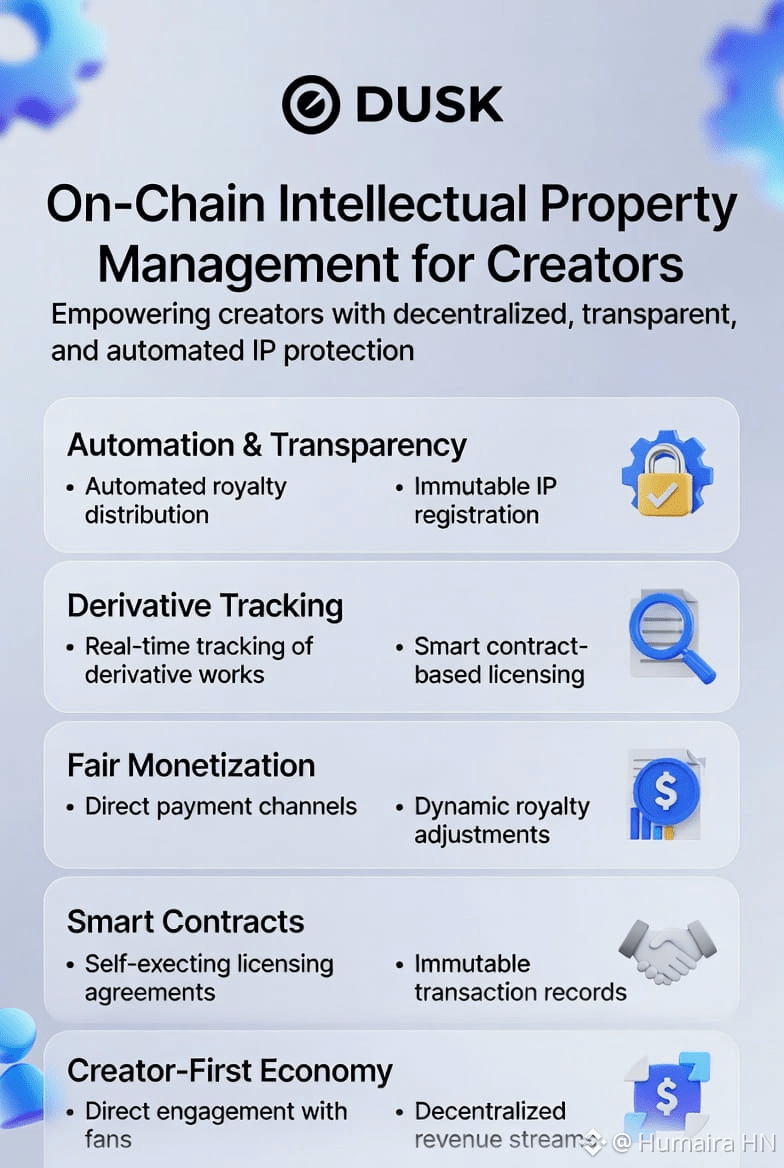
Collaborative Workflows Made Transparent
Collaboration has always been one of the most challenging aspects of digital creation. I’ve often participated in projects where multiple creators contributed, but ownership, credit, and compensation were poorly defined. Resolving these issues required tedious negotiations or legal intervention. With Dusk, I can define clear ownership shares and rights for every contributor, all recorded on-chain. This makes it easier to coordinate multi creator projects without worrying about disputes or miscommunication.
What excites me even more is how Dusk supports dynamic collaboration models. In some projects, contributors may join at different stages, or contribute in variable amounts. On-chain IP registration allows me to assign weighted ownership based on the level of contribution. This ensures fairness and encourages people to participate, knowing that their efforts are automatically recognized. It transforms collaboration from a trust-based system to a transparent, rule-based system, which is particularly useful in decentralized creative networks where teams may not know each other personally.
The platform also encourages shared creative accountability. Because every action is recorded on-chain, contributors are aware that their participation is tracked and verifiable. This encourages higher quality work, timely contributions, and adherence to project standards. From my perspective, this transforms the creative process itself, making it more structured while still allowing freedom and innovation. It is rare to find a system that balances accountability and creative freedom so effectively.
Monetizing Creative Work Fairly and Transparently
Monetization is one of the most practical concerns for any creator, and Dusk addresses this in a way that feels fair, automated, and transparent. In traditional models, royalties and licensing payments often rely on intermediaries or centralized platforms, which may take a large cut or delay payments. With $DUSK , payments can be encoded into smart contracts, ensuring that creators receive compensation instantly when their work is used according to the license. This has fundamentally changed the way I view revenue streams for creative projects.
One of the most innovative applications I’ve explored is tiered licensing and revenue sharing. Using Dusk, I can offer different levels of access to my content, such as personal, commercial, or derivative rights. Each tier can have distinct pricing and conditions, all enforced on-chain. This allows me to monetize my work more efficiently while giving clients and collaborators clarity on their rights. It also encourages wider adoption of my work because potential users know that usage rights are transparent and secure.
Additionally, on-chain revenue sharing has transformed how I handle collaborative projects. Previously, distributing royalties among multiple contributors was a manual process prone to errors or disputes. Now, Dusk enables automated revenue distribution based on pre-defined percentages stored in smart contracts. Each contributor receives their fair share automatically whenever the work generates revenue, without delays or manual intervention. From my perspective, this is one of the most practical applications of blockchain for creators, it removes friction, builds trust, and ensures fairness across the board.
Expanding Creative Opportunities with Derivative Tracking
One of the most transformative aspects of Dusk that I’ve experienced is the ability to track derivative works on-chain. In the traditional digital world, once a creator publishes a work, derivatives or adaptations often occur without proper attribution or oversight. This can range from minor edits to full reimaginings, and without a proper system, it’s difficult to recognize contributors or maintain licensing control. With $DUSK, I can register my original creations and track all derivatives automatically. Each derivative work is linked to its source, ensuring that the original creator is recognized and fairly compensated. From my perspective, this is a game-changer because it turns the chaotic nature of content adaptation into a structured, transparent process.
Tracking derivatives also encourages collaborative experimentation. I’ve noticed that when contributors know their adaptations will be properly attributed, they are more willing to innovate and build upon existing works. This creates a ripple effect of creativity, where the original work becomes a foundation for new ideas rather than a static artifact. By using Dusk, I can see how my work evolves over time, who contributes to its growth, and how each iteration is tied back to the original license. It transforms IP from a rigid legal concept into a living, dynamic ecosystem of creative collaboration.
Another benefit is the long-term recognition and monetization of derivatives. Often, derivative works gain value independently, but traditional licensing systems fail to ensure the original creator benefits. With Dusk, every derivative is automatically linked to the original creator’s smart contract, and revenue flows proportionally to all stakeholders. For me, this adds a sense of fairness and security, and it encourages more creators to participate in open, collaborative projects without fearing loss of recognition or compensation.
Licensing Innovation and Experimentation
Dusk doesn’t just replicate traditional licensing, it allows me to experiment with new models that were previously impossible. For example, I can create conditional licenses that activate only under certain circumstances, such as usage in a specific platform, timeframe, or project type. These smart licenses give me unprecedented control over how my work is accessed and used. I’ve personally experimented with granting temporary licenses for short-term campaigns, which has allowed my work to reach wider audiences while maintaining strict IP control.
Another innovation is tiered or fractional licensing, which allows me to divide rights among multiple users or collaborators while still maintaining oversight. For example, one team may receive commercial rights, while another receives non commercial educational access. This type of flexible licensing empowers me to explore new revenue streams and reach diverse audiences without compromising my creative control. Dusk has made it practical to implement these structures efficiently, which would have been incredibly cumbersome with traditional methods.
The ability to innovate in licensing also encourages me to push creative boundaries. Knowing that I can define, track, and enforce how my work is used makes me more confident in experimenting with new formats, styles, and collaborative approaches. In the past, fear of misuse or loss of control often constrained my projects, but Dusk removes these barriers. It creates a sandbox where creativity and security coexist, allowing me to focus fully on the creative process.
On Chain Dispute Resolution
One of the challenges in traditional IP management is dispute resolution. Conflicts over ownership, licensing, or revenue distribution can become drawn-out legal battles, delaying projects and straining relationships. With $DUSK, I’ve noticed that on-chain dispute resolution mechanisms simplify this dramatically. Because all contributions, licenses, and transactions are recorded immutably, the facts are verifiable by anyone authorized. This reduces ambiguity and provides a neutral, transparent basis for resolving conflicts without relying on external legal systems.
In collaborative projects, this transparency fosters trust among contributors. Knowing that every action is recorded and auditable gives me confidence when working with new collaborators, even in decentralized or international contexts. It also reduces friction in negotiations, because there is a clear, objective record of ownership, contribution, and licensing rights. From my perspective, this transforms how creative teams operate, making it easier to scale collaborative efforts without fear of disputes or mismanagement.
On-chain dispute resolution also supports community based oversight. For some projects, I’ve experimented with allowing stakeholders or community members to verify license compliance and flag potential misuse. This creates a participatory ecosystem where the community helps ensure fairness and adherence to rules, while I retain ultimate control over creative and licensing decisions. It’s a level of accountability that feels both empowering and practical.
Long Term Sustainability of Creator Ecosystems
Finally, Dusk empowers me to think about long term sustainability in the creator economy. With automated licensing, transparent contribution tracking, and fair monetization, creators are no longer dependent on centralized platforms or unpredictable revenue streams. This creates a foundation for sustainable creative careers. By using $DUSK, I can build a portfolio of work that continuously generates recognition and revenue, while retaining full control over how it is used and distributed.
The system also encourages collaboration across borders and disciplines, making it possible to scale projects globally. I’ve seen firsthand how Dusk fosters networks of creators, collaborators, and supporters who operate in a transparent, trustless environment. Over time, this not only benefits individual creators like me, but also strengthens the entire ecosystem, making it more resilient, fair, and innovative. It’s exciting to imagine a world where creators are empowered to focus fully on their craft, supported by decentralized infrastructure that respects ownership, transparency, and fairness.
Real World Examples of On Chain IP in Action
As I’ve explored Dusk more deeply, I began experimenting with practical applications of on-chain intellectual property management. For instance, I registered a series of digital artworks on-chain using $DUSK. Each piece was automatically assigned usage rules, commercial licensing permissions, and revenue-sharing terms. Later, when collaborators adapted the artwork for derivative projects, the system automatically tracked contributions and ensured royalties were fairly distributed. This hands-on experience made it clear how transparent, automated IP management can simplify complex workflows, even for projects involving multiple creators across different time zones and platforms.
Another example I explored was in digital publishing. I authored a collection of articles and research content and registered them with Dusk, embedding licensing rules directly on-chain. When educators and other creators wanted to use excerpts, they could instantly verify their permissions without waiting for me to manually approve each request. This not only saved time but also increased engagement and trust, as users could see clearly that permissions were legitimate. For me, this was a tangible demonstration of how Dusk can reduce administrative burdens while creating a more professional and trustworthy creative environment.
I also experimented with collaborative music projects. Multiple artists contributed to tracks, each recording their parts and submitting them through a Dusk powered system. Smart contracts managed rights allocation and revenue sharing, ensuring that each contributor received fair compensation whenever the tracks were streamed or licensed. The transparency and automation transformed what could have been a logistical headache into a smooth, efficient, and verifiable creative process. Experiences like these show me that Dusk is not just a theoretical tool, it has real, practical impact for creators managing complex projects today.
Impact on the Creator Pad Ecosystem
From my perspective, Dusk’s IP management tools are a perfect fit for the Creator Pad ecosystem. Creator Pad emphasizes supporting creators with resources, mentorship, and opportunities to launch projects securely and efficiently. On-chain IP registration and licensing complement this mission by giving creators full control over their work, while ensuring fair collaboration and monetization. I’ve noticed that projects using Dusk feel more structured and professional, as contributors understand their rights, revenue is handled transparently, and disputes are minimized. This strengthens the overall ecosystem and encourages more creators to participate confidently.

Furthermore, the ability to experiment with dynamic licensing models is highly relevant to Creator Pad participants. For instance, creators can offer limited-time licenses for community projects, fractional licenses for collaborative work, or conditional licenses tied to milestones. Each of these approaches encourages experimentation, increases engagement, and allows creators to tailor monetization strategies to their specific audiences. From my experience, this flexibility has helped me explore innovative revenue models while maintaining creative control, which aligns perfectly with the goals of Creator Pad.
The transparency of Dusk also fosters a more engaged community. When creators use on-chain IP management, supporters and collaborators can see exactly how rights, contributions, and revenue are structured. This builds trust, encourages participation, and allows communities to rally around creative projects in a meaningful way. In my projects, I’ve noticed that audiences feel more confident contributing or purchasing rights when they can verify licenses and see clear records of ownership. This trust is invaluable for long term success in the decentralized creator economy.
Future Vision for On-Chain IP Management
Looking forward, I believe the potential of Dusk extends far beyond current use cases. I envision a future where all forms of creative work art, music, writing, code, and digital media are registered, licensed, and tracked on-chain. For creators like me, this means complete control over our intellectual property, the ability to experiment with novel licensing models, and a transparent, fair way to monetize our contributions. It also opens doors for cross-platform collaboration, as contributors from around the world can work together with confidence that their rights are protected.
I also see the integration of Dusk into broader decentralized ecosystems. For example, creative marketplaces could automatically verify licenses using on-chain data, communities could fund derivative projects confidently, and even educational content could be shared with automated permissions and attribution. This would create a holistic creator economy, where work is valued, tracked, and rewarded fairly, and creators are empowered to innovate without fear of misuse or loss of credit. Personally, I find this vision inspiring because it finally aligns digital ownership with the principles of decentralization and transparency.
Additionally, on-chain IP management could transform how creators approach long-term project sustainability. By building portfolios with verifiable ownership, licensing, and revenue history, creators can attract collaborators, sponsors, and supporters more confidently. In my experience, having a clear, auditable record of contributions and revenue potential creates credibility and encourages investment both financial and community driven into creative projects. It turns the digital creator ecosystem into a professional, scalable, and trust based environment, rather than one dominated by uncertainty or platform control.
Closing Thoughts – Dusk as a Creator-First Solution
In conclusion, my experience with @Dusk and $DUSK has shown me that on-chain IP management is more than just a technical tool,it’s a paradigm shift for creators. By combining automation, transparency, derivative tracking, and fair monetization, Dusk empowers creators to control their work like never before. It reduces friction in collaboration, ensures fair compensation, and opens doors to innovative licensing and funding models. For creators participating in Creator Pad, this represents a practical, immediately useful solution that supports long-term growth and creative freedom.
Personally, what excites me the most is how Dusk enables a creator first economy, where value flows transparently, rights are protected, and innovation is encouraged. The combination of smart contracts, automated IP management, and on-chain verification has fundamentally changed the way I approach creation, collaboration, and monetization. Looking ahead, I am confident that Dusk will continue to shape the future of the digital creator ecosystem, giving creators like me the tools to fully own, manage, and benefit from our work in a decentralized, secure, and professional way. #dusk