
One of the strangest things about modern payments is that money can arrive before anyone is ready to admit it did.
On Plasma, a USDT transfer can finish almost instantly. The transaction reaches finality. PlasmaBFT confirms it. The receipt is clean and permanent. From the network’s perspective, the story is over. Nothing can be reversed. Nothing is pending.
But inside finance, the story is not finished at all.
I keep thinking about how odd that feels. The payment is real. The balance updates. The funds are visible. Yet the accounting system still says “not yet.” Not because anyone doubts Plasma. Not because there is uncertainty. But because finance does not move on transaction speed. It moves on time windows.
Settlement happens in seconds. Booking waits for the close.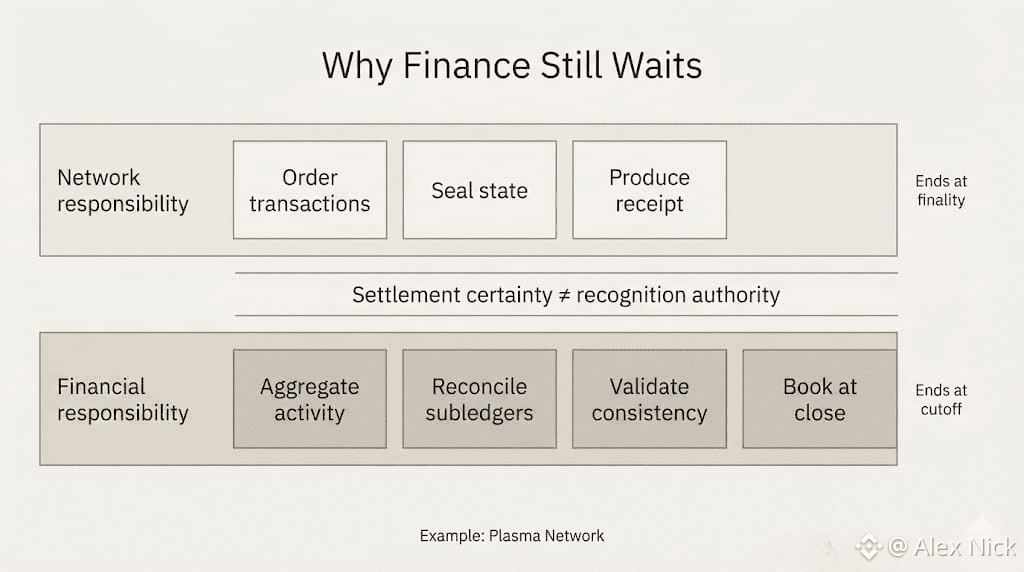
That creates a quiet space where money exists, but is not counted.
From a treasury dashboard, the balance shows up immediately. You can see it. You can verify it. Everyone agrees it arrived. Still, it does not enter the books until the moment finance is trained to trust. End of day. Batch reconciliation. A clean snapshot where numbers stop moving long enough for someone to export a report and put their name under it.
So the payment sits there in between states.
Settled, but not booked.
This is not a problem Plasma created. Plasma simply makes it visible.
The difference between settled and booked has always existed. Traditional rails just hide it behind delays. When settlement itself takes hours or days, nobody notices the gap because everything moves slowly together. But when settlement becomes immediate, the separation becomes impossible to ignore.
Plasma finishes the transaction while finance is still waiting for its clock.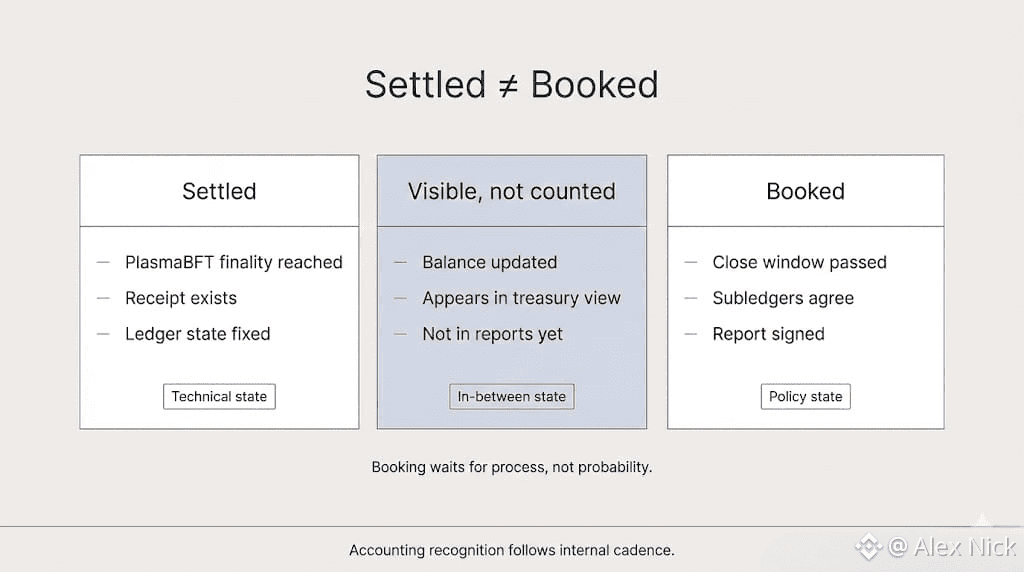
From the chain’s perspective, certainty is instant. From accounting’s perspective, certainty is procedural. A transaction being final is not the same thing as it being recognized. One is technical. The other is policy.
I have seen this play out in real treasury workflows. A finance team sees the funds arrive. They do not touch the numbers yet. Not because they fear the chain. Because the rest of their system depends on consistency, not speed.
Subledgers must match. Reports must align. Audit trails must tell a clean story tomorrow morning. If balances move mid hour, reconciliation becomes messy. So finance does what it has always done. It waits.
The phrase becomes familiar very quickly.
“It settled on Plasma. We will book it at close.”
Nothing breaks when that happens. But behavior changes.
Operations do not immediately treat the funds as usable. Cash managers plan around tomorrow’s numbers instead of today’s balances. Internal dashboards show money that exists but does not belong to any column yet. Support teams learn to answer questions with dates instead of states.
The payment happened.
Accounting has not caught up.
Gasless USDT transfers on Plasma make this more noticeable. When transfers are cheap and frictionless, they arrive in bursts. Sometimes hundreds in a short window. The close process was never designed for that tempo. It was designed for predictability.
Plasma compresses settlement into a precise moment. Accounting stretches recognition across time.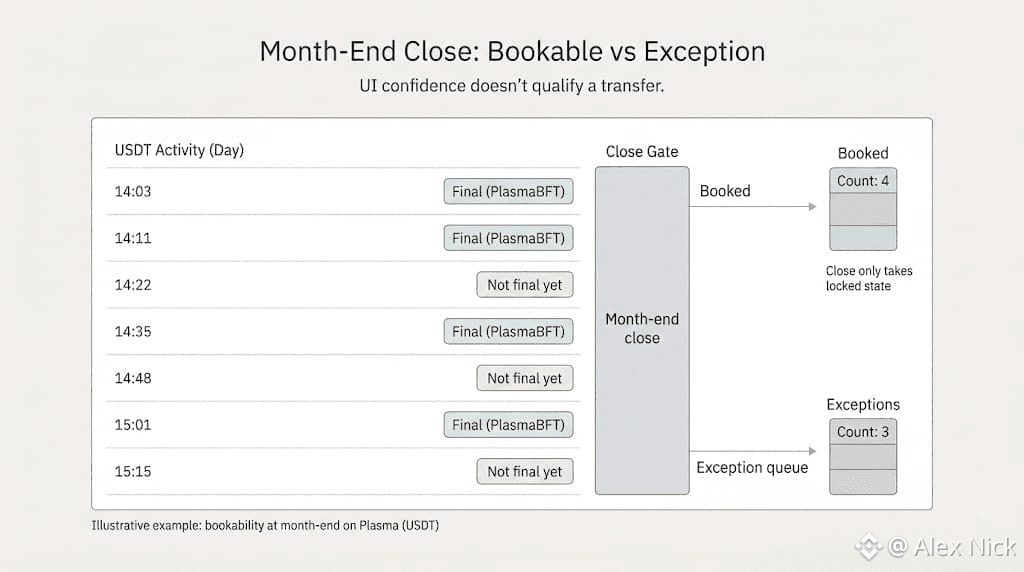
The faster settlement becomes, the more visible that stretch feels. Not as friction for users sending money, but as quiet delay inside finance departments.
This is why Plasma being accounting friendly does not mean instant recognition. It means something more subtle. It means when the close finally happens, it can be clean.
Finance teams are not rewarded for speed. They are rewarded for accuracy. For reports without footnotes. For numbers that do not change after declaration. For closes that do not require explanations.
So they keep their rhythm.
End of day still matters. Cutoffs still matter. Booking rules matter more than how fast a transaction reached finality.
The chain can finish in seconds. The books can still take hours.
On Plasma, certainty arrives early. Recognition waits its turn. And between those two moments sits money that is already real, already visible, sometimes already spent, but not yet allowed onto the page.
The close has not happened yet.

