
Most blockchains force an uncomfortable choice. You can make things transparent so everyone can verify what’s happening, or you can make things private and accept that trust becomes harder. Dusk starts from a different assumption: privacy and verification don’t have to be opposites. They can exist at the same time, if the system is designed that way from the beginning.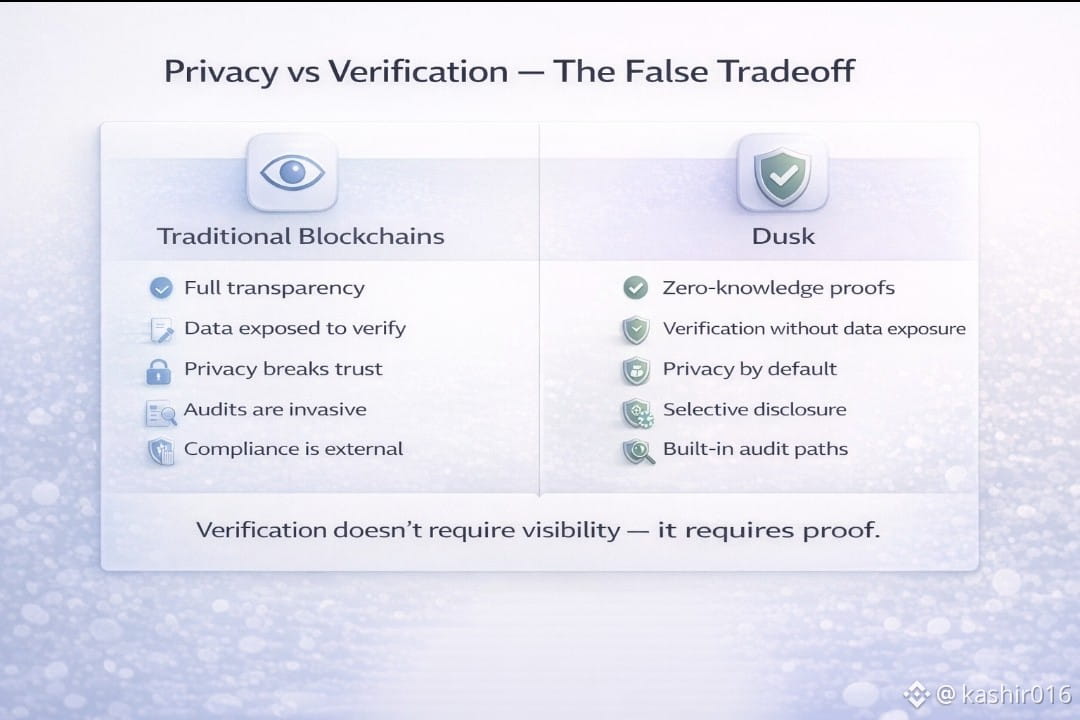
That design choice matters more than it sounds.
Dusk uses zero-knowledge proofs to let transactions be verified without exposing the underlying data. In simple terms, the network can confirm that something is valid without needing to see the sensitive details behind it. This changes how blockchain can be used outside of pure finance speculation. Suddenly, use cases that were awkward or impossible on public chains start to make sense.
Think about payroll, medical records, or identity systems. These are areas where transparency alone is not a feature, it’s a liability. People need guarantees that actions are correct, compliant, and auditable, but they also need strong limits on who can see personal information. Dusk is built around that reality rather than trying to patch it later.
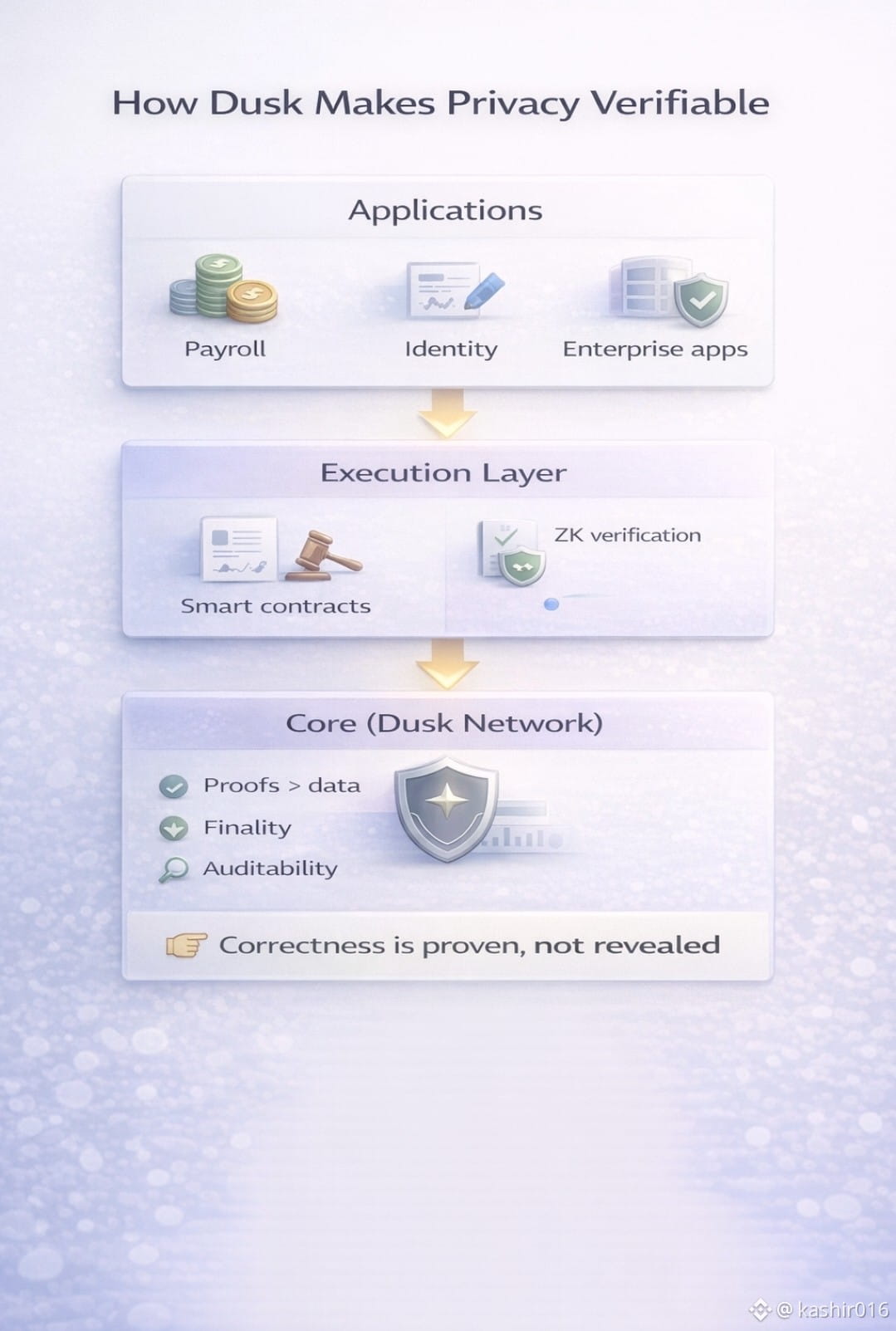
What stands out is that privacy on Dusk isn’t an add-on. It isn’t something bolted onto a public system after the fact. It’s part of the base architecture. That gives developers, validators, and users a shared expectation: sensitive data is protected by default, not by special configuration. Over time, that consistency builds trust, because everyone knows what the system is designed to do.
Another important detail is that Dusk doesn’t lock everything behind privacy. It supports both public and private transactions at the same time. This hybrid approach is easy to underestimate, but it’s crucial for real-world adoption. Regulators don’t want blind systems. Businesses don’t want to expose everything. Dusk allows applications to choose what needs to be visible and what must remain confidential, without breaking the integrity of the network.
This balance is why Dusk fits better into enterprise environments than most people expect. Large organizations don’t think in terms of “privacy versus compliance.” They think in terms of risk, accountability, and failure modes. A system that can prove correctness without leaking data reduces both legal and operational risk. It also makes audits less painful and less invasive.
Dusk’s approach also reduces the chance of catastrophic mistakes. When sensitive data isn’t constantly exposed, there are fewer points where things can go wrong. That’s not just a technical benefit, it’s a governance one. Systems fail less dramatically when they don’t rely on everyone behaving perfectly.
At a deeper level, Dusk treats privacy and accountability as equal design goals. Not competing goals, not trade-offs, but requirements that have to coexist. That’s rare in decentralized systems, where one usually dominates the other. By giving both equal weight, Dusk creates space for decentralized applications that can actually be used by institutions without abandoning the principles of decentralization.
This is why Dusk feels less like an experiment and more like infrastructure. It’s not trying to shock the market with novelty. It’s trying to quietly solve a problem that becomes obvious only when blockchain leaves theory and enters real operations.
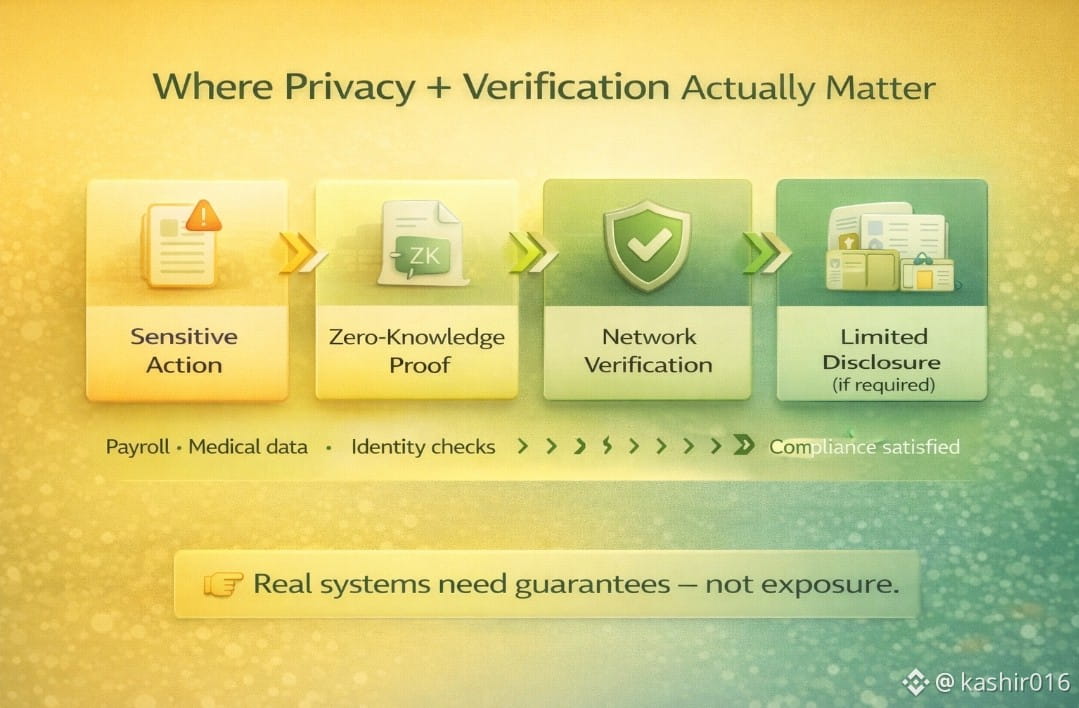
Privacy that can’t be verified doesn’t scale. Verification that destroys privacy doesn’t last. Dusk sits in the narrow middle ground where both can survive together—and that’s exactly where serious adoption tends to happen.
