I’ve watched a lot of AI projects look amazing in their early phase. The demo works. The model responds fast. Everyone nods and says this is the future. Then a few weeks later, when real users show up and the system has to stay online all day, things start to crack. Not loudly. Quietly. Files pile up. Responses slow. Someone has to step in manually. That’s usually where the excitement fades.
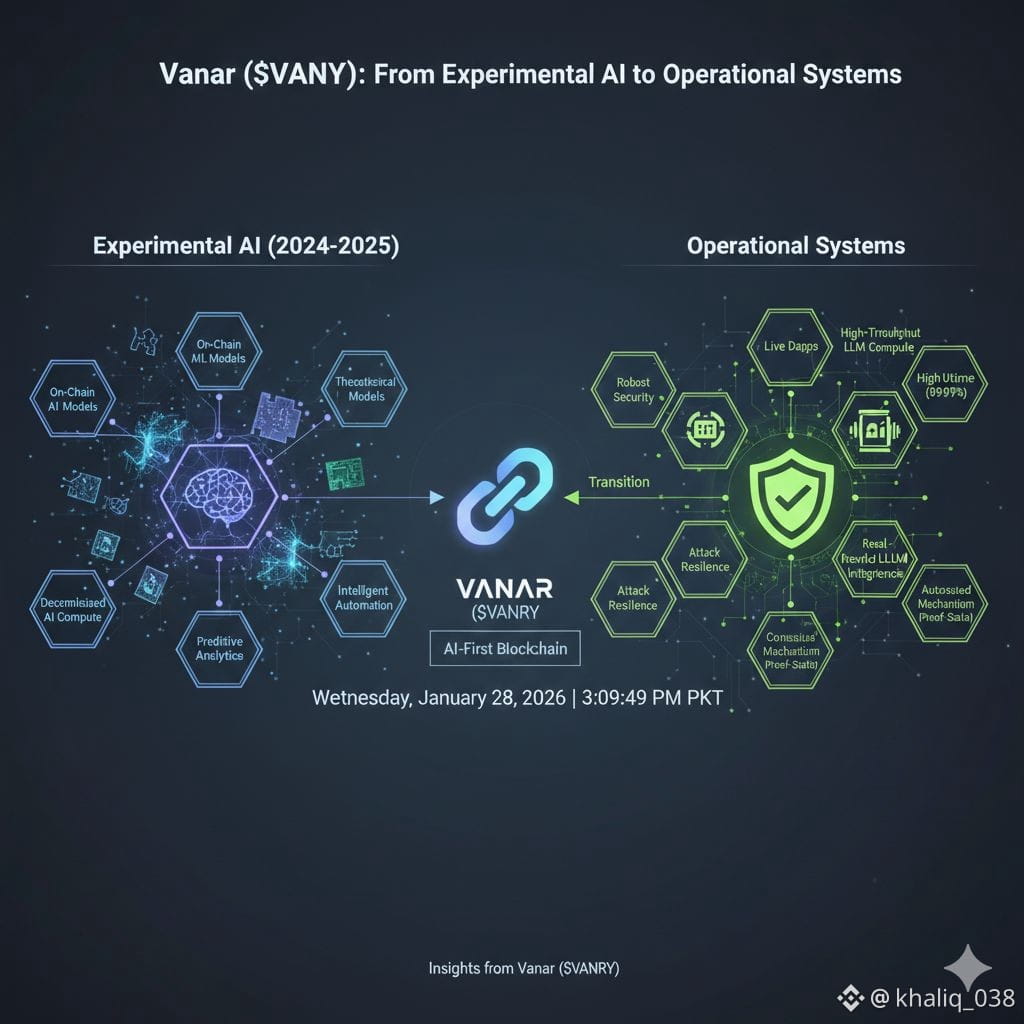
The shift happening now isn’t really about smarter AI. It’s about keeping AI running without babysitting it. Experimental systems can afford rough edges. Operational systems can’t. Once people depend on them, delays and inconsistency stop being acceptable. That’s the gap Vanar ($VANRY) is trying to sit in.
AI in practice generates a lot of weight. Media files, outputs, state changes, continuous interactions. I’ve seen setups where the model was solid, but everything around it struggled to keep up. Storage became a bottleneck. Data delivery lagged. Simple tasks felt heavier than they should. Vanar’s approach makes more sense when you look at it from that angle. It’s built around handling ongoing workloads, not just showcasing AI capability once.
What makes this shift feel real right now is how AI is being used. Agents aren’t just answering questions anymore. They’re producing content, coordinating tasks, reacting to users, and doing it continuously. That turns AI from an experiment into infrastructure. Vanar seems to understand that difference. It treats AI output as something that needs to live, move, and persist reliably over time.
I’ve grown skeptical of platforms that lead with big AI narratives but leave operations as an afterthought. Once systems go live, reliability becomes the product. Vanar feels closer to that mindset. Less about surprise, more about endurance.
There’s also a quieter change in how teams think. Operational systems assume things will break and plan for it. They focus on recovery, not perfection. From what I’ve seen, Vanar’s design choices lean in that direction. Keep things running. Handle load without drama. Let the system breathe.
Moving from experimental AI to operational systems isn’t flashy. It’s a grind. But it’s where real adoption happens. Vanar ($VANRY) fits into that transition by focusing on what AI can sustain day after day, not just what it can impress with once. That’s usually the difference between a demo people talk about and a system people actually rely on.
There’s another part of this shift that only shows up after months, not weeks. Once AI systems become operational, they start shaping habits. People expect them to be there, to respond the same way every time, to remember context, to not lose work. I’ve seen teams underestimate this and get overwhelmed when users begin treating an AI tool like infrastructure instead of a feature. That’s when the cracks really show.
What changes at that stage is how you judge success. It’s no longer about how impressive the output looks. It’s about whether the system holds up during boring, repetitive use. Can it handle the same task a thousand times without drifting? Can it store, retrieve, and move data without slowing down? Vanar’s role fits into that reality. It supports AI systems that need to run continuously, not just perform once.
There’s also less room for narrative at this point. Users don’t care what stack you used or how advanced the model is. They care if their content loads, if their data stays intact, if the system responds when they need it. Infrastructure like Vanar matters because it removes friction from those everyday interactions. When it works, it disappears.
I’ve learned to respect platforms that design for this phase. It’s not glamorous, but it’s honest. Vanar doesn’t position itself as the star of the show. It positions itself as the thing that keeps the show going. Over time, that’s what builds trust.
The move from experimental AI to operational systems is slow and sometimes uncomfortable. But it’s necessary. Vanar ($VANRY) fits into that transition by focusing on stability, continuity, and long-term use. In my experience, that’s where real systems stop being ideas and start becoming part of people’s routines.