
Vanar Chain was created to address one of the most persistent issues with blockchain adoption: creating infrastructure that is quick, affordable, safe, and able to smoothly onboard billions of users. Many blockchains continue to face usability issues, erratic fees, and scalability limitations that prevent widespread adoption despite substantial technological advancements. In order to solve these problems, Vanar Chain provides Web3 infrastructure that is just as smooth and user-friendly as Web2 without compromising security or decentralization.
Vanar Chain's primary goal is to minimize friction for both developers and users. Account abstraction, constant transaction fees, and quick block finality are examples of protocol-level advancements that let consumers engage with decentralized apps without complicated wallet administration or erratic expenses. Vanar is specifically designed to satisfy the performance and user experience requirements of next-generation consumer apps. It is backed by a team with more than ten years of experience in gaming, virtual reality (VR), augmented reality (AR), and the metaverse. Vanar Chain is therefore an ideal infrastructure option for gaming, metaverse platforms, and extensive decentralized ecosystems.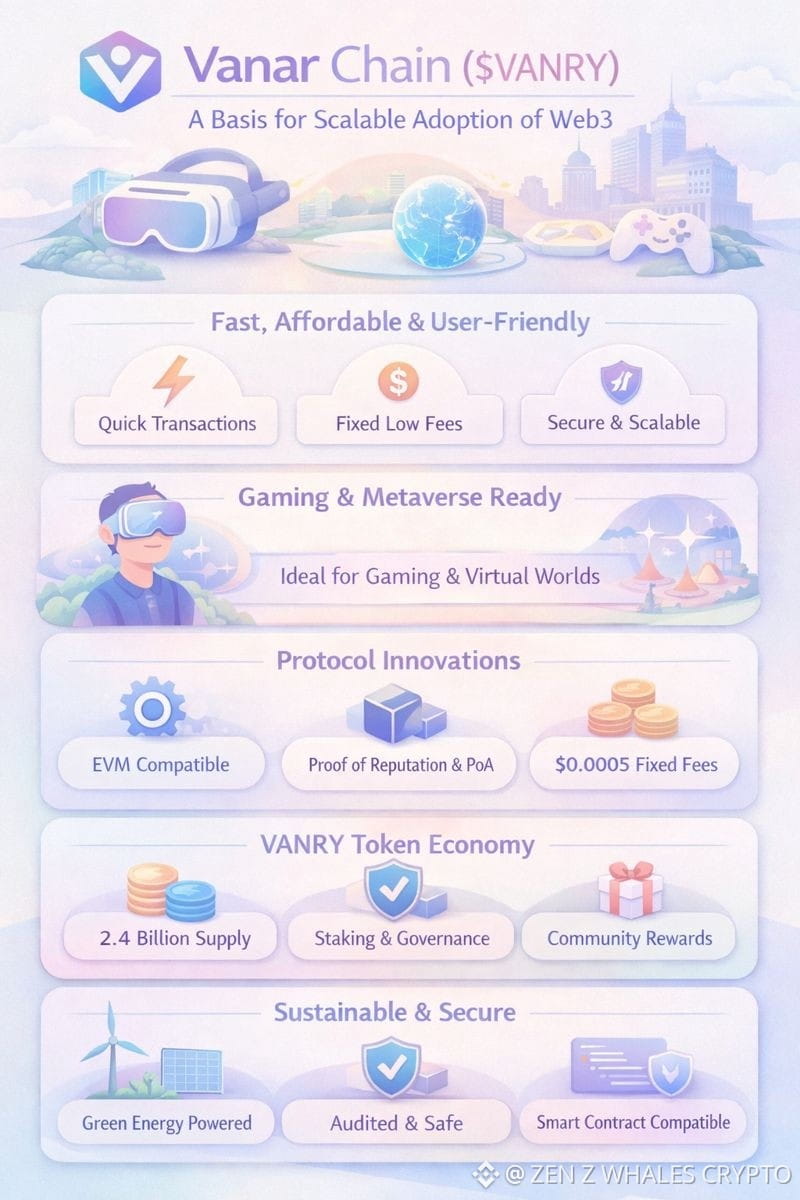
Vanar's Engineering-First Method
Vanar approaches blockchain development with a practical, engineering-driven mindset. Vanar is based on the tried-and-true Go Ethereum (GETH) codebase rather than constructing essential infrastructure from the ground up. GETH is trusted by millions of users worldwide, has been extensively audited, and is implemented in operational environments. Vanar is able to concentrate innovation at the protocol level because to this foundation, which offers a solid security baseline.
To increase onboarding, scalability, cost predictability, and transaction speed, specific improvements are implemented. These enhancements are intended to maintain complete compatibility with the Ethereum ecosystem, guaranteeing that developers can grow and migrate with no difficulty. Another guiding concept is sustainability, with Vanar striving to use green energy-powered infrastructure to reduce its environmental impact.
Enhancements to Protocol and Fixed Fees
Several protocol-level enhancements are introduced by Vanar Chain to enable scalable and high-performance applications. Transaction costs, block creation speed, throughput, transaction ordering, and long-term sustainability are all addressed by these modifications. The protocol is designed to guarantee fairness and transparency while managing high-frequency transactions without congestion.
Vanar's fixed charge concept is a key innovation. Because traditional blockchains rely on dynamic gas pricing, transaction fees are erratic and frequently unaffordable during times of heavy demand. By tying transaction fees to a set dollar amount rather than the volatile native gas token price, Vanar removes this uncertainty. Regardless of market conditions, standard transactions on Vanar Chain are guaranteed to cost as little as $0.0005.
Vanar has a tiered charge system depending on transaction size and gas usage to prevent abuse of the network. Token transfers, swaps, NFT minting, staking, and bridging are examples of routine activities that are still quite inexpensive, while transactions that are exceptionally massive or resource-intensive cost more. This strategy maintains performance and accessibility while deterring spam.
Token Economics for VANRY
The Vanar ecosystem's native gas and utility coin, VANRY, functions similarly to Ethereum's ETH. Transaction fees, staking, involvement in governance, and validator incentives all require VANRY.
The maximum quantity of VANRY tokens is set at 2.4 billion. As part of Vanar's progression from the Virtua ecosystem, an initial 1.2 billion tokens are produced at Genesis, allowing for a smooth 1:1 swap from the current TVK token. Over the course of a 20-year issuance period, the remaining supply is progressively dispersed as block rewards to ensure long-term sustainability and controlled inflation.
83% of the extra 1.2 billion tokens go toward validator rewards, 13% go toward development incentives, and 4% go toward airdrops and community benefits. Vanar's dedication to decentralization and community alignment is reinforced by the fact that no tokens are set aside for the team.
Staking, Validators, and Consensus
Vanar Chain uses a hybrid consensus approach that combines Proof of Reputation (PoR) with Proof of Authority (PoA). To maintain stability in the early stages, the Vanar Foundation runs validator nodes. Reputable external validators are gradually added via PoR, and community voting is used to strengthen the selection process.
Block creation and transaction validation fall within the purview of validators. They earn block rewards in the form of freshly created VANRY tokens in exchange. In order to create matched incentives between validators and token holders, these rewards are distributed to community members that stake VANRY and take part in the validator selection process.
A key component of network security and governance is staking. Stakeholders in VANRY receive rewards and voting rights, encouraging sustained involvement and decentralized decision-making.
Security, Interoperability, and Smart Contracts
According to the idea that what works on Ethereum also works on Vanar, Vanar Chain is completely EVM compatible. Vanar's GETH-based architecture makes it possible for Ethereum-based apps to migrate smoothly with little to no code modifications. This guarantees that DeFi protocols, NFT marketplaces, games, and current developer tools will all be simple to integrate.
On Vanar, smart contracts have native support for Solidity and Ethereum-standard tools, making them first-class citizens. Vanar's minimal fees and quick finality let developers to implement complicated decentralized apps.
In Vanar's design, security is still fundamental. Reputable blockchain security companies thoroughly audit every protocol and code-level modification. The network's resilience, dependability, and credibility are maintained by meticulous management of validator selection.
Conclusion
A next-generation blockchain designed for practical use is Vanar Chain. Vanar provides scalable infrastructure that can support billions of users through predictable fees, fast performance, EVM compatibility, and community-driven governance. Vanar Chain is a viable and developer-friendly foundation for Web3's future, supported by the VANRY token and a security-first mindset.
