
@Dusk : For more than a decade public blockchains have chased visible metrics. Transactions per second block times measured in milliseconds, gas wars framed as proof of demand and short-lived hype cycles treated as adoption. Yet the world of real finance has never optimized for those numbers. Banks, exchanges, asset issuers, and regulators do not measure trust in TPS. They measure it in controllability, accountability, legal clarity and the ability to operate without exposing sensitive strategies to the entire world.
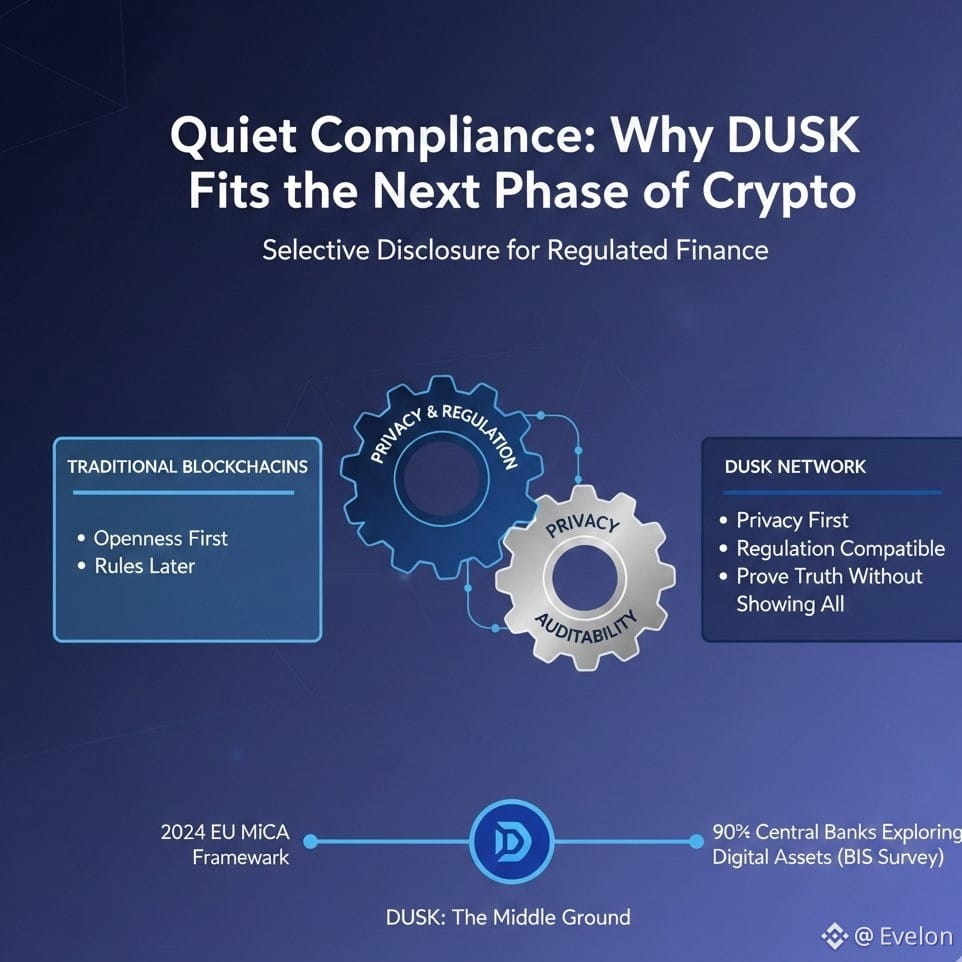
This fundamental mismatch is where most blockchains fail to cross the boundary from experimentation into institutional reality. Dusk Network exists precisely to address that gap.
At its core, Dusk is a privacy-first Layer-1 blockchain purpose-built for regulated finance. This is not privacy as an ideological stance, nor anonymity as an end goal. Instead, Dusk introduces the concept of auditable privacy: transactions, identities, and amounts remain confidential by default, while regulators and auditors can cryptographically verify compliance when required. In traditional public DeFi systems, every transaction is broadcast globally, which works for permissionless tokens but becomes a liability in regulated markets. Corporations, brokers, banks and sovereign entities cannot expose balance sheets, trading behavior or capital flows to competitors and attackers without incurring real world risks. When it comes to tokenized real-world assets, such as securities, bonds or debt instruments, excessive transparency is not a virtue. It is a vulnerability.
Dusk approaches this challenge through selective privacy powered by zero-knowledge cryptography. Transactions can be verified as valid without revealing underlying data, while still allowing lawful disclosure paths. This enables issuers to meet reporting obligations, auditors to confirm integrity and regulators to exercise oversight, all without turning the blockchain into a public surveillance layer. The result is an environment where privacy and compliance are not opposites but complementary requirements.
What makes Dusk particularly distinctive is that its architecture is informed by legal realities rather than abstract ideals. The network is designed with European regulatory frameworks such as MiCA, MiFID II and GDPR in mind. These frameworks dictate how data must be handled, stored, and disclosed. A blockchain that blindly publishes all metadata struggles to coexist with such regulations without exposing participants to legal or competitive harm. Dusk’s design demonstrates that on-chain systems can respect data protection laws while still delivering verifiability and trust. Privacy is not a workaround here it is the foundation.
This philosophy extends into Dusk’s approach to real-world assets. Unlike generic smart contract platforms.Dusk is explicitly built to support the issuance and lifecycle management of regulated financial products. Through standards such as the Confidential Security Contract, issuers can encode regulatory logic directly into assets before they are ever issued. Transfer restrictions, eligibility rules, identity requirements, and automated reporting can all be enforced at the protocol level. This transforms compliance from a manual, off-chain burden into an intrinsic property of the asset itself.
The ecosystem’s evolution reflects this focus. With Dusk moving toward full production readiness across 2025 and early 2026, the network is positioning itself as a live Layer-1 capable of hosting confidential smart contracts, tokenized securities and EVM-compatible applications through DuskEVM, enhanced with optional privacy modules. This is not about replicating existing DeFi patterns, but about bridging the gap between traditional financial infrastructure and programmable digital assets in a way institutions can actually adopt.
Concrete progress matters in regulated markets, and recent developments point in that direction. The launch of an NPEX dApp for tokenized securities, in collaboration with a regulated Dutch exchange, signals a transition from theory to practice. Institutions and regulators adopt systems only when they demonstrate real usage, clear governance, and legal interoperability. Dusk’s trajectory suggests an understanding that credibility is earned through implementation not marketing.
Even at the consensus layer, Dusk reflects institutional considerations. Its privacy-aware Proof of Stake mechanism, built around Segregated Byzantine Agreement and supported by mechanisms like Proof of Blind Bid filters, is designed to discourage concentration of power while protecting validator identities. This responds directly to concerns about centralization and regulatory capture, both of which become critical when networks are expected to underpin financial infrastructure rather than speculative ecosystems.
Looking ahead, two trends are becoming clear. First, regulators do not equate privacy with secrecy. Traditional privacy coins pursue anonymity at all costs, often putting them at odds with compliance. Dusk’s selective auditability aligns with regulatory expectations: protect sensitive information while proving adherence to rules. Second, adoption will be driven by solutions, not narratives. Markets will favor blockchains that integrate with existing legal, custody, and reporting systems, minimizing operational risk rather than maximizing ideological purity.
Dusk’s path is not without challenges. Regulatory approval, institutional integration, and interoperability with legacy systems take time. These are socio-technical shifts involving law, governance, and trust, not just engineering. Whether Dusk becomes a standard layer for regulated on-chain finance depends on broader ecosystem alignment. Yet its privacy-by-design and compliance-by-design approach represents a meaningful departure from the assumption that visibility must always be absolute.
In a future where blockchains are embedded in global financial systems, the winning infrastructures will be those that respect legal and economic realities while still delivering cryptographic trust. That is the thesis behind Dusk, and it is why @Dusk and $DUSK continue to stand out as serious contenders in the evolution of regulated blockchain finance.
