
,
Stablecoins are now that dominant use case, and they place
very different demands on a network.Plasma takes a specialized approach.
Instead of asking how many things it can support, it asks how well it can
support one thing: stablecoin settlement. Specialization allows tighter
optimization, clearer performance targets, and fewer trade-offs. In finance,
specialization is normal. Payment networks, clearing houses, and settlement



 systems all exist for specific roles.As stablecoins continue to absorb more real
world value flows, the infrastructure behind them will need the same clarity of
purpose. Plasma's design reflects a shift in thinking from building flexible
platforms to building dependable systems. That shift may not look exciting, but
it's often how lasting financial infrastructure is built.
Every emerging infrastructure project eventually faces a
paradox: the more fundamental the role it plays, the harder it is to explain
its value in simple terms. Plasma sits squarely inside this paradox.
Unlike consumer-facing applications, Plasma does not compete
for attention through flashy features or immediate user growth. Instead, it
operates in a layer where relevance is defined by dependence, not popularity.
This raises a set of recurring questions from investors and builders alike —
questions that are often dismissed as impatience, but are in fact structural
concerns worth addressing.
This article examines the key issues surrounding Plasma
today, why they exist, and how Plasma attempts to resolve them.
1. If Plasma Is Critical Infrastructure, Why Isn’t Adoption
Obvious Yet?
One of the most common doubts is straightforward:
If Plasma solves a real problem, why aren’t applications
rushing to use it?
This question assumes that infrastructure adoption behaves
like consumer adoption. It doesn’t.
Infrastructure adoption is reactive, not proactive. Builders
do not migrate to new primitives because they are novel, but because existing
systems begin to fail under real operational load. Most chains and layers
appear “good enough” early on. Pain only emerges at scale — sustained
throughput, persistent storage, and predictable costs over time.
Plasma is designed for that second phase: when
inefficiencies stop being theoretical and start appearing on balance sheets.
Until applications reach that point, Plasma looks optional. When they do, it
becomes unavoidable.
This delay is not a weakness. It is a structural feature of
infrastructure cycles.
2. Is Plasma Competing With Existing Layers or Replacing
Them?
Another frequent concern is positioning. Investors often ask
whether Plasma is attempting to displace existing L1s, L2s, or data layers — or
whether it simply adds more fragmentation.
Plasma’s design suggests a different intent: complementarity
rather than displacement.
Instead of replacing execution layers, Plasma focuses on
providing an environment where persistent performance remains stable regardless
of execution volatility. It assumes that execution environments will continue
to change, fragment, and compete. Plasma positions itself as a stabilizing
layer beneath that chaos.
In that sense, Plasma is not competing for narrative
dominance. It is competing for irreversibility — becoming difficult to remove
once integrated.
3. Why Does Plasma Appear More Relevant in Bear Markets Than
Bull Markets?
This is not accidental.
Bull markets reward optionality. Capital flows toward what
might grow fast, not what must endure. In those conditions, infrastructure
optimized for long-term stability is underappreciated.
Bear markets reverse the incentive structure. Capital
becomes selective. Costs matter. Reliability matters. Projects that survive are
those whose infrastructure assumptions hold under reduced liquidity and lower
speculative throughput.
Plasma is implicitly designed for this environment. Its
relevance increases as speculative noise decreases. That does not make it
immune to cycles, but it aligns its value proposition with the phase where
infrastructure decisions become irreversible.
4. Is $XPL Just Another Utility Token With Limited Upside?
Token skepticism is justified. Many infrastructure tokens
have failed to accrue value beyond short-term speculation.
The key distinction with $XPL lies in where demand
originates. If token demand is driven by incentives alone, it decays once
emissions slow. If demand is driven by dependency — applications requiring the
network to function — value accrual becomes structural rather than
narrative-driven.
Plasma’s thesis is that sustained usage, not transaction
count spikes, will determine demand for $XPL. This is slower to materialize,
but harder to unwind once established.
That does not guarantee success. But it defines a clearer
failure mode: if applications never become dependent, Plasma fails honestly
rather than inflating temporarily.
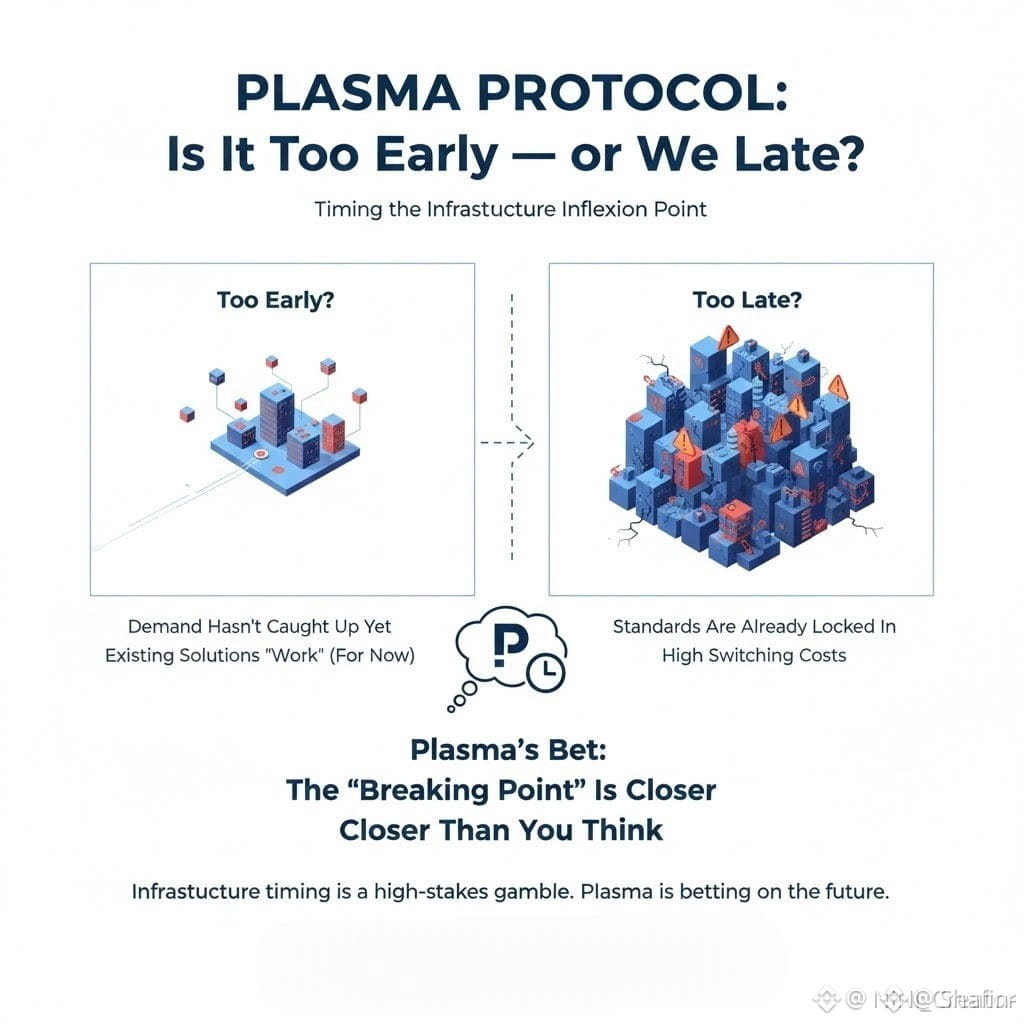
5. Is Plasma Too Early — or Already Too Late?
Timing is perhaps the most uncomfortable question.
Too early means building before demand exists. Too late
means entering after standards are locked in. Plasma sits in a narrow window
between these extremes.
On one hand, many applications have not yet reached the
scale where Plasma’s advantages are mandatory. On the other, existing solutions
are showing early signs of strain under sustained usage. Plasma is betting that
the transition from “working” to “breaking” will happen faster than most expect
— and that switching costs will rise sharply once it does.
This is not a safe bet. But infrastructure timing never is.
6. Who Is Plasma Actually Built For?
Retail narratives often obscure the real audience.
@Plasmais not built for short-term traders, nor for
speculative users chasing early yields. It is built for application teams
planning multi-year roadmaps, predictable costs, and minimized operational
risk.
That audience is smaller, quieter, and less vocal — but also
more decisive once committed. Plasma’s design choices make more sense when
viewed through that lens.
Conclusion: The Cost of Asking the Wrong Questions
Most debates around Plasma focus on visibility, hype, and
near-term metrics. These questions are understandable — but they are also
incomplete.
The more important questions concern dependency,
persistence, and long-term risk allocation. Plasma does not attempt to win
attention. It attempts to remain useful after attention moves elsewhere.
Whether it succeeds depends less on market sentiment and
more on whether applications eventually reach the limits Plasma was designed
for.
Infrastructure rarely looks inevitable at the beginning. It
only becomes obvious after it is already embedded.
Plasma is betting on that moment.