
The first thing I noticed about Plasma wasn’t performance numbers or headline metrics. It was how unconcerned it felt about whether I grasped the mechanics behind it. At first that comes across as a flaw, but the more you sit with it, the more it seems intentional.
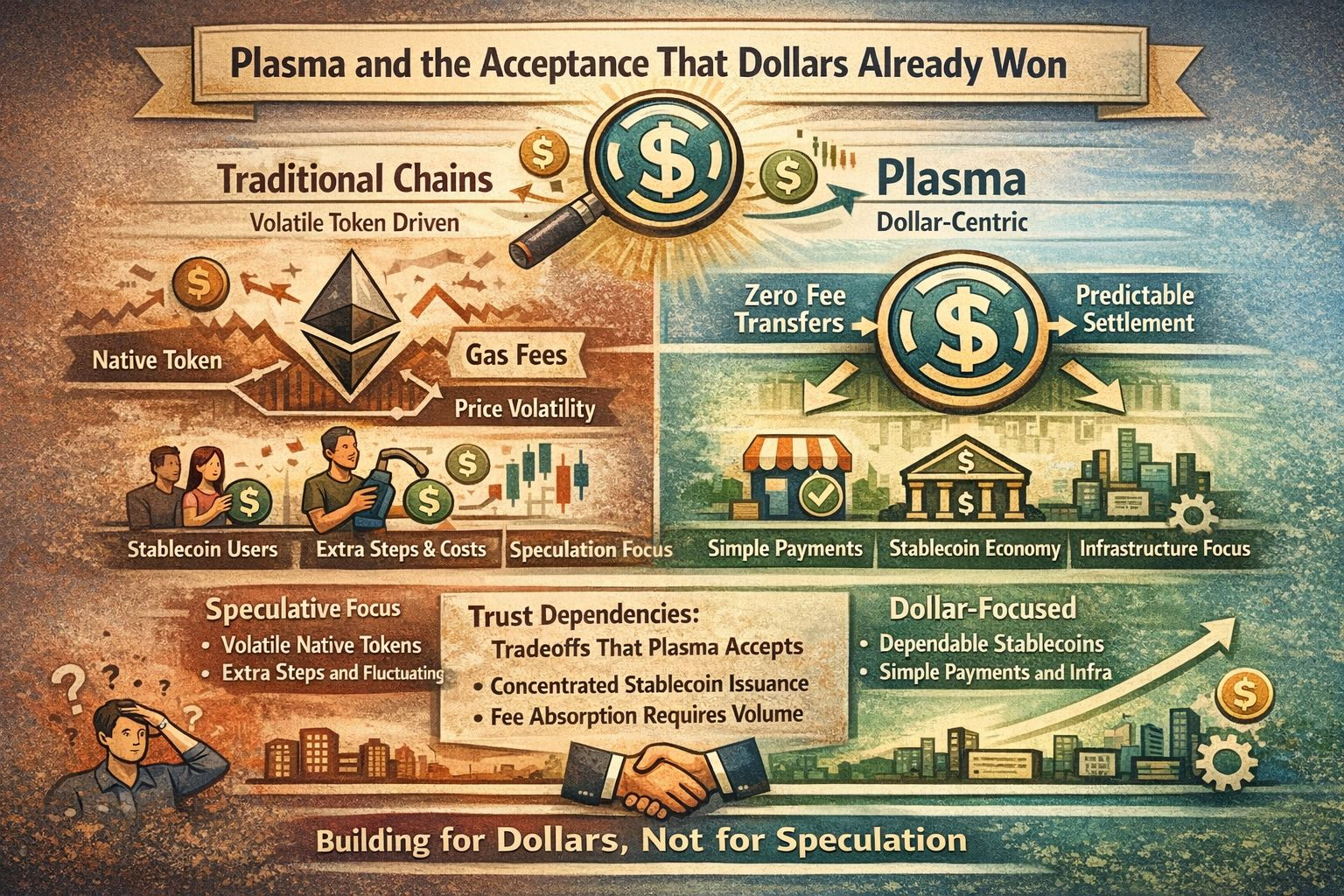
What drew me toward Plasma was not a flashy metric or a bold promise. It was the quiet recognition of something that has been obvious for a while. Stablecoins carry much of crypto’s real economic activity, yet most blockchains still treat them as guests inside systems designed around volatile native tokens. Payroll runs, cross border transfers, treasury movements, and trading flows are already dollar denominated, but the infrastructure underneath often assumes a different priority.
Plasma starts from a simple premise: stablecoins are not an add on. They are the center of gravity. That shift changes the foundation. Instead of asking dollars to adapt to token economics, it builds the economics around dollar stability. Features like zero fee transfers for stable assets and familiar EVM execution are surface expressions of a deeper decision. The network is shaped for people who are moving money with intent, not chasing price swings.
This is more behavioral than technical. When someone sends value for operational reasons, they want predictability. They do not want to calculate gas in a separate asset that can change price before the transaction settles. They want confirmation to be routine and uneventful. Plasma leans into that expectation. By abstracting fees and reducing visible friction, it prioritizes steady flow over extracting marginal costs from each movement.
Once users no longer need a volatile token to move a dollar, stablecoins stop feeling secondary. They become the unit of account for applications. Builders can design pricing models without inserting buffers for token fluctuations. Accounting becomes simpler. Cost projections become cleaner. As friction declines, transaction velocity increases, and velocity is what gradually transforms a chain from a speculative venue into core infrastructure.
Plasma’s design reflects this discipline. It does not simply allow stablecoins to exist. It assumes they will dominate activity. Smart contract logic, settlement patterns, and fee handling are structured around assets that are meant to remain stable. That clarity narrows the philosophical ambition of the network, but it strengthens its practical direction.
There are obvious compromises. Stablecoin issuance is concentrated, and building around those assets means inheriting certain trust assumptions. Fee abstraction also shifts cost to someone else in the stack, which only works if meaningful volume sustains the model. Plasma does not hide from these realities. It accepts them as part of building around existing money rather than inventing a replacement.
A broader divide is forming across crypto. Some networks optimize for leverage, narrative cycles, and token driven growth. Others focus on settlement and reliability. Plasma is clearly aligning with the second group. It does not argue that its token should replace the dollar. It assumes the dollar already has its role and concentrates on making it feel native on chain.
If that orientation proves durable, the networks that matter most may not be the loudest. They may be the ones that made existing financial behavior easier to execute without forcing it to change. Plasma is placing its bet there, not on rewriting money, but on supporting it with rails that feel natural and dependable.
