
Crypto people love to talk about payments. Faster, cheaper, global. It sounds great on paper. But in reality, sending money between blockchains still feels like dealing with border control. You need random gas tokens, fees jump without warning, and confirmations take long enough to make traditional banking look efficient.
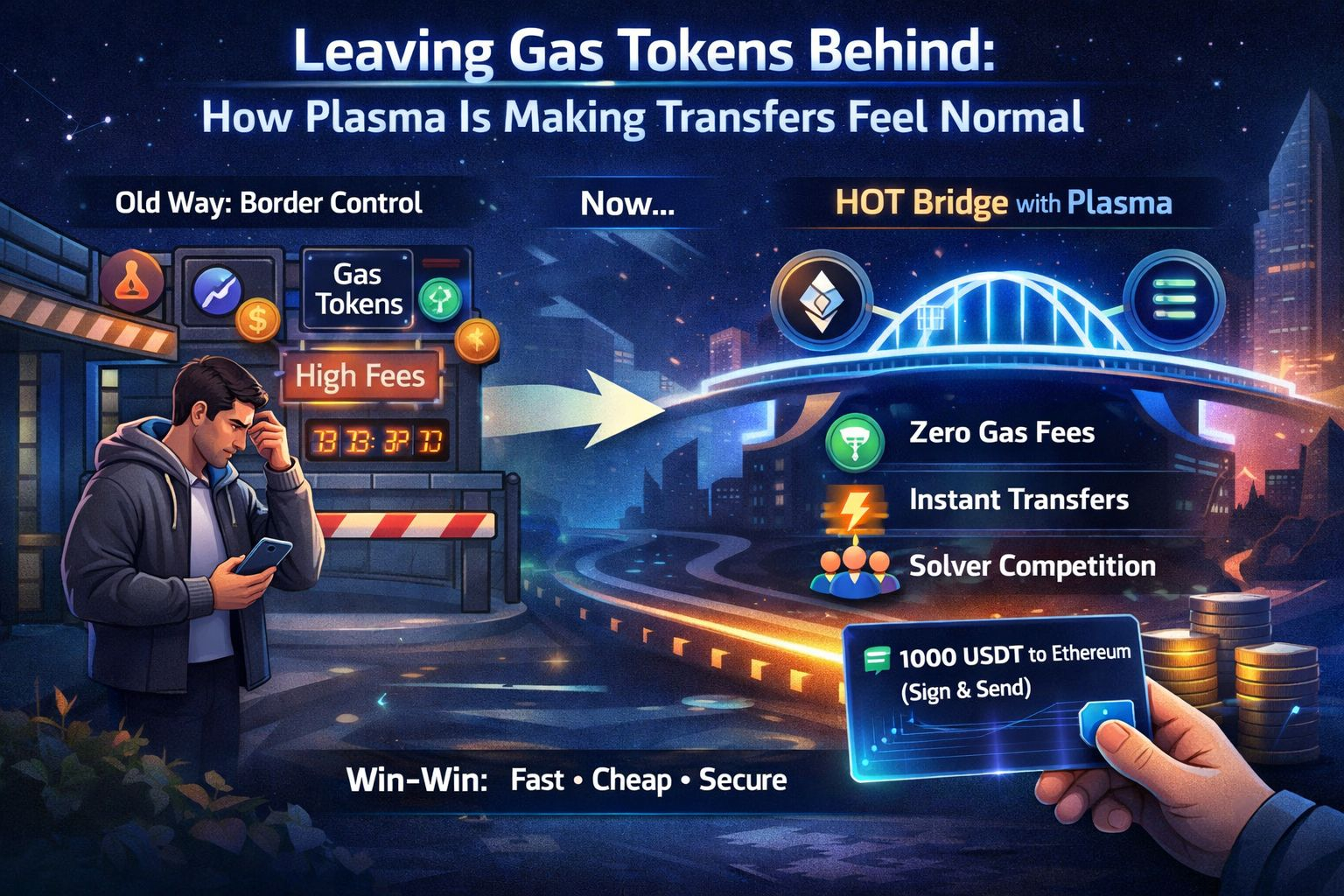
Plasma is trying to fix that pain point. It is a stablecoin-first Layer 1 where USDT transfers already work with zero fees inside the network. More than $7B in stablecoins live on-chain, Plasma One cards are getting real users, and transactions finalize in under a second. The system works well as long as funds stay inside Plasma. The real headache starts when users want to move money out to other chains. And that problem is not unique to Plasma, it affects the whole crypto payment space.
That is where the upcoming HOT Bridge comes in.
Instead of using the old bridge design where tokens get locked on one chain and recreated on another, HOT Bridge takes a different route. Traditional bridges attract attackers because they become giant vaults. HOT Bridge runs on NEAR Intents. Rather than manually paying gas and choosing routes, users simply declare what they want, for example: “Send 1,000 USDT to Ethereum.”
From there, solvers compete to complete that request. The winning solver pays all the gas, finds the best path, executes the transfer, and earns a small margin from the trade. The user never touches $ETH , $NEAR , or any gas token. One signature, and the funds arrive within seconds.
What makes this more than a gimmick is the solver economy behind it. Anyone routing transactions has to stake and hold $XPL . As cross-chain activity grows, more solvers want to participate, competition increases, spreads tighten, and demand for XPL rises. It becomes a natural feedback loop instead of just a flashy feature.
There will still be small fees, usually between 0.1% and 0.5%. They have to exist. Computing is not free, and totally free bridges would get spammed into collapse almost instantly. The difference here is psychological and practical: users do not think about gas. The cost is handled by a competitive market in the background, the way normal finance hides infrastructure from customers.
On the security side, Plasma uses Taproot with threshold signatures for settlement. No single party controls assets while they move. That does not mean the system is risk-free, because no bridge ever is, but it is a big improvement over fragile multisig setups that caused disasters like Ronin.
The bigger question is adoption. Early on, solver liquidity may be limited. High volatility could slow intent matching. And real trust only comes after surviving real traffic and stress. But if the execution matches the idea, Plasma stops being just another payment chain and becomes actual cross-chain plumbing.
And that is the real goal of payments. When everything works, users stop thinking about networks, gas, and bridges. They just send money.