


The treasury analyst pulls the settlement report at 9:47 AM. Transaction complete. Funds moved. Everything confirmed.
She opens the monthly reconciliation template, the one auditors require and the one that's been standard since before she started.
Settlement date. Check.
Amount. Check.
Counterparty. There's the problem.
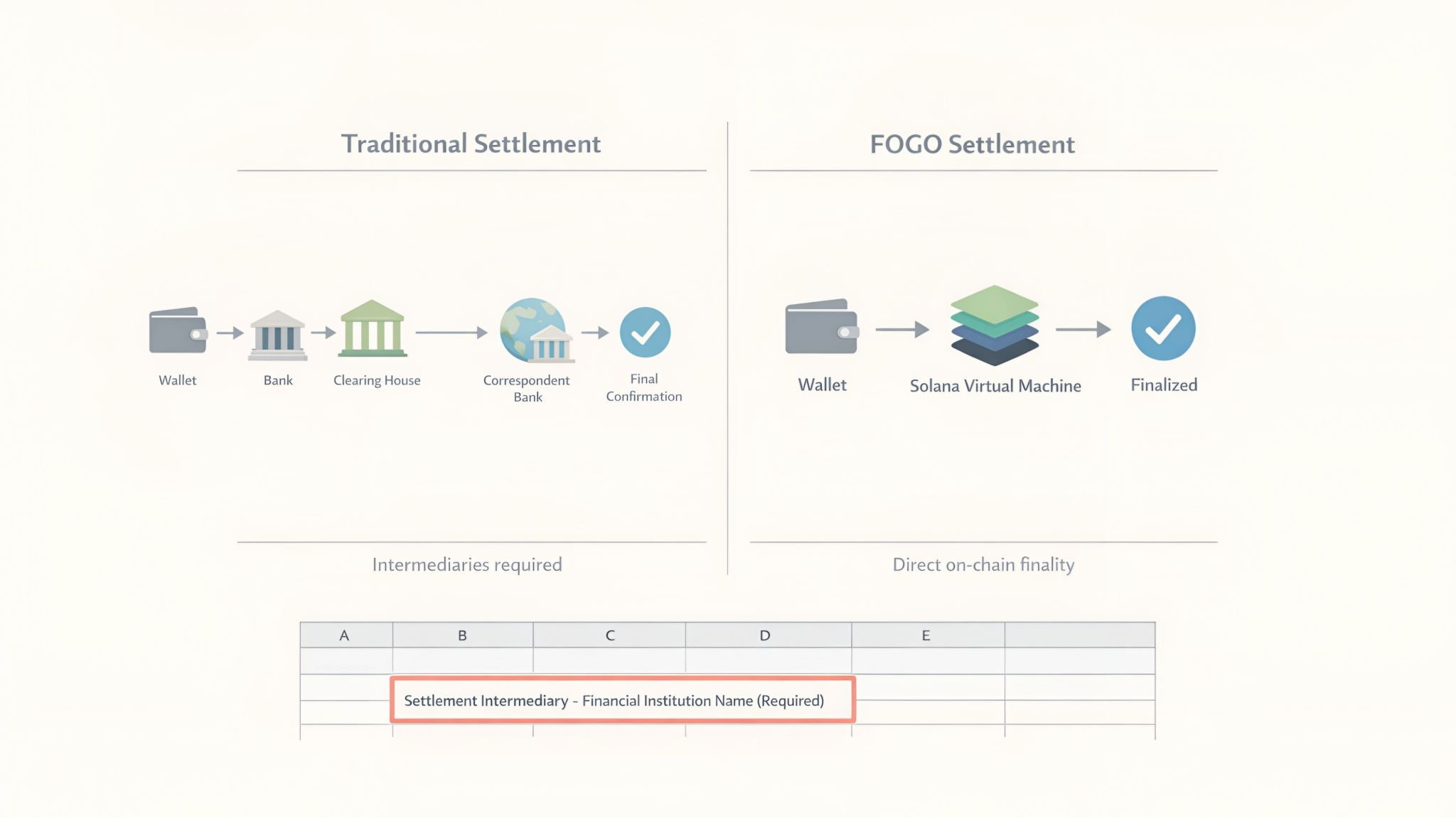
Field label: Settlement Intermediary - Financial Institution Name (Required)
She types: "FOGO Network - Direct Settlement"
Deletes it. That's not an institution name.
Types: "N/A - Native blockchain settlement"
Deletes it. The field is required. It doesn't accept explanations. It expects a bank name.
She tries one more time: "Direct - SVM execution"
Stares at it. Deletes it.
The settlement happened on FOGO's infrastructure, where Solana Virtual Machine architecture enables finality in milliseconds at near-zero cost. No intermediary to list. No three-day clearing window to document. No correspondent banking relationship.
The form has nowhere to put that.
She calls the controller directly.
"The auditor wants banking relationship documentation for the FOGO settlements."
"What did you tell them?"
"That there isn't one. Settlement happens directly on-chain through SVM execution."
"And?"
"They said their framework requires documenting the settlement agent."
The controller is quiet for a moment. "The settlement agent is the protocol itself."
"Right. But I can't put 'Solana Virtual Machine' in the intermediary bank field."
Another pause.
"Let me talk to the auditors."
Two days later, the response comes back through the controller: "Our framework requires documentation of the financial institution that facilitated settlement."
She reads that twice.
Audit frameworks don't measure whether settlement worked. They measure whether it worked the familiar way. Through delays that prove verification occurred. Through fees that prove service was provided. Through intermediaries that prove someone's accountable.
FOGO's SVM removes all three while delivering faster, cheaper, more certain settlement.
The infrastructure proves the outcome. The documentation proves the process.
And when the process doesn't exist, the documentation has nowhere to go.
FOGO settled the money. The spreadsheet is still looking for a bank.
She opens a new email to the auditors. Starts typing an explanation about how high-performance L1 architecture changes what "settlement agent" means.
Deletes it.
Tries again: "Settlement occurs natively on FOGO infrastructure through Solana Virtual Machine execution. There is no intermediary financial institution."
Hovers over send.
Knows they'll ask for something to put in the field anyway.
Sends it.
Two weeks later, she's still adding footnotes to the reconciliation report, explaining that certain fields are "not applicable due to infrastructure architecture." The auditors accept it, eventually. But the template doesn't change.
Next month, she'll stare at the same blank field again.
Settlement Intermediary - Financial Institution Name (Required)
The infrastructure works. The documentation framework doesn't have fields for how it works.
And that gap sits there, every month, waiting for audit standards that don't exist yet.