
Ethereum $ETH , the second biggest blockchain, still processes transactions one after another, which is why it often gets labeled as slow. Meanwhile, newer Ethereum compatible chains that run transactions in parallel, like Sei and Monad, market themselves as “autobahn” chains, implying they scale better and move way faster than Ethereum.

Parallel execution can absolutely make a blockchain faster because the architecture is built for it. But it’s worth being skeptical of the hype. A lot of chains that advertise parallel execution do look quicker on paper, yet they haven’t seen the real world usage needed to prove they can consistently handle the transaction volumes they claim.
In many cases, the parallel design is there, but the demand isn’t, so the benefits stay mostly unused. And while the architecture is meant to be efficient, it still hasn’t been stress tested at scale enough to know whether all the extra complexity needed to manage parallel execution edge cases is actually worth it.
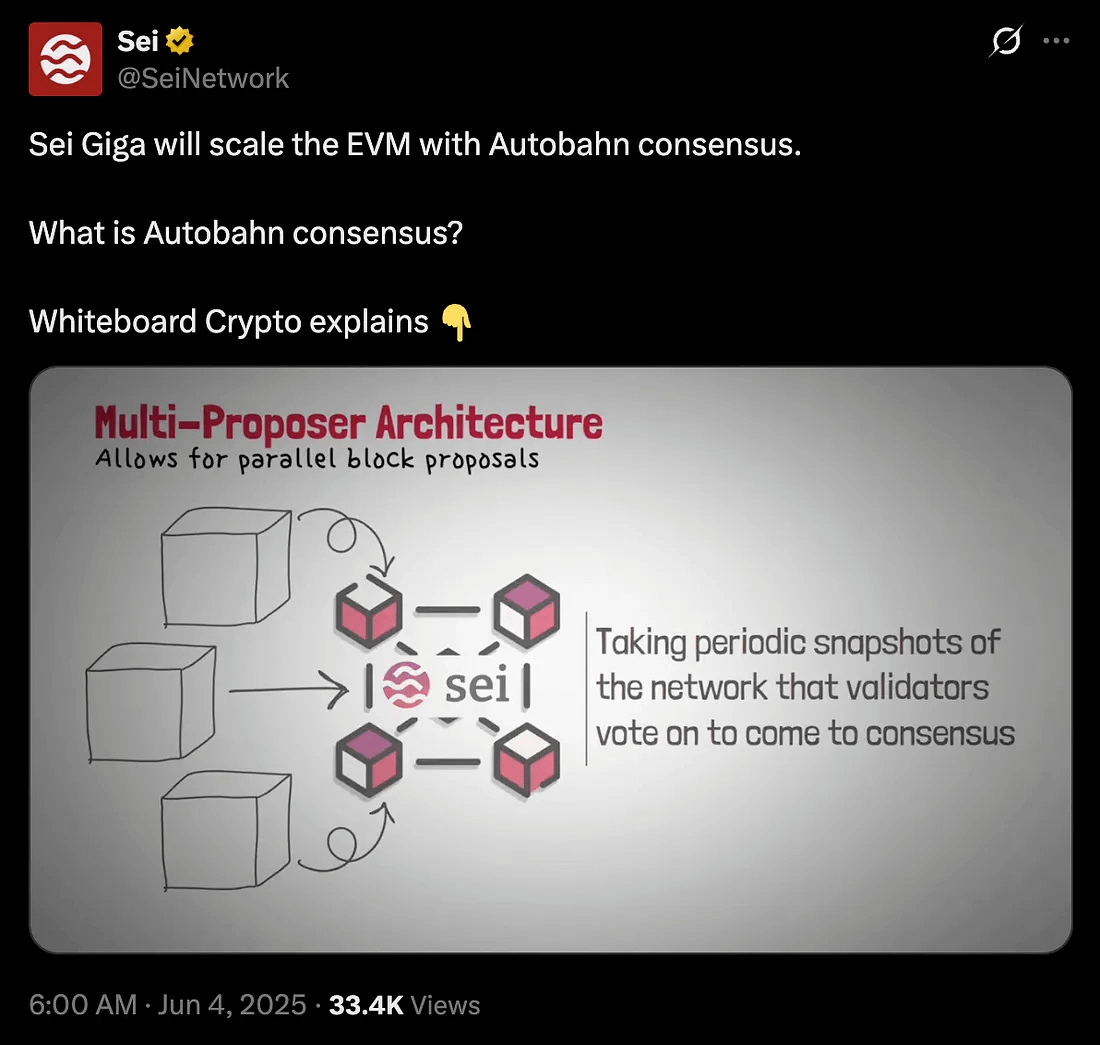
This article takes a closer look at parallel execution designs, especially within the EVM ecosystem, with Sei and Monad as the main case studies. The goal is to evaluate how much of a real speed advantage asynchronous parallel execution offers compared to traditional synchronous sequential processing.

Defining parallel execution
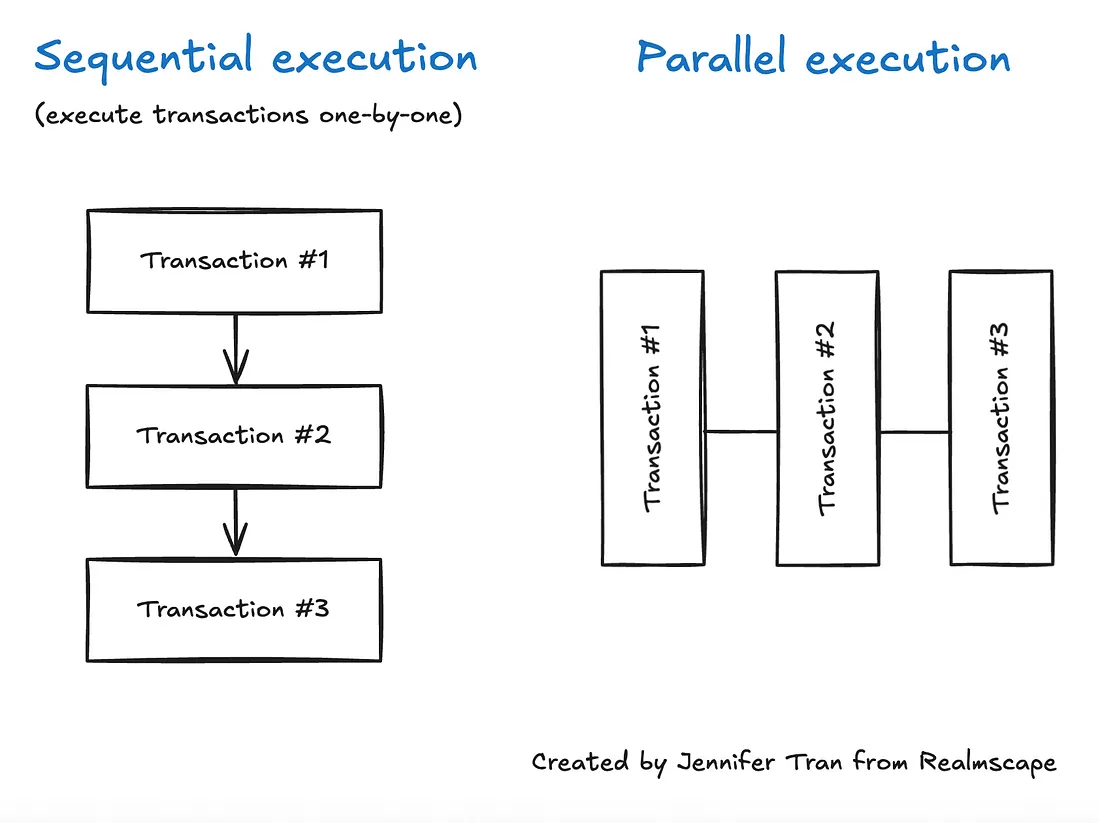
Parallel execution means running multiple tasks at the same time, which is naturally faster than sequential execution, where tasks happen one after another. Think of it like cooking: making several dishes in parallel while other parts are prepping is much quicker than finishing each dish from start to finish before starting the next.

In computing, the same principle applies. Parallel processing can enhance EVM based architectures, even though the chains using it today are not yet as widely adopted.
At its core, a blockchain is a distributed and immutable ledger that records transactions as they are processed. You can think of it like a tamper proof SQL database that keeps track of wallet addresses, contract addresses often represented by tokens, and the balances tied to each wallet and token. Every time someone makes a transaction, that database updates to reflect the change. Updating one entry at a time is naturally slower than updating several at once.
Many established blockchains such as Bitcoin and Ethereum rely on sequential execution, meaning transactions are processed and recorded one by one.
In contrast, newer networks like Solana, Sei, Sui, and Monad are built around parallel execution, allowing multiple transactions to be processed at the same time.
Architecture of Parallel Execution
Even though parallel execution is naturally faster, blockchains that rely on it need more complex architectures to handle the challenges that come with processing many transactions at once.
To run tasks simultaneously, you need multiple groups of workers or machines operating in parallel. In blockchain terms, this means splitting nodes, the computers that maintain the network and handle transaction processing and finalization, into groups that can execute transactions concurrently.
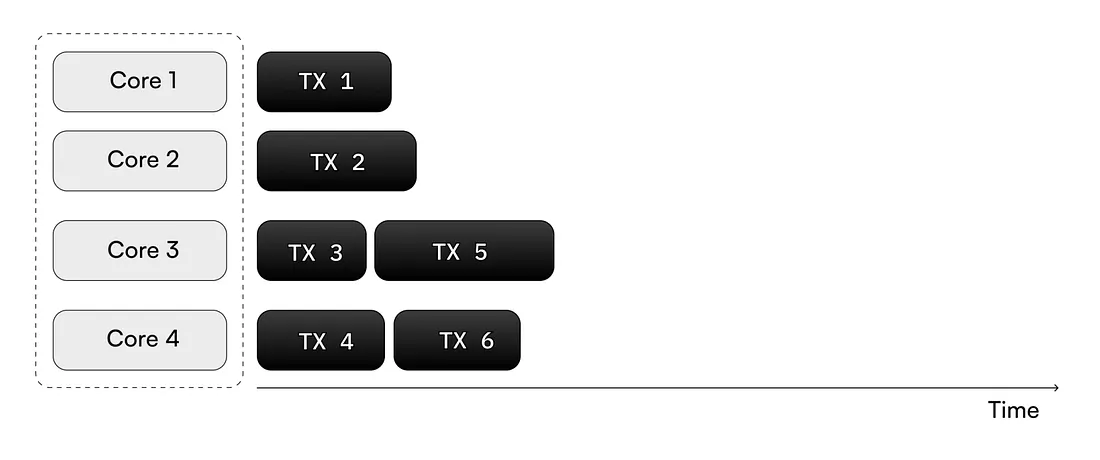
In most designs, parallel execution is handled by running multiple cores or “instance groups” that process transactions at the same time. During finalization, networks may use a separate group to reduce the risk that any single node gains enough control to collude or undermine security [1]. Sei’s source code suggests it uses 500 workers for parallel execution, although its documentation says that number can scale up or down depending on demand. Monad does not publicly disclose how many nodes or workers it runs today.
Parallel execution clearly improves throughput, but as parallelism becomes more common in EVM style environments, the architecture may evolve into more targeted models. Some researchers argue that splitting execution across multiple node groups is unnecessarily complex. A potentially cleaner approach is to parallelize only the heavy work, like smart contract deployment or computation-heavy calls, while keeping simpler actions, like basic token transfers, sequential [1]. There are also proposals where nodes that choose to parallelize could earn additional rewards for processing more transactions [2].
The hard part is correctness under concurrency. Parallel chains need robust ways to detect and resolve conflicts when transactions touch the same state at the same time. Without those safeguards, you open the door to issues like a form of double spend, where the same tokens appear to be used twice. For example, User A has 10 tokens, sends all 10 to User B, then immediately sends 5 to User C, even though their balance should already be empty.
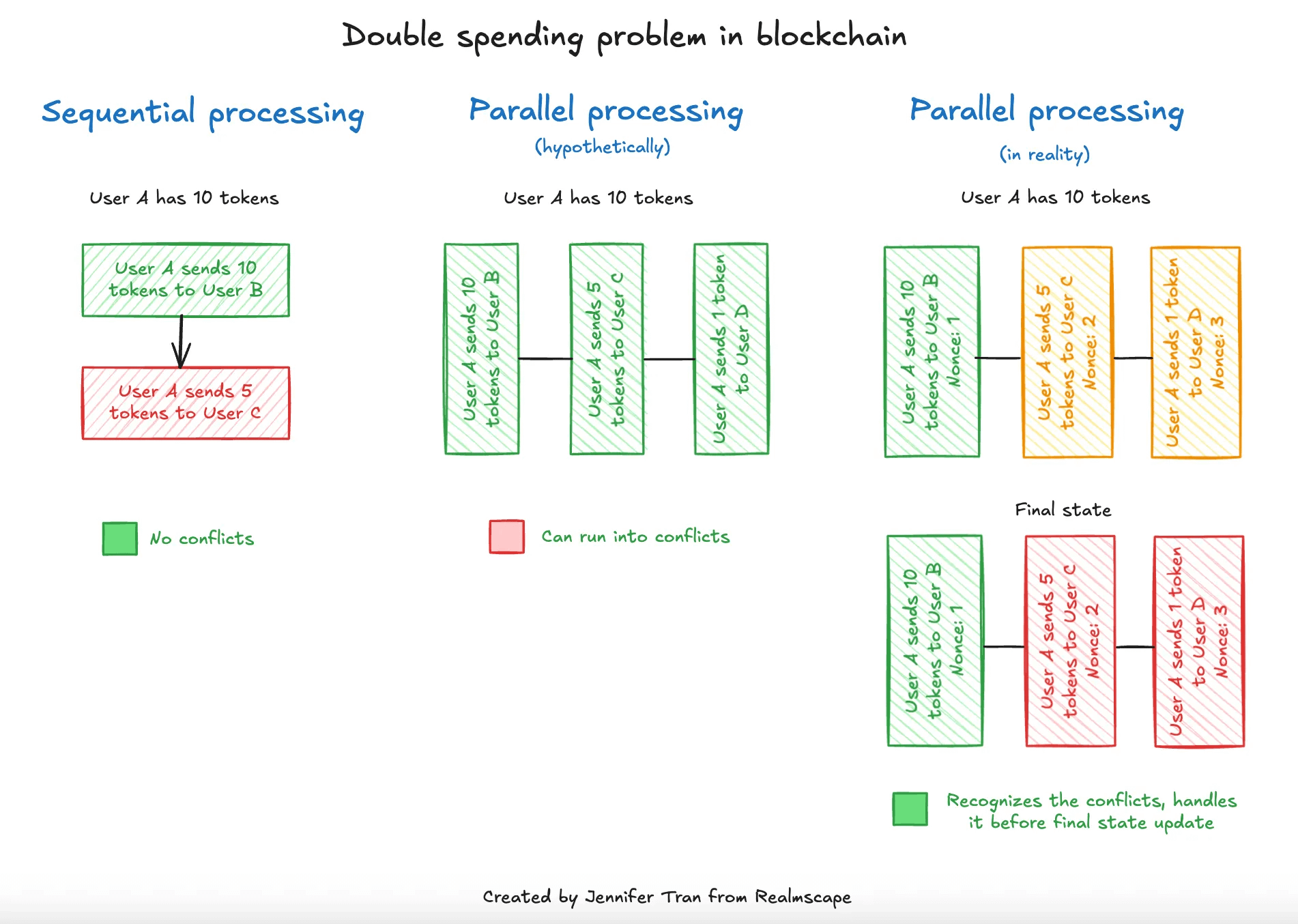
One of the major inefficiencies of parallel execution is the need to abort and resubmit transactions to avoid double spending or inconsistent state updates [1].
In practice, some level of sequential handling may still be required to guarantee correctness. Networks like Sei and Monad use optimistic parallel execution. Transactions are processed in parallel first, but the final state is not confirmed until conflicts are checked and resolved. Transactions are placed in a temporary state, scanned for overlaps as new ones arrive, and any conflicting transactions are removed and replayed in sequential order to ensure accuracy [2].
For instance, imagine User A has 10 tokens and sends 3 to User B. Before that transaction is fully finalized, User A sends another 3 tokens to User C. A parallel process might initially read User A’s balance as 10 for both transactions, even though after the first transfer the real balance should be 7. Without conflict resolution, the system could momentarily reflect incorrect data, which is why reordering and reprocessing are necessary safeguards.
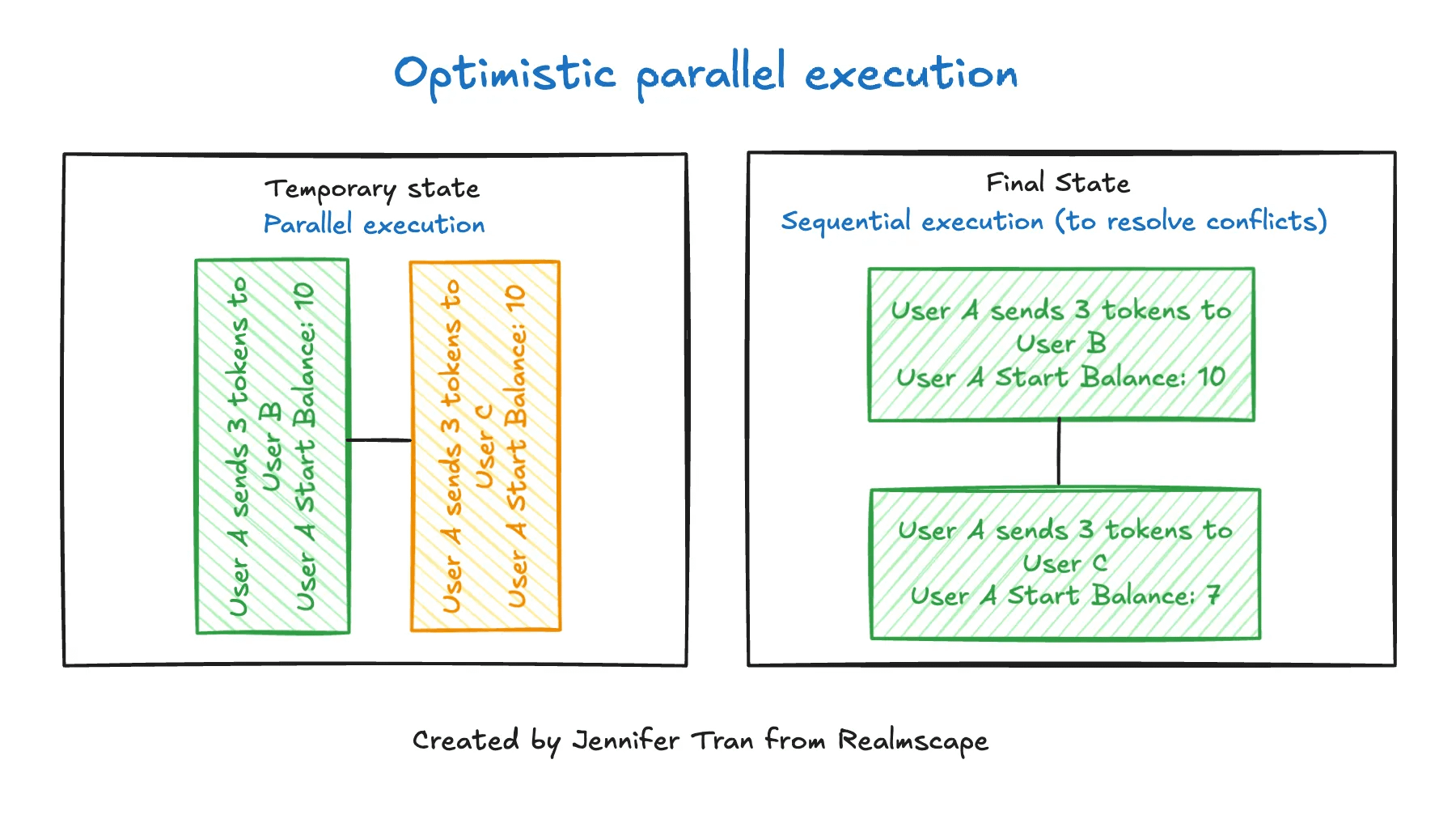
Transaction execution data
Blockchains with parallel execution claim higher transaction processing speeds but lack sufficient usage to prove it. Instead, analyzing the speed of individual transaction execution provides greater clarity.
Sequential execution chains execute a single or double-digit number of transactions per second. Bitcoin can handle 3.3 to 7 transactions per second (TPS), whereas Ethereum can process 15 to 30 TPS.
Blockchains that use parallel execution claim to be magnitude times faster. Sei states they can handle anywhere from 1,500 TPS to 15,000 TPS, depending on the type of transaction. Monad reports a general 10,000 TPS.
The challenge with these claims is that neither Sei nor Monad has ever met these usage levels. Even at the mainnet launch (production version), Monad peaked at over 100 TPS. In recent months, Sei reached over 4 million daily transactions, well below the average of 50 TPS. Most EVM users have not experienced the full benefits of parallelization, as Sei and Monad have not reached the adoption levels of Ethereum and its L2s (for example, Base recently peaked at 20 million daily transactions, with an average of 150 TPS).
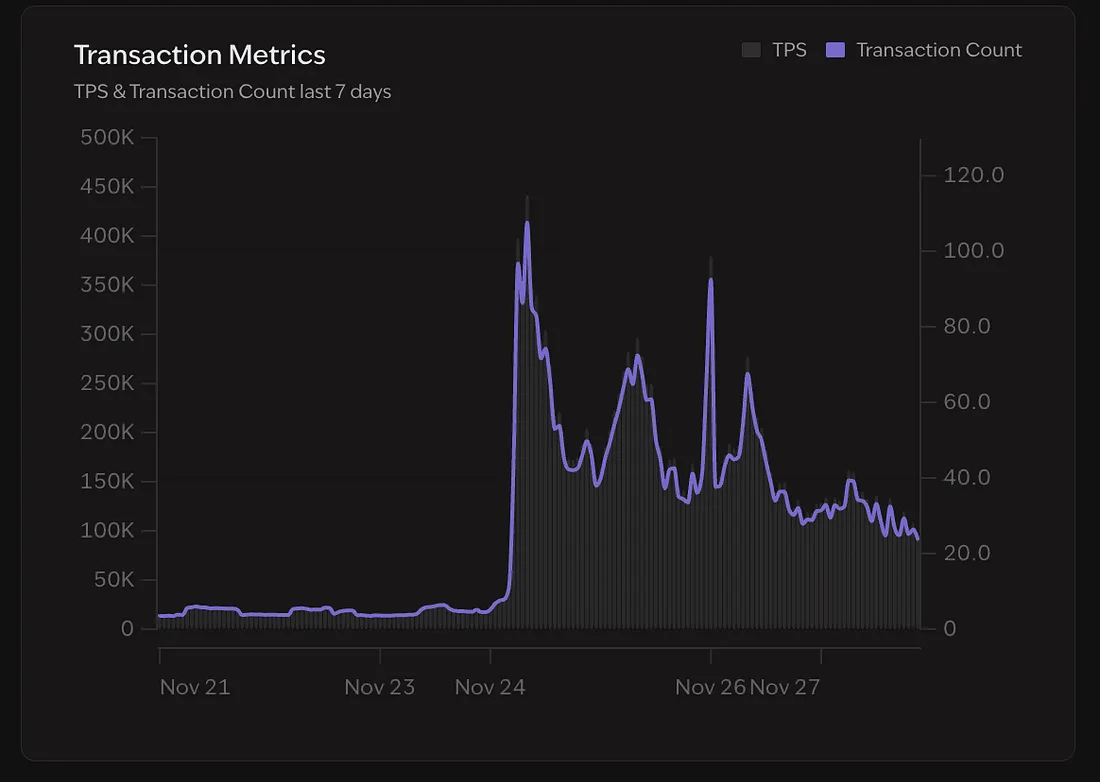
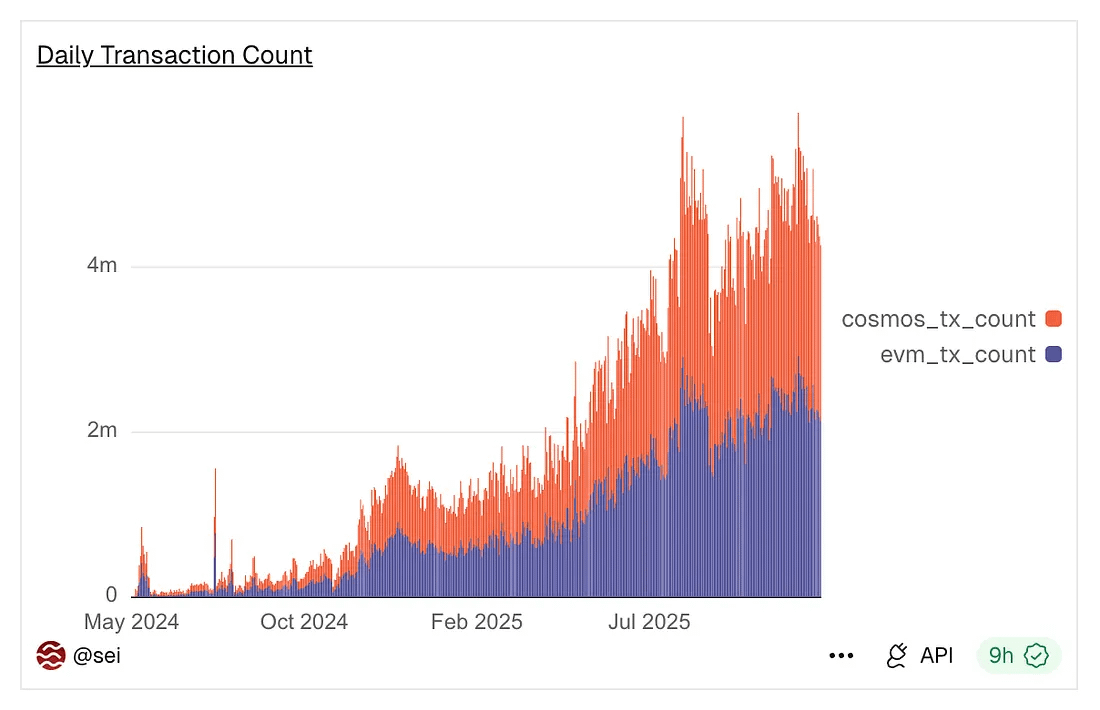
It is more insightful to look at individual transaction execution times and gas costs rather than just TPS when assessing how parallel execution improves EVM environments.
Blockchains do not typically publish raw execution time metrics, but finalization times can offer a rough proxy for performance. One simulation found that introducing parallelization within the same architecture improved transaction finalization speed by about 1.54 times [3]. On the network level, Ethereum finalizes transactions in roughly 15 minutes, while Sei does so in about 400 milliseconds and Monad in around 800 milliseconds.
Parallelization can also lower gas fees. Because blockchains rely on surge style pricing, greater capacity helps absorb higher demand, which reduces fee pressure. Sei and Monad both have much lower base gas costs than Ethereum. A simple ERC 20 token transfer costs approximately $0.000098 on Sei, compared to about $0.03 on Ethereum.
Even if these networks are not yet operating at their theoretical TPS limits, parallel execution still delivers meaningful gains in speed and cost efficiency.
Overall,
Parallel execution clearly strengthens Ethereum compatible blockchains, arguably by more than just a marginal amount.
Legacy networks like Bitcoin and Ethereum rely on sequential execution. That approach is dependable and straightforward, but it comes with tradeoffs in speed and cost.
Parallel execution is designed to make blockchains faster and more affordable, improving their chances of broader adoption. Sei and Monad, which currently see far less usage than Ethereum, are the two main EVM compatible networks that have implemented this model at scale.
However, because their transaction volumes remain relatively low, the full capacity of parallel execution has not yet been tested. Its more intricate architecture still needs to prove itself under sustained, real world demand at the levels it aspires to support.
Sources
Liu, J., Cheng, R., Asokan, N., & Song, D. (2020). Parallel and Asynchronous Smart Contract Execution. Journal of LaTeX Class Files, 14(8). https://arxiv.org/pdf/2306.05007
Marsh, B., Landers, S., & Jog, J. (2025, November 18). Sei Giga v0.2. Sei Labs. https://arxiv.org/pdf/2505.14914
Das, S., Bäumer, J., Preechakul, K., Patel, R., & Li, J. J. (2025, April 2). Accelerating Blockchain Scalability: New Models for Parallel Transaction Execution in the EVM. University of California, Berkeley. https://arxiv.org/html/2504.01370v1