
The first time I really examined Fogo, it wasn’t the usual highlights like speed or throughput that caught my attention. What stayed with me was how indifferent it seemed to whether I grasped the mechanics behind it. At first that almost felt like a flaw. Then I realized it might be intentional. Maybe the real aim isn’t to showcase complexity, but to make the underlying system so seamless that users never have to think about it.
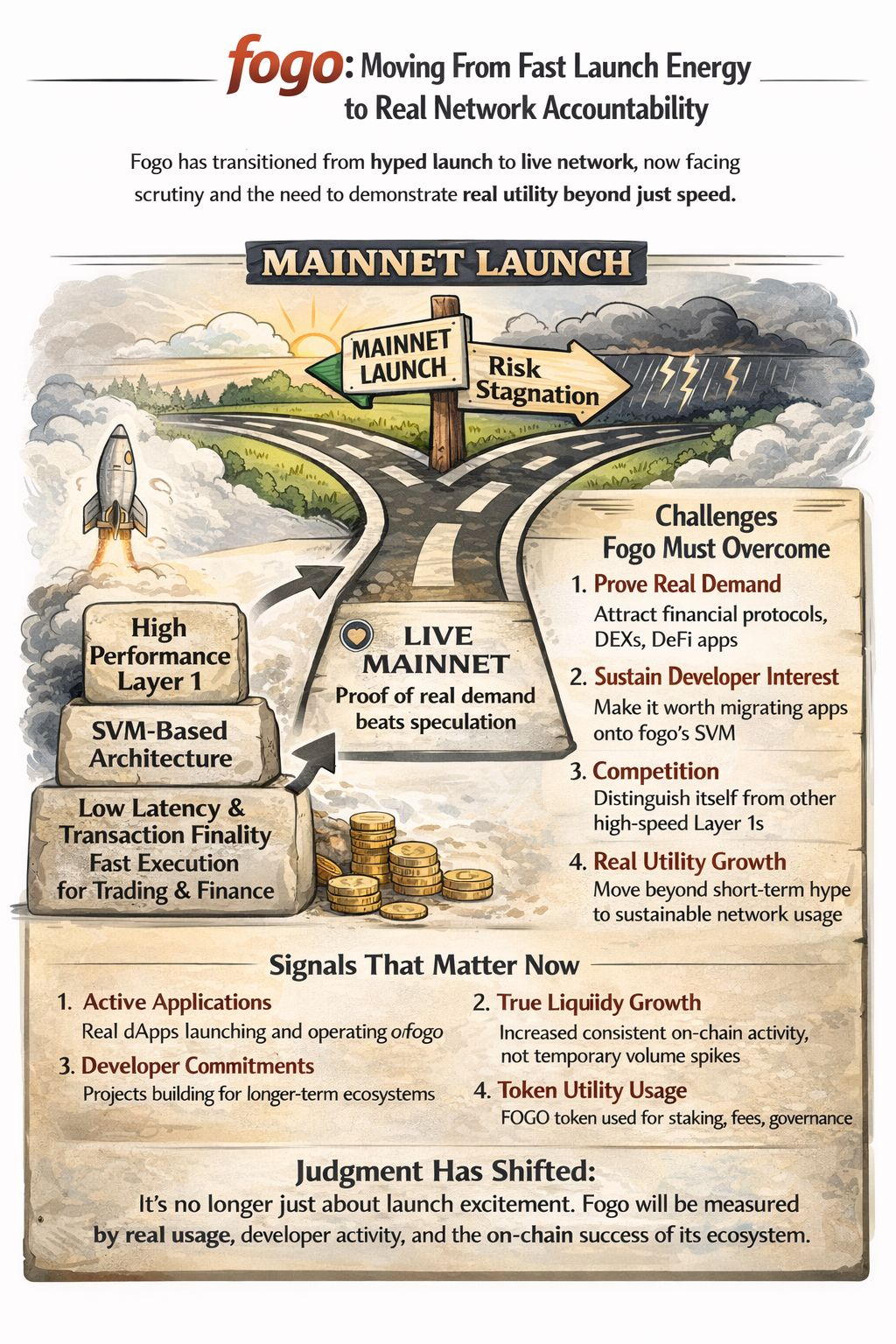
fogo is no longer just an idea built around performance metrics. It is now live, liquid, and being judged by the market in real time. That shift changes everything. When a Layer 1 moves from roadmap promises to actual mainnet activity, expectations harden. The conversation moves away from how fast the chain claims to be and toward whether anyone truly depends on it.
Right now, fogo trades in the low two-cent range, with daily volume fluctuating in the tens of millions. Liquidity is present and traders are clearly engaged. At the same time, weekly performance has been uneven. There are brief bursts of strength followed by periods of cooling off. This pattern suggests that interest exists, but conviction is still forming. The market is participating, but it is not fully committed.
Technically, fogo positions itself as a high-performance Layer 1 built on the Solana Virtual Machine. That design choice is not random. SVM compatibility lowers the barrier for developers who already understand Solana’s tooling and architecture. Instead of asking builders to learn a completely new environment, fogo offers familiar ground with the promise of optimized execution. In theory, that should accelerate ecosystem growth. In practice, it depends on how many developers decide the migration is worth it.
The mainnet launch marked a turning point. Before that, fogo could be evaluated on ambition. After launch, it must be evaluated on behavior. Blocks are being produced, transactions are being processed, and the native token is actively used for fees and staking. This is where the narrative becomes more serious. Live networks cannot hide behind potential.
One of fogo’s defining claims is ultra-low latency and rapid finality. That matters most for performance-sensitive applications like decentralized trading, order books, and real-time financial tools. Many chains advertise speed, but fogo leans into this identity deliberately. It is not trying to be a generic smart contract hub. It is trying to be infrastructure that feels closer to traditional trading systems in responsiveness.
However, speed in isolation does not create ecosystems. Developers build where users are, and users stay where applications solve real problems. fogo’s path forward will depend on whether it can attract meaningful financial protocols, decentralized exchanges, or on-chain trading environments that genuinely benefit from its execution model. If it succeeds in that, its identity will solidify. If not, it risks becoming one more technically capable chain in an already crowded field.
Another aspect that shaped fogo’s early reputation was its token distribution approach. By shifting away from a traditional presale model and favoring broader community distribution, the project signaled a preference for decentralization over concentrated capital. That move differentiated it from many new chains that prioritize early fundraising over long-term distribution balance. Whether that decision leads to stronger community alignment over time remains to be seen, but it did create an early narrative of fairness.
Market structure around fogo reflects its transitional stage. Market capitalization remains modest relative to established Layer 1 networks. Daily volume shows engagement but also volatility. Price swings are noticeable, which often indicates that short-term traders are active. This environment can generate visibility, but it does not replace steady adoption.
The competitive landscape adds pressure. There are multiple high-performance chains competing for developers who care about speed and throughput. fogo must demonstrate that its version of performance delivers practical advantages that others do not. That could come from tooling support, ecosystem incentives, user experience improvements, or specific integrations tailored to trading environments.
Token utility will also shape fogo’s trajectory. As with any Layer 1, the native token underpins transaction fees, validator incentives, and staking mechanisms. If on-chain activity grows, token demand tends to follow organically. If usage stagnates, price movements become driven primarily by speculation. fogo is currently at the stage where usage growth will matter more than marketing narratives.
The most meaningful signals to monitor are not short-term price spikes but structural developments. Are new applications launching on fogo? Is transaction volume rising because of real user activity rather than trading bots? Are liquidity providers choosing to deploy on the network consistently? These are the indicators that separate temporary attention from sustainable growth.
At this moment, fogo sits at a crossroads. It has a credible technical foundation, SVM compatibility that lowers entry barriers, and enough liquidity to remain relevant in trading conversations. It also faces a competitive environment where speed alone is no longer a differentiator. Execution, ecosystem depth, and developer retention will determine whether fogo evolves into a specialized trading-focused infrastructure layer or remains an emerging experiment.
Infrastructure is ultimately judged by repetition. Systems that work attract return usage. fogo has demonstrated that it can launch and operate. The next phase will reveal whether participants rely on it repeatedly or simply pass through during volatile cycles. That distinction will define its long-term narrative far more than any single day’s price movement.
