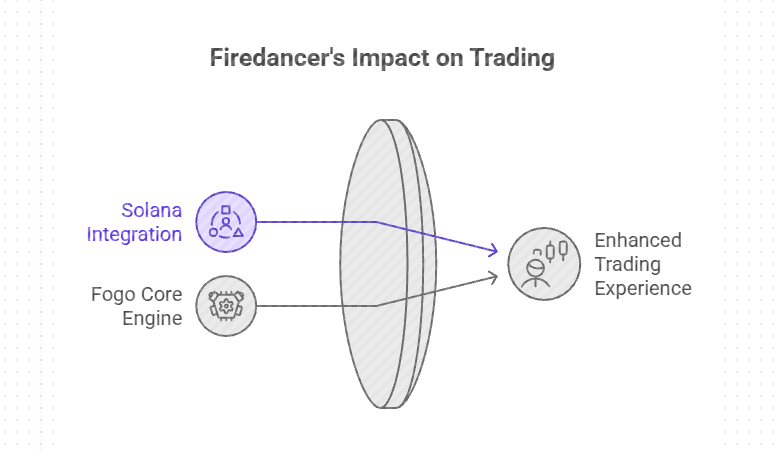
Fogo’s Firedancer-based client improves performance over Solana mainly by going “all‑in” on a single, ultra‑optimized validator implementation, tuned specifically for low‑latency DeFi, rather than balancing multiple slower clients and general‑purpose workloads.
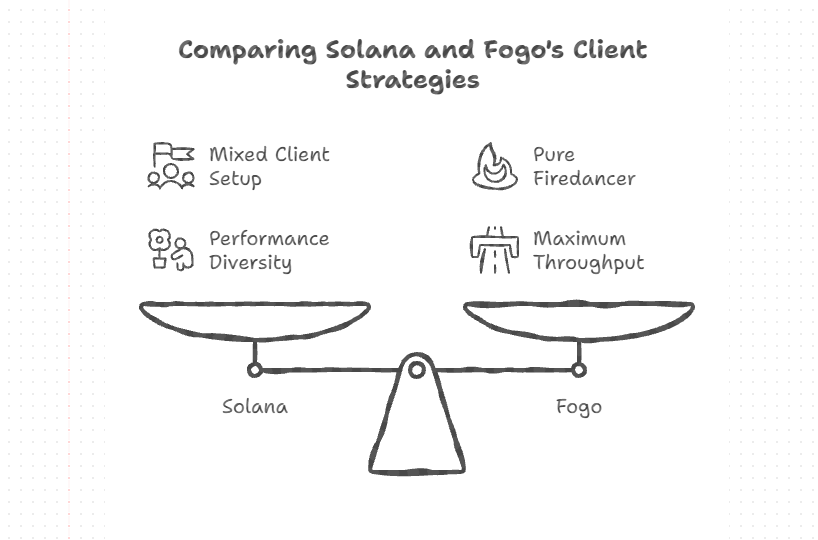
1. Pure Firedancer vs Solana’s mixed client setup
Solana today runs primarily on the Agave/Solana Labs client, with Firedancer being rolled out as an additional client to add diversity and performance.
Fogo instead launches with Frankendancer (a hybrid) and plans to migrate to pure Firedancer, explicitly prioritizing maximum throughput and latency over client diversity.
Because networks are often bottlenecked by their slowest clients, Fogo’s “Firedancer‑only” stance lets it tune the network around one highly optimized engine without waiting for slower implementations to catch up.
2. Lower latency and faster block times
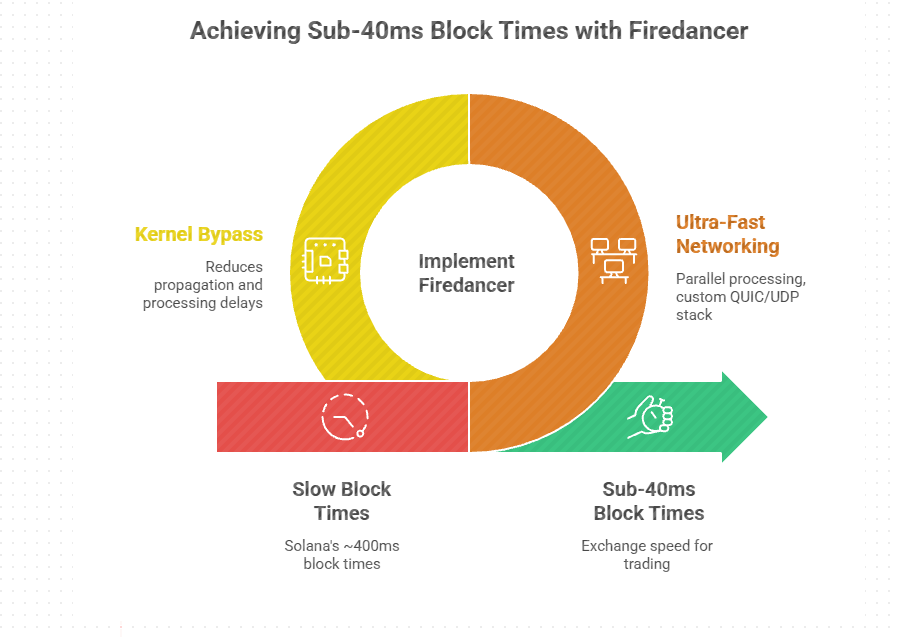
Firedancer is architected for ultra‑fast networking and parallel processing (tile‑based architecture, custom QUIC/UDP stack, kernel bypass), which dramatically reduces propagation and processing delays.
Fogo uses this to target sub‑40ms block times and ~1.3s finality, versus Solana’s roughly ~400ms block times on its current mainnet profile.
For trading, this is critical: order placement, cancellation, and oracle updates can all settle closer to “exchange speed,” which is the core design goal of Fogo.
3. Hardware‑level and concurrency optimizations
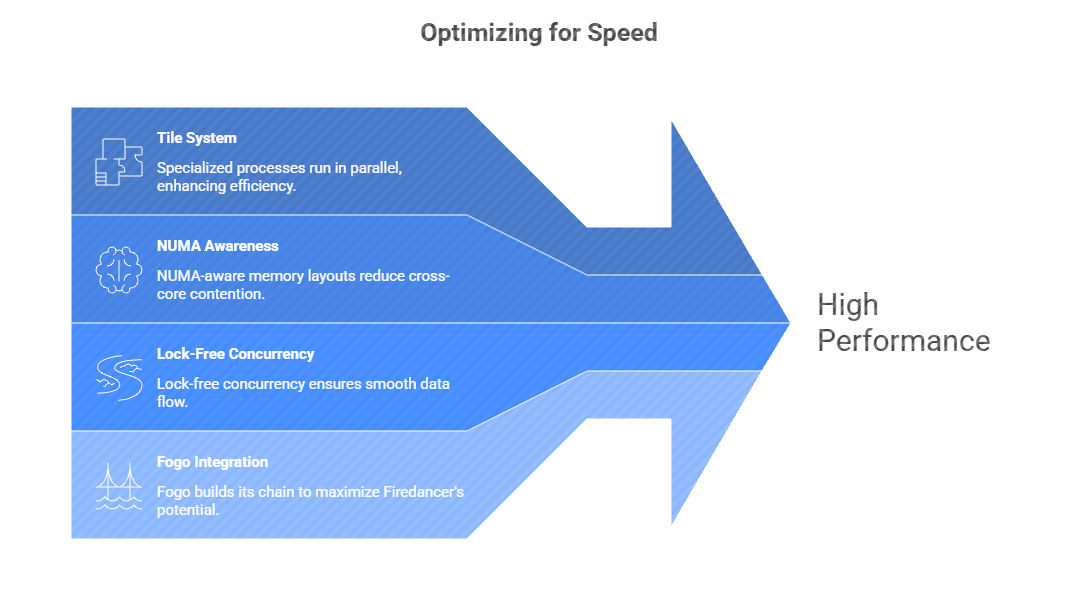
Firedancer’s tile system splits work into specialized processes (network I/O, signature verification, block production) running in parallel, rather than a largely monolithic process like the original Solana client.
NUMA‑aware memory layouts and lock‑free concurrency keep each tile close to its local memory and avoid bottlenecks from cross‑core contention, sustaining very high TPS even under heavy load.
Fogo builds its chain around these assumptions from day one, so validator hardware, colocation, and network parameters are chosen to fully exploit Firedancer’s performance envelope.
4. Network and consensus tuned for trading
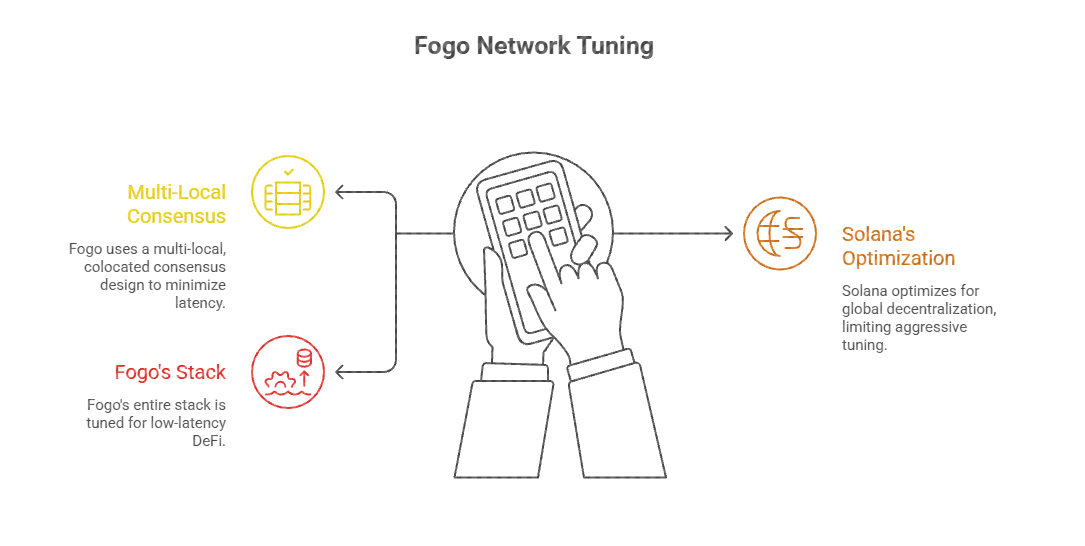
Fogo combines Firedancer with a multi‑local, colocated consensus design (e.g., validators initially concentrated in Tokyo near major exchanges) to minimize physical latency as well as software latency.
Solana, by contrast, optimizes for broader global decentralization and a wider app mix, so it cannot tighten its block times and networking parameters as aggressively around one region and one use case.
The result is a chain whose entire stack (client implementation + consensus + geography) is tuned around Firedancer’s strengths and the needs of low‑latency DeFi.
5. Practical effect in simple terms
On Solana, Firedancer is a big performance upgrade layered into a general‑purpose ecosystem, improving throughput and resiliency but still sharing the stage with existing constraints and diverse workloads.
On Fogo, Firedancer is the core engine: by standardizing on this client and shaping consensus and validator strategy around it, Fogo squeezes out additional gains—sub‑40ms block formation, ~48k TPS capacity, and near‑instant UX for trading flows.