

When I first read that Vanar was built around AI from day one, I assumed it was marketing.
Not because AI isn’t important. It clearly is. But because I’ve seen too many projects retrofit themselves around whatever narrative is trending. If AI is hot, suddenly everything was “AI-native.” If real-world assets trend, suddenly every roadmap pivots to tokenization.
So “built for AI from day one” sounded like positioning, not architecture.

I didn’t dismiss it outright. I just didn’t give it much weight.
There’s a pattern in crypto where infrastructure gets designed first, and then narratives are layered on later. A chain launches as general-purpose. A few months pass. Then it becomes a DeFi chain. Or a gaming chain. Or an AI chain. The core architecture doesn’t change much only the messaging does.

That’s why I’m cautious when I hear strong claims about being purpose-built.
But the more I looked at Vanar, the more it felt less like a pivot and more like a premise.
Most blockchains were designed around human-triggered actions. Transactions, approvals, governance votes. Even automation usually revolves around user-defined parameters. The entire mental model assumes a person initiating and overseeing activity.
AI doesn’t operate like that.
AI systems generate outputs continuously. They interpret data, create content, make predictions, and increasingly execute logic without needing constant human prompts. If that kind of activity becomes normal and we’re already heading there then infrastructure built purely around manual interaction starts to feel incomplete.
That’s where the “built for AI” framing started to make more sense.
Instead of asking how to integrate AI tools into an existing chain, the more interesting question is how infrastructure changes when AI is assumed to be active all the time.
How do you track machine-generated outputs?
How do you verify provenance?
How do you anchor activity without exposing sensitive data?
How do you maintain accountability if systems are partially autonomous?

Those aren’t marketing questions. They’re design questions.
Another thing that shifted my perspective is the transparency gap in AI systems today. Large models operate behind APIs and corporate layers. You input something. You get an output. You trust that it was generated responsibly and hasn’t been manipulated.
That trust might be fine for casual interactions. It becomes more fragile when money, ownership, or identity are involved.
Blockchain doesn’t magically solve AI opacity. But it does provide a framework for anchoring events in a verifiable way. Timestamping outputs. Recording interactions. Creating an auditable layer that doesn’t depend entirely on centralized infrastructure.
If you assume AI activity is going to increase not decrease that kind of anchoring starts to feel less optional.
Vanar’s positioning around AI-first infrastructure seems to revolve around that assumption. Not that AI is a feature. Not that it’s a narrative booster. But that it’s becoming part of the operating environment.
That’s a quieter thesis than most AI + crypto pitches.
It doesn’t promise autonomous superintelligence. It doesn’t suggest replacing centralized AI giants overnight. It focuses more on accountability and structural readiness.
And that’s probably why I moved from dismissive to curious.
There are still open questions.
AI workloads are computationally heavy. Most serious processing will remain off-chain. That’s unavoidable. So the challenge becomes deciding what belongs on-chain verification layers, metadata, interaction logs and what doesn’t.
Execution matters more than framing.
There’s also the question of adoption. Infrastructure built around AI assumes developers want those rails. It assumes enterprises or creators see value in verifiable outputs. It assumes users care about provenance.
Those assumptions might prove correct. Or they might take longer than expected to materialize.
But the key difference for me is that Vanar’s claim didn’t dissolve under scrutiny. It felt internally consistent.
Being “built around AI from day one” doesn’t necessarily mean AI is doing everything. It means the system was designed with AI activity in mind rather than adapting later to accommodate it.
That’s harder to fake.
I’m still cautious. I don’t think AI + blockchain automatically creates value. The combination has to solve something concrete. Otherwise it’s just narrative stacking.
But I’ve become more open to the idea that infrastructure will need to evolve as AI becomes more integrated into digital life.
If machines are generating assets, influencing decisions, and interacting with economic systems, then the rails underneath should reflect that reality. They should anticipate constant machine participation, not treat it as an edge case.
When I first read that Vanar was built around AI from day one, I assumed it was marketing.
Now, I’m not so sure.
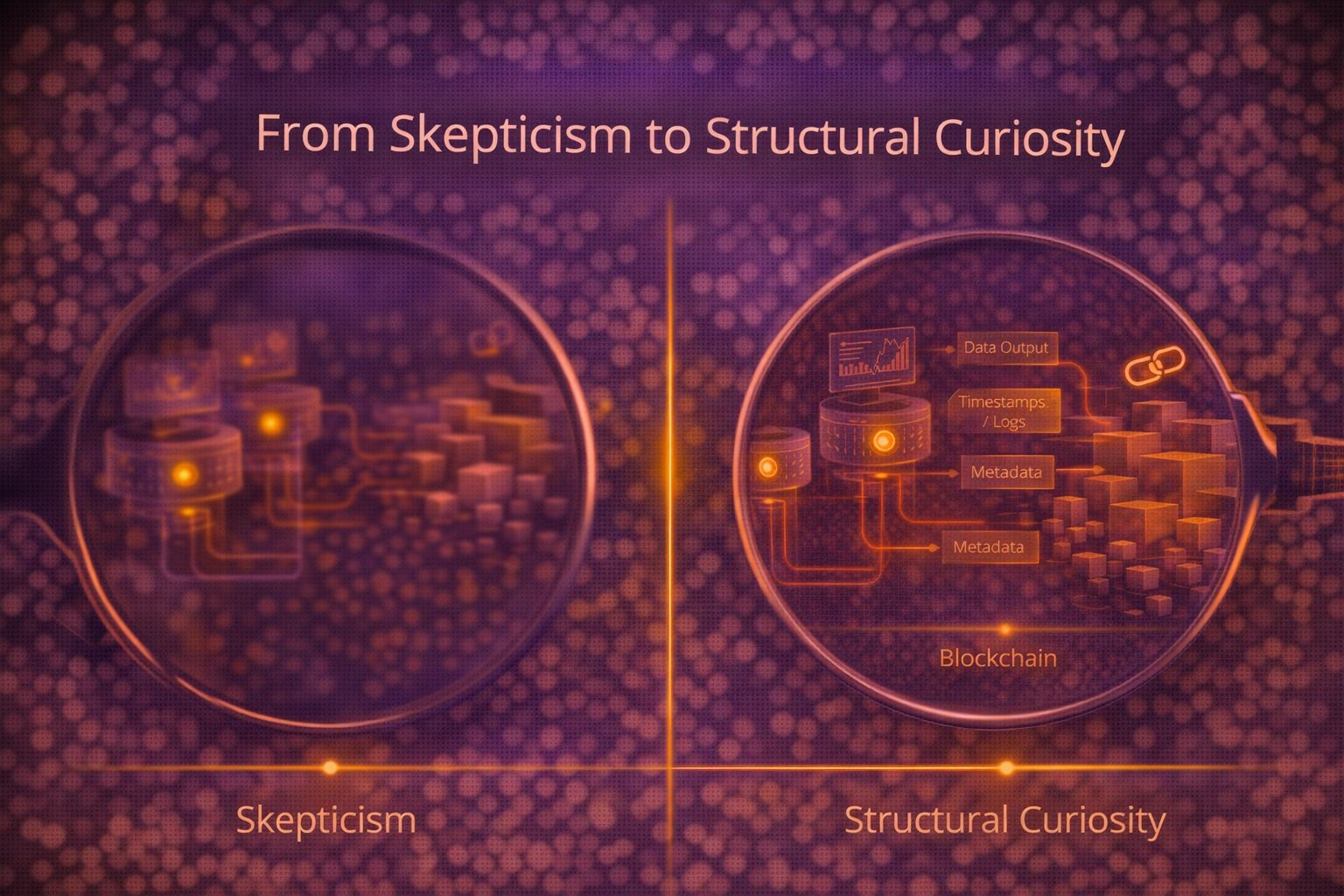
It might just be a recognition of where things are heading and an attempt to build for that direction before it becomes obvious to everyone else.
I’m not convinced. I’m not skeptical in the same way anymore either.
I’m watching how the architecture develops.
And sometimes, that shift from dismissal to attention is the most meaningful one.