
Same price. Same size. Same hand swear.
The desk chat didn’t even have time to be dramatic.
“fill?”
“why partial”
Not “why pending.” Partial means the argument already happened without you.
The gap wasn’t liquidity.
It was time.
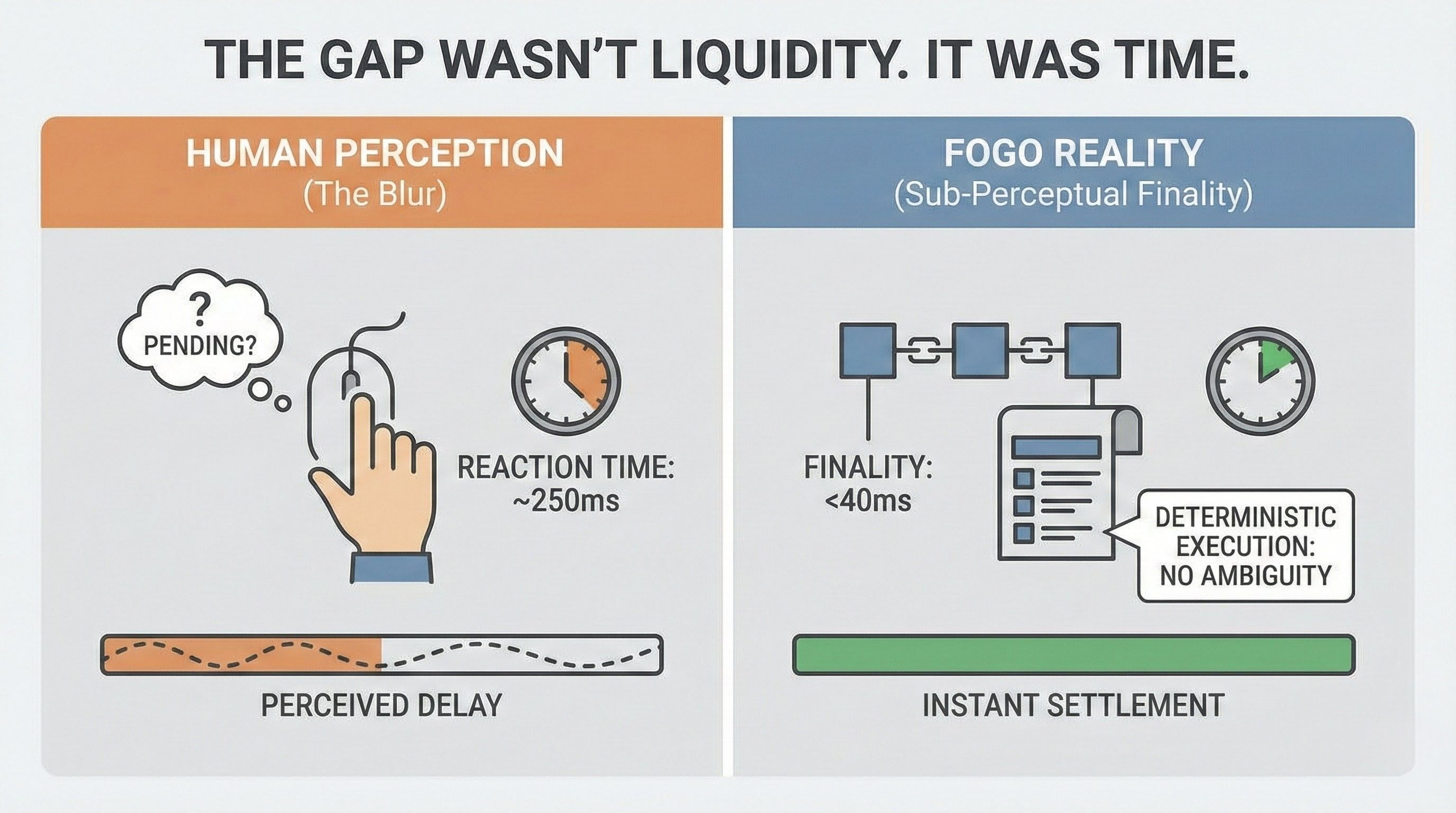
The ladder looked thick when you sent it. Three levels deep, clean, reasonable. On most rails you get a cushion between seeing size and losing it, just enough blur to pretend you were basically simultaneous. On Fogo, that blur collapses into the ultra-low block time cadence before your finger finishes being sure.
The timestamps don’t come back as a story. They come back as math, four block rotations that turn “I was in” into “you were late.”
The fogo on-chain order book updates like a moving floor. Real-time liquidity propagation pushes state forward and sub-perceptual finality makes “available” and “already gone” feel like the same word with different consequences.
You don’t miss because the chain is slow.
You miss because it isn’t.
Someone tries the usual coping move, refresh twice, stare at the ladder like the numbers might apologize. They don’t. The receipt stays clean. No soft middle state to argue inside. No pending state to live in.
Risk opens their panel. Hunting for jitter. For congestion. For any story that lets them say “it’s the network.”
Nothing spikes. No congestion drag.
On a fogo high-performance SVM chain, the Solana Virtual Machine compatibility is the comfortable part. The discomfort is what it does to human timing. The SVM-native execution layer schedules intent. Parallel transaction execution doesn’t pause so the room can coordinate. Deterministic execution ordering resolves conflict the way a matching engine does: by deciding.
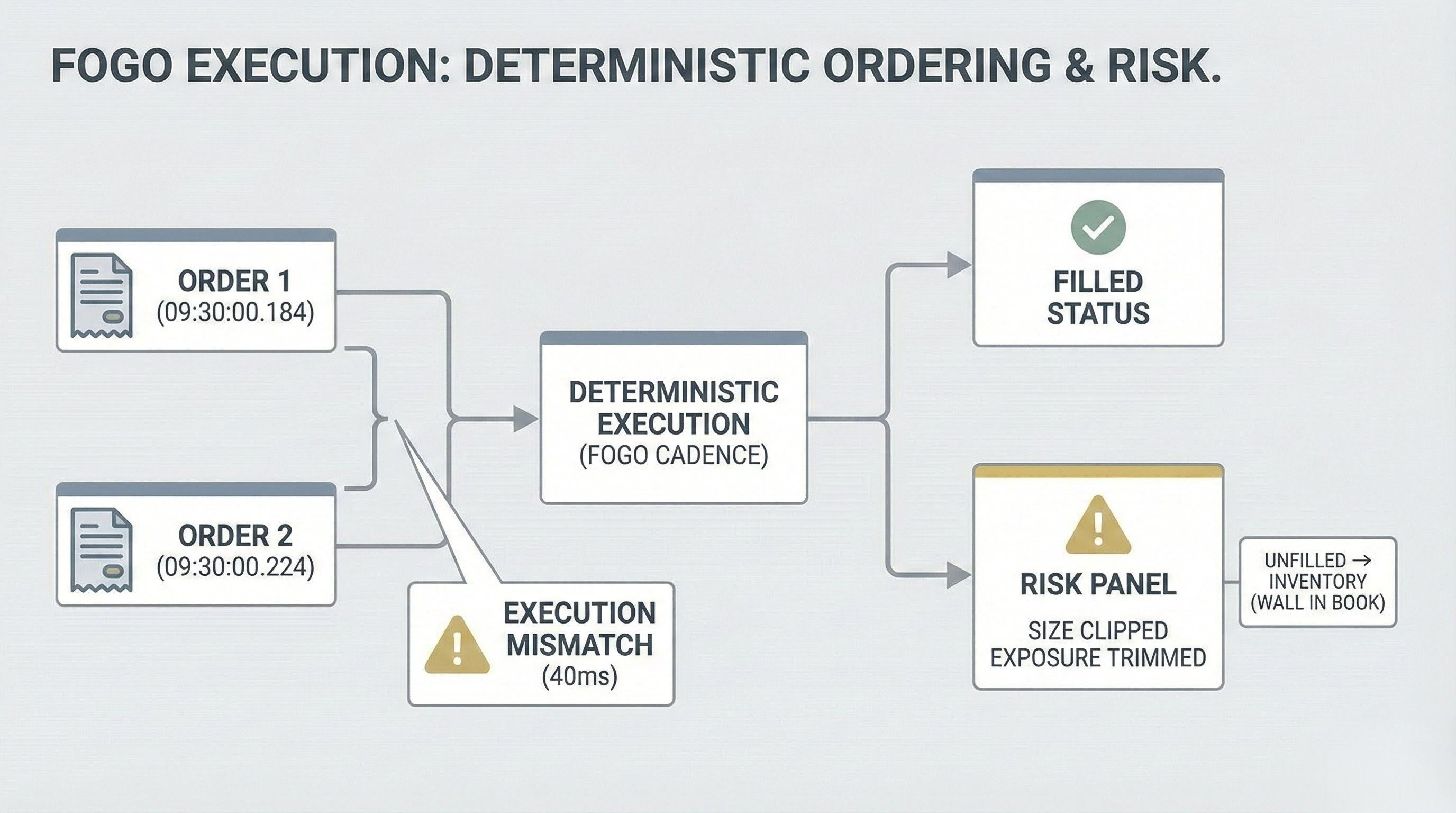
The order that lands first doesn’t win by being smarter. It wins by fitting inside the cadence window, where hesitation becomes allocation loss and identity fades behind timestamp.
Another message comes in, casual-mean:
“why didn’t you leg in?”
Start typing. Delete. Start shorter. Delete that too. Everything you want to say feels late on a system that already settled what happened.
Someone pastes the two timestamps into a ticket.
Execution mismatch (40ms).
Like naming it makes it negotiable. Like an audit trail is a bargaining chip. The whole point is there’s no ambiguity to hide behind no RPC lag excuse, no MEV scapegoat, no ghost in the pipe. Latency-minimized consensus routing and fast commit cycles leave fewer corners for excuses to live.
The miss turns into inventory.
Your unfilled order sits there becoming a wall in the book. Not because anyone targeted you. Because continuous throughput integrity keeps the market moving in order, and your order is now part of the structure other people trade against.
Then the risk limit banner flickers on the next attempt. Size clipped. Exposure trimmed. Nobody thanks it. Being protected feels different when the system didn’t wobble first.
You hover over cancel. Don’t click. Not yet. Old muscle memory wants a grace window that doesn’t exist here. Competitive execution timing isn’t a vibe on Fogo; it’s the only clock in the room.
Somewhere inside the Fogo validator co-location topology, geography becomes a rounding problem and the decision is already past tense. The receipt doesn’t argue. The clean settlement just sits there.
You check the timestamps again. Stupid. Still do it.
The ladder refreshes, not as a courtesy, just as fact. Another block rotates. Another receipt lands. The market doesn’t pause to let your narrative catch up.
Cursor still hovering.