

When I look at Fogo, I’m not seeing a copy of something that already exists. I’m looking at a team that is making a very specific base decision. I’m watching them build a Layer 1 around the Solana Virtual Machine, and I’m thinking about what that really means in practical terms.
Most new Layer 1 chains start from scratch. I’m picturing a brand new execution environment, new rules, new tools, and developers who have to relearn everything. I’m imagining builders asking, “How does this runtime behave? What breaks under load? What patterns actually scale?” That learning curve is slow. It costs time. And I’m watching how that delay quietly kills momentum for many chains before they ever reach real usage.
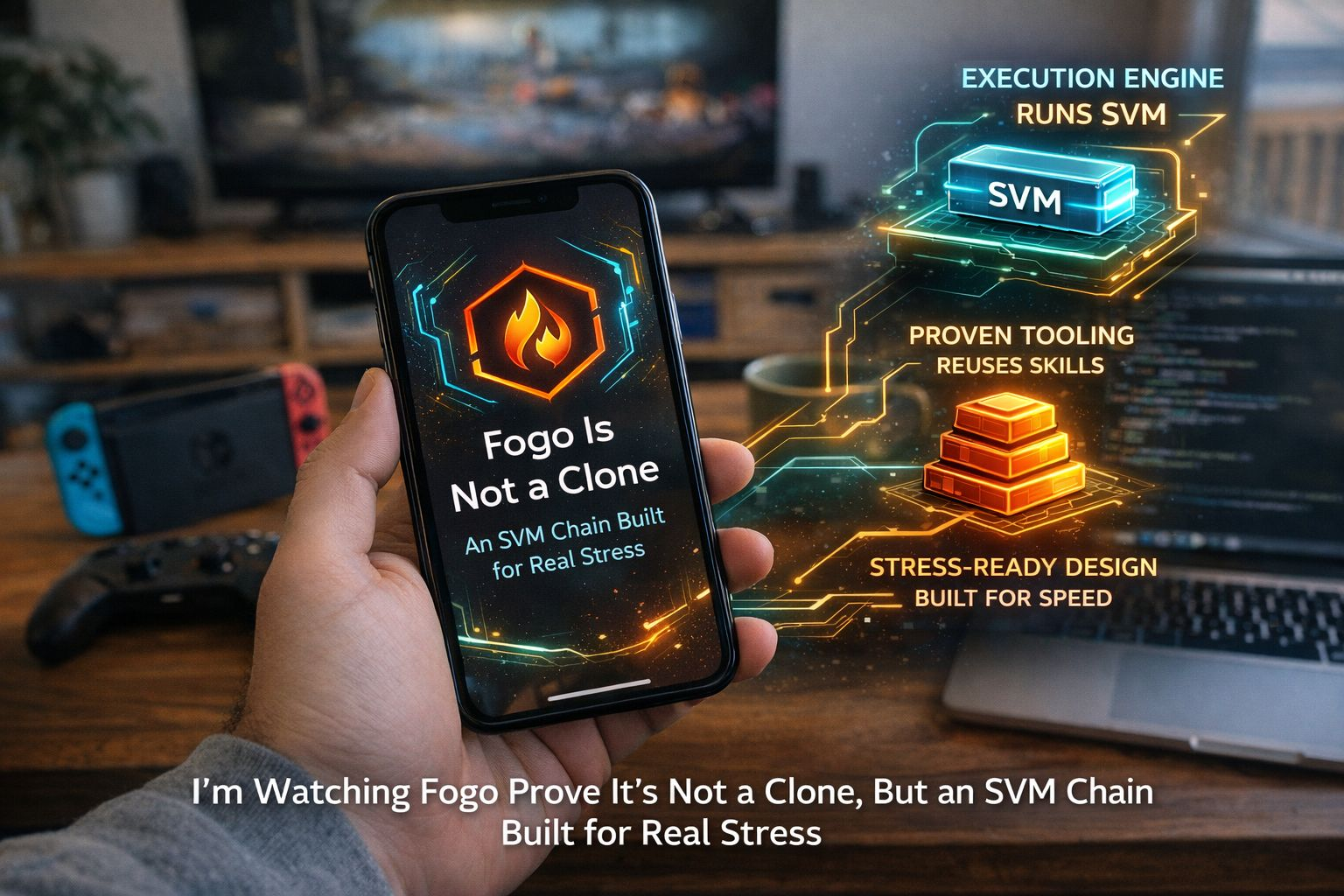
Fogo feels different to me because it’s not starting empty. By choosing SVM as its execution engine, it’s starting with something that has already shaped how serious developers think about performance. I’m talking about parallelism. I’m talking about state layout. I’m talking about designing apps that don’t fight the runtime.
SVM isn’t just a buzzword when I look at it closely. I’m seeing it as a system that rewards discipline. If I’m building on SVM, I’m learning to avoid contention. I’m designing for concurrency from day one. I’m thinking about how my application behaves under pressure, not just how it behaves in a demo. Over time, that creates a certain kind of builder mindset. I’m watching Fogo import that mindset along with the engine itself.
But I’m also being realistic. I’m not assuming that just because it uses SVM, success is guaranteed. Liquidity doesn’t magically appear. Users don’t automatically move. I’m reminding myself that adoption still has to be earned.
What I do see, though, is a reduced cold start problem.
I’ve seen how the cold start loop traps new chains. Builders hesitate because there are no users. Users hesitate because there are no apps. Liquidity providers hesitate because there’s no volume. And volume stays weak because liquidity is thin. I’m watching that cycle repeat across crypto.
With SVM, Fogo lowers the friction for the first wave of builders. I’m imagining developers who already understand this execution model. They don’t need to relearn everything from zero. Even if they can’t just copy and paste code, they can reuse their instincts. They already know how to structure accounts. They already know how to think about throughput. That muscle memory matters more than people admit.
I’m seeing that as time compression. Instead of spending months figuring out the basics, builders can move faster toward serious deployment.
But I’m also clear about what doesn’t transfer easily. Liquidity does not teleport. Network effects don’t automatically follow a new chain just because it shares an engine. I’m watching for whether Fogo can build trust again from scratch. I’m watching how they handle audits, edge cases, and stress scenarios.
Because here’s where I think the real difference lives: the base layer choices.
Two networks can share the same execution engine and still behave very differently. I’m thinking about consensus. I’m thinking about validator incentives. I’m thinking about networking models and congestion handling. When demand spikes and everyone shows up at once, that’s when the real character of a chain is revealed.
I like using a simple comparison in my head. If SVM is the engine, then the base layer design is the chassis. You can put the same engine into two vehicles, but how they handle turns, bumps, and stress depends on the chassis. I’m watching Fogo’s chassis decisions closely.
I’m asking: does latency stay predictable when things get chaotic? Does transaction inclusion remain stable? Does the network feel steady when it’s carrying real weight?
Because I’ve learned something important in crypto. Performance claims are easy in calm conditions. Real tests happen during volatility, during congestion, during moments when everyone is trying to act at once.
I’m also thinking about composability. When many high-throughput apps share the same execution environment, something interesting happens. I’m seeing how dense ecosystems create second-order effects. More apps mean more routing paths. More routing paths mean tighter spreads. Tighter spreads attract more volume. More volume brings deeper liquidity.
When that loop starts working, a chain doesn’t feel empty anymore. It feels alive.
That’s what I’m watching for with Fogo. I’m not just looking for one successful app. I’m watching for app density. I’m watching for builders plugging into shared flows instead of building in isolation.
And I’m not expecting loud announcements every week. Sometimes silence means the work is structural. I’m imagining teams improving onboarding, smoothing out friction, hardening infrastructure. Those changes don’t trend on social media, but they are what make a chain feel reliable.
In simple terms, I’m seeing Fogo’s SVM choice as more than compatibility. Yes, it helps builders feel familiar. But the deeper advantage is speed toward usability. If they can reach a stable, functioning ecosystem faster than a typical new Layer 1, that changes their trajectory.
Still, I’m not romantic about it. Execution decides everything. I’m watching whether builders treat Fogo as a serious deployment environment or just an experiment. I’m watching whether liquidity pathways deepen. I’m watching whether performance stays consistent when the network is under real stress.
Because in the end, that’s the moment that matters.
If Fogo can carry real weight without breaking, if it can keep performance stable when activity spikes, then the SVM-on-an-L1 thesis becomes more than theory. It becomes lived experience.
And that’s when a chain stops being a narrative.
That’s when it starts behaving like an ecosystem.