Most L1s try to win by polishing the upper layers (better consensus, more TPS, new VM). Fogo starts where blockchains usually pretend reality doesn’t exist: distance and variance. That sounds boring until you realize those two things quietly decide whether your “fast chain” stays fast when markets get violent.
Here’s the core idea behind @Fogo Official and why I think it matters for DeFi.
1) The real speed limit isn’t compute. It’s geography.
In a global network, the bottleneck is rarely the “average” validator. It’s the slowest tail routing, congestion, and the simple fact that signals don’t teleport. On a planet-sized system, consensus time becomes a networking problem more than a code problem.
Fogo’s Thesis #1: if you reduce the distance a quorum needs to coordinate across, you can reduce settlement latency in a way software-only tuning can’t.
That’s where validator zones come in.
2) Zoned consensus: shrink the critical path, rotate the trust surface
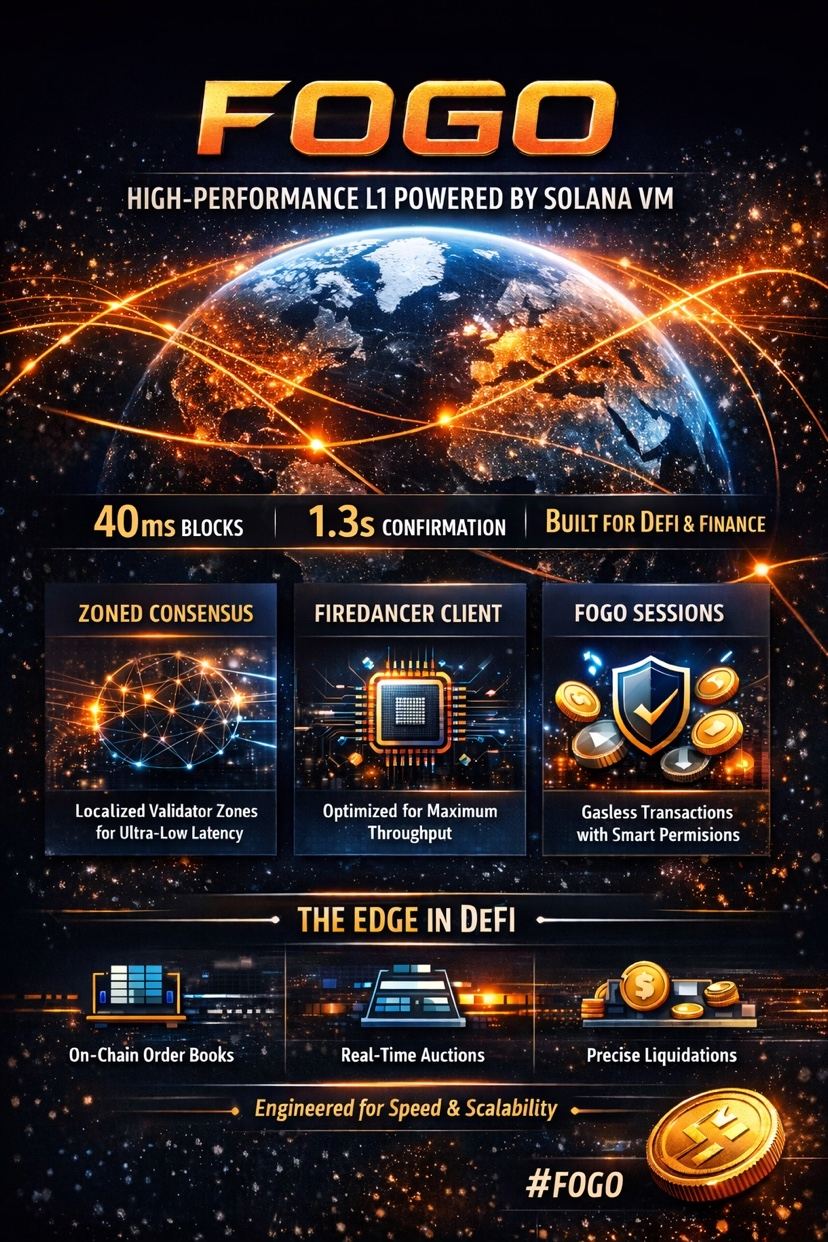
Fogo introduces a zone system where only one zone is active in consensus during an epoch, while other validators remain synced but don’t vote/produce blocks in that epoch. Why is that interesting?
Think of it like a relay race: instead of asking everyone globally to sprint at the same time, you choose the group that can coordinate the fastest right now, then rotate responsibility.
Two things happen:
Lower latency because consensus is happening among validators in closer network proximity.
Less tail risk because the “slowest outliers” in a globally scattered set don’t dominate the quorum path.
And importantly: zone configs include minimum stake thresholds, so a weak zone can’t become the active one.
3) Performance enforcement: a controversial idea… that finance actually needs
Most chains tolerate wide performance variance across clients/hardware. That’s great for diversity, but it also means the chain’s real-time behavior gets governed by the distribution of setups in the wild.
Fogo’s Thesis #2: a chain that requires high-performance validator implementations can be faster than one that doesn’t.
That’s why Fogo leans into a Firedancer-based client (Frankendancer today → full Firedancer trajectory). Their “tiles” design (pinned cores, tight loops, shared-memory queues, kernel-bypass networking like AF_XDP) is basically the opposite of “general-purpose software.” It’s closer to how low-latency trading systems are built: reduce jitter, reduce copies, reduce context switching.
This isn’t a marketing line this is how you keep 40ms blocks from collapsing into “sometimes fast” when load spikes.
4) Why this matters: DeFi that depends on time, not vibes
If your application’s edge is timing, then “average confirmation time” is not the metric you care about predictability.
Fogo’s target numbers (40ms blocks, ~1.3s confirmation) are exciting, but the more important part is what becomes possible when latency is treated as a first-class design constraint:
On-chain order books where updates feel real-time
Real-time auctions without waiting games
Precise liquidation timing (less chaos, tighter risk control)
Reduced MEV extraction (not magic just fewer latency gaps to exploit)
The ambition is simple: make on-chain execution feel less like “web3 patience training” and more like a modern financial system.
5) UX is also performance: Sessions is the quiet killer feature
Most DeFi UX friction comes from two things: repeated signatures and gas handling.
Fogo Sessions pushes toward a “Web2-smooth” flow: one scoped, time-limited permission that lets users interact without signing every step, plus optional fee sponsorship. The key is the protection model (domain binding, limits, expiry). It’s not “trust the app,” it’s “trust but verify, on-chain.”
If Fogo wants real adoption, this part matters as much as block time.
6) The honest risks (because professionalism > hype)
No chain gets a free pass:
Zoned consensus tradeoffs: rotation design + governance need to be resilient and transparent.
Performance enforcement: raises questions about validator accessibility and centralization pressure.
Adoption reality: compatibility with SVM helps, but ecosystems don’t migrate just because a chain is faster.
So the real question isn’t “Is it fast?”
It’s: Can Fogo keep it fast under stress, while still widening participation over time?
Takeaway
Fogo’s strongest narrative isn’t “we have 40ms blocks.”
It’s: we designed the base layer around physics and tail latency, then built UX primitives (Sessions) to make that speed usable.
That’s why I’m watching @Fogo Official closely. If DeFi is going to feel like real-time finance, it needs chains that treat latency as the base layer not an afterthought.