
Fogo is no longer trading on promises alone. The network is live, the token is liquid, and the market is reacting in real time. That shift from idea to operational infrastructure changes the tone of the conversation. Early enthusiasm fades, and what remains is a simple question: does this chain offer something developers and users genuinely need?
At the moment, fogo trades in the low two-cent range with daily volume moving through the tens of millions. Liquidity is clearly present. Traders are active. But the weekly chart tells a more cautious story. Short bursts of strength are followed by cooling phases, and momentum has not yet turned into sustained conviction. This pattern suggests the market is interested but still waiting for stronger proof of utility.
Technically, fogo positions itself as a high-performance Layer 1 built on the Solana Virtual Machine. That design choice is strategic. By aligning with SVM compatibility, fogo lowers the barrier for developers already comfortable with Solana’s tooling and architecture. Builders do not need to abandon familiar workflows or rewrite everything from scratch. In theory, that should accelerate adoption. In practice, adoption depends less on compatibility and more on opportunity. Developers migrate when there is a reason to.
The mainnet launch marked the real beginning of fogo’s accountability. Before launch, speed claims and throughput metrics lived mostly in documentation and test environments. After launch, the network’s behavior is measurable. Blocks are produced, transactions settle, validators earn, and the native token powers fees and staking. From this point forward, fogo is judged by performance under real conditions, not simulated ones.
One of fogo’s defining narratives is ultra-low latency and rapid finality. For performance-sensitive environments such as on-chain trading, decentralized exchanges, and order book infrastructure, responsiveness matters. Traders operating at scale care about milliseconds. fogo leans into this identity deliberately. It does not present itself as a general-purpose chain trying to do everything. It focuses on becoming infrastructure that feels closer to traditional financial systems in execution speed.
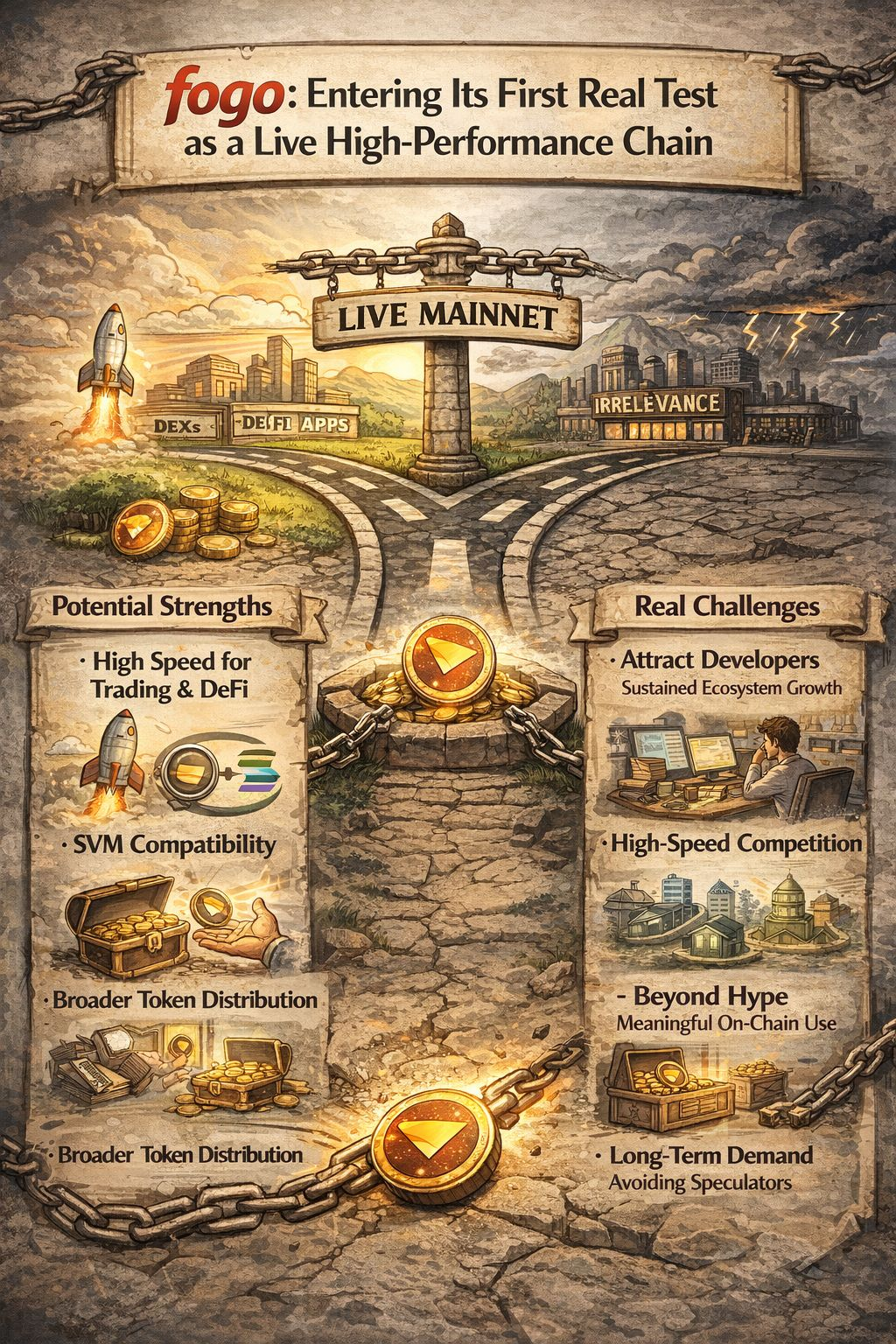
However, performance alone does not build ecosystems. Many chains advertise impressive throughput. What separates sustainable networks from short-lived experiments is whether applications emerge that truly depend on that performance. fogo’s future depends on whether trading protocols, DeFi platforms, and real-time financial applications choose it as their home base rather than as an experimental deployment.
Exchange listings and liquidity support have given fogo visibility. Spot markets are active, and derivatives markets add depth. This creates opportunity for broader participation and ensures the token remains in circulation. Yet exchange liquidity, while important, does not equal network usage. The more meaningful signal will be growth in on-chain transaction volume tied to actual application activity.
Another distinctive early decision was fogo’s shift away from a traditional presale model toward broader token distribution. By canceling a large presale and emphasizing community allocation, the project signaled an intent to avoid heavy concentration of early investor control. That approach carries tradeoffs. It may strengthen community alignment, but it also removes the cushion of concentrated capital that often fuels aggressive early ecosystem expansion. Over time, this distribution strategy could shape governance and long-term decentralization.
Market structure around fogo reflects a network still in transition. Market capitalization sits in the mid-tier range for Layer 1 assets, neither obscure nor dominant. Daily trading activity shows consistent engagement but also volatility. Price sensitivity remains high, which indicates speculative participation is still significant. This is typical for a network in its first operational cycle.
The competitive environment is intense. Multiple high-performance chains are fighting for the same segment of developers and liquidity. Speed has become a baseline expectation rather than a differentiator. For fogo to stand out, it must demonstrate advantages beyond raw throughput. That could include specialized tooling for order books, deeper integrations with trading infrastructure, or a developer experience that simplifies building performance-heavy applications.
Token economics will also influence fogo’s trajectory. The native token underpins transaction fees, validator incentives, and staking mechanisms. If on-chain activity increases, token demand grows organically. If usage stagnates, price movements become dominated by speculation and sentiment. fogo is approaching the stage where sustainable growth in application activity will matter more than promotional narratives.
The metrics worth watching are structural rather than emotional. Are developers deploying meaningful applications? Is daily transaction volume rising because of real user demand rather than short-term farming? Are liquidity providers committing long term capital to protocols built on fogo? These indicators will define whether the chain matures into specialized infrastructure or remains in experimental territory.
At present, fogo stands at an inflection point. It has a technically credible foundation and compatibility that lowers entry barriers. It has enough liquidity to remain relevant in trading conversations. But it operates in a landscape where speed is common and differentiation is hard earned. Execution quality, ecosystem depth, and developer retention will decide its next chapter.
Infrastructure is ultimately judged by repetition and reliance. Systems that work attract repeat usage. fogo has proven it can launch and operate. The coming months will reveal whether participants return because they need what it offers, or because volatility temporarily attracts them. That distinction will shape its long-term narrative far more than any single day’s price action.
