I have been thinking deeply about AI agents and where they actually break in the real world. Everyone talks about autonomy, reasoning, automation, and multi agent systems. Very few people talk about the real bottleneck that quietly limits everything.
Memory.
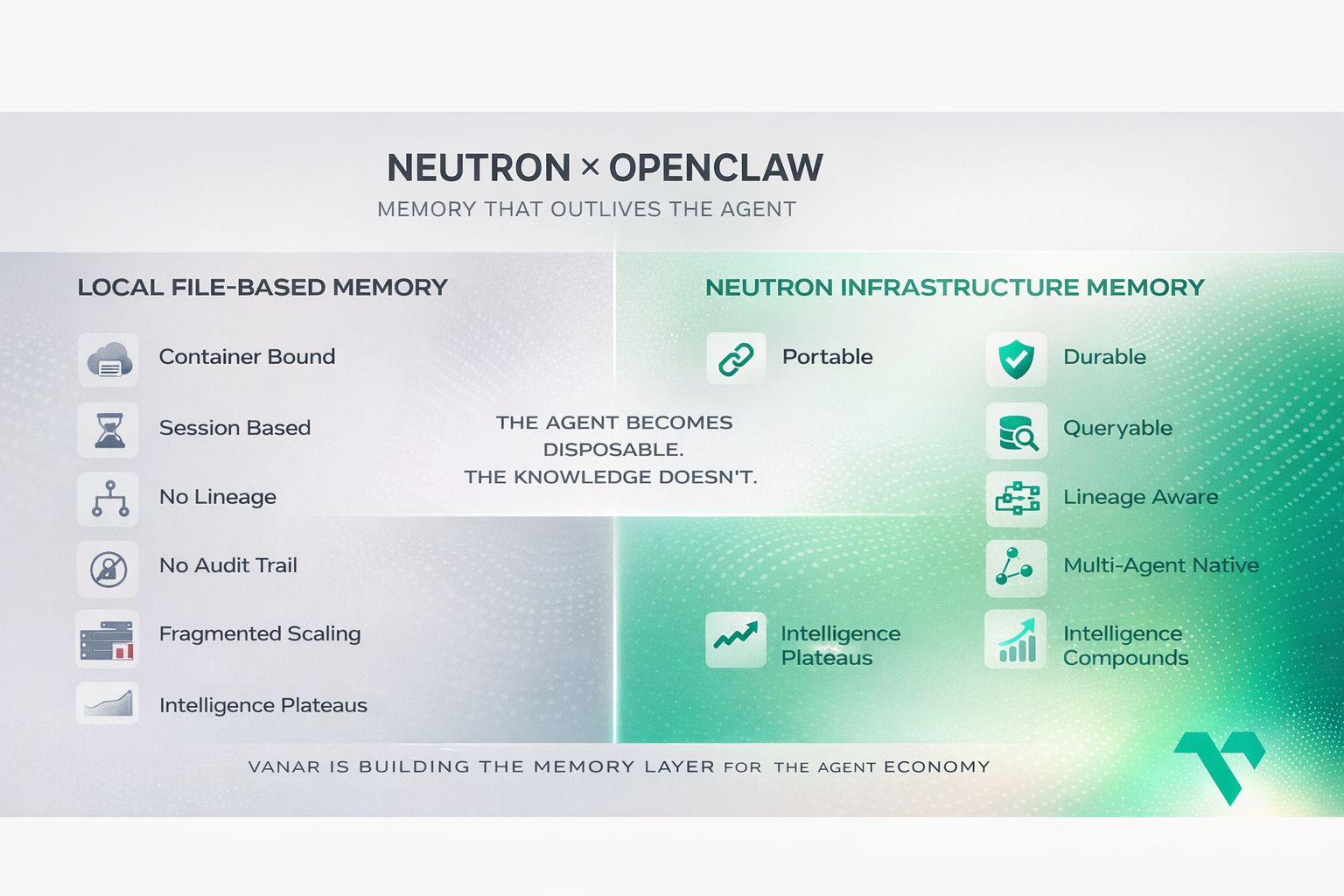
When we look at OpenClaw agents today, they are powerful. They can reason, execute workflows, connect to APIs, process onchain data, and coordinate actions. But behind all that intelligence is something fragile. Most agents rely on local, file based, or session based memory. That means their knowledge is tied to a container, a server instance, or a runtime environment.
As long as the agent stays alive in that environment, everything looks fine. But once the container resets, the infrastructure scales, or the process restarts, that memory becomes unstable, fragmented, or lost.
This is where agents hit a ceiling.
Local memory works for small experiments. It works when one agent runs on one machine for a short time. But when you introduce real world complexity such as multiple agents, enterprise workflows, financial applications, regulatory audit requirements, or cross region deployment, file based memory collapses under scale.
You start seeing state inconsistencies. Agents forget context. Knowledge fragments across instances. There is no cryptographic integrity. There is no lineage tracking. Intelligence becomes temporary instead of cumulative.
That ceiling is exactly what Neutron from Vanar Chain is designed to break.
Neutron changes the economics of AI agents by transforming memory from a local utility into infrastructure. Instead of storing context in a file on a machine, OpenClaw agents can anchor memory into a persistent, structured, queryable layer. Memory becomes portable, durable, verifiable, and lineage aware.
This sounds technical, but the impact is simple.
The agent becomes disposable. The knowledge does not.
Imagine an OpenClaw agent running in one region building a complex risk model for DeFi exposure. Under traditional architecture, if that instance shuts down, scaling events occur, or infrastructure migrates, its intelligence is either trapped locally or lost. With Neutron, that knowledge is stored in a durable memory layer that can be reattached to any new instance.
You can terminate the agent.
You can upgrade the model.
You can migrate servers.
You can scale horizontally.
The memory reconnects.
That separation between execution and knowledge is a massive architectural shift. It means intelligence compounds independently of the runtime environment.
Memory is not just context. Memory is economic value.
If an agent learns optimal strategies, builds behavioral insights, optimizes game economies, or constructs compliance frameworks, that knowledge becomes intellectual capital. When memory is local, that capital is fragile. When memory is anchored to Neutron, it becomes durable digital property.
It can be versioned.
It can be verified.
It can be queried.
It can be audited.
And most importantly, it can survive upgrades and infrastructure failure.
Another powerful dimension is lineage awareness. In most AI systems, it is extremely difficult to answer where knowledge originated, how it evolved, or which model version generated a specific reasoning path. That creates compliance risks and limits enterprise adoption.
Neutron introduces structured memory that can track evolution and trace origin. That means decisions can be audited. Outputs can be explained. Knowledge history can be reconstructed. For enterprises and regulated environments, this is not optional. It is mandatory.
Vanar is not simply building a high performance chain for gaming or brands. It is quietly building AI native infrastructure that understands real world constraints.
Now think about multi agent collaboration. If you deploy ten OpenClaw agents working on a shared financial strategy or coordinating in a digital economy, local memory creates chaos. Synchronization issues emerge. Context drifts. Knowledge duplication occurs.
With Neutron acting as a shared backbone, agents write into and read from a unified, structured memory layer. Collaboration becomes persistent instead of temporary. Intelligence becomes collective rather than isolated.
This is where the deeper philosophy comes in.
In traditional systems, the server matters. The instance matters. The machine matters.
In an AI native architecture powered by Vanar, the agent becomes replaceable. The knowledge becomes sovereign.
You can swap infrastructure providers.
You can upgrade models.
You can optimize performance.
You can even redesign the agent architecture.
But the accumulated intelligence remains intact.
That unlocks faster innovation cycles because you are no longer afraid of losing context during iteration. It also creates a new kind of digital asset class. Structured, verifiable memory becomes something that can underpin AI driven businesses, onchain games, digital identities, and automated commerce systems.
When Vanar talks about enabling real world adoption, this is what that looks like in practice. If AI agents are going to power gaming economies, brand engagement systems, decentralized finance tools, or consumer applications, their memory must scale with users. It cannot live in a local folder. It must live in infrastructure.
Neutron is that infrastructure.
We have moved from tokens to DeFi to NFTs to gaming. The next wave is AI native Web3. But AI native systems require persistent state, portable intelligence, verifiable context, and composable memory. Without that, agents remain impressive demos instead of scalable economic actors.
Neutron × OpenClaw represents one of the clearest examples of solving this properly at the foundational layer. Not as a marketing narrative. Not as a surface integration. But as an architectural decision that redefines how intelligence compounds.
The most powerful line in all of this is simple.
The agent becomes disposable. The knowledge does not.
And in a world where AI agents will manage capital, communities, brands, and digital economies, that difference changes everything.
Vanar is not just building another Layer 1.
It is building the memory layer for the agent economy.