


I first looked into Fogo, I tried to frame it like every other Layer-1: What’s the TPS? What’s the block time? How big is the validator set?
That was the wrong lens.
Fogo isn’t trying to win a spreadsheet comparison. It’s building around a constraint most chains quietly ignore — physical latency.
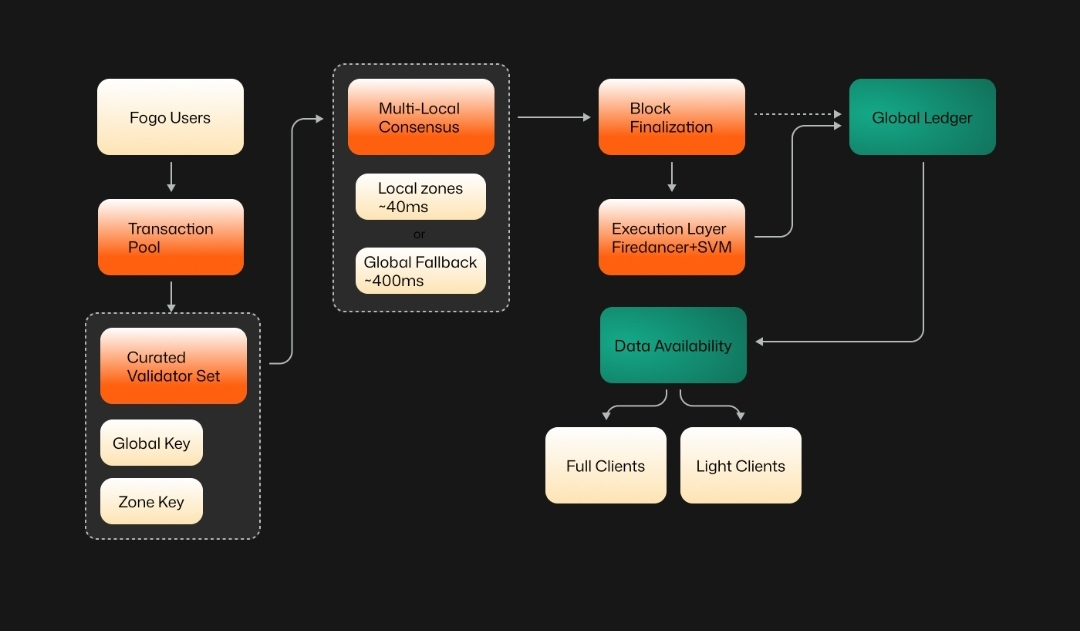
Fogo is a high-performance L1 that utilizes the Solana Virtual Machine (SVM). That choice alone is strategic. Instead of inventing a new execution environment, it adopts one developers already understand. Tooling, smart contract patterns, and ecosystem familiarity come pre-packaged.
But the differentiation isn’t execution.
It’s consensus design.
Where Most Chains Compromise
Global validator distribution sounds ideal in theory. In practice, it embeds unavoidable delay into the system. Light traveling through fiber has limits. If validators are scattered across continents, coordination time expands. Under load, that variance becomes visible.
Fogo doesn’t pretend geography doesn’t matter.
Its Multi-Local Consensus model narrows validator coordination into optimized zones. Validators are curated and co-located in performance-focused environments. The result is tighter communication loops and more deterministic block production.
This is not maximalist decentralization.
It’s performance-oriented architecture.
And that tradeoff is deliberate.
Because if your target user is latency-sensitive — derivatives markets, real-time auctions, on-chain structured products — consistency matters more than ideological symmetry.

SVM Compatibility Without Congestion Inheritance
One of the more underappreciated aspects is that Fogo runs the Solana Virtual Machine independently.
Same programming environment.
Separate network.
Separate state.
If congestion hits Solana, Fogo doesn’t automatically inherit that pressure. Developers can port SVM-native contracts and tooling without importing external bottlenecks.
That separation reduces friction while preserving autonomy.
It’s a quiet but powerful positioning move.
The main Question
The conversation shouldn’t be “Is 40ms impressive?”
The real question is: Who is this infrastructure for?
Retail speculation doesn’t require micro-deterministic finality. Institutional liquidity and market-structure products do.
Fogo feels like infrastructure built for a version of DeFi that behaves more like capital markets than meme cycles.
And that version of DeFi may or may not arrive at scale. That’s the bet.
But I respect this: Fogo isn’t pretending the world is smaller than it is. It’s designing around the speed information can actually move.
In a space full of theoretical decentralization debates, that kind of realism stands out.