


6:58am. BTC is down another 2% and volatility is accelerating rather than stabilizing. On most chains that would mean waiting through a few blocks of repricing. On FOGO, three minutes isn’t drift — it’s 4,500 slots of state change.
Her session is still active.
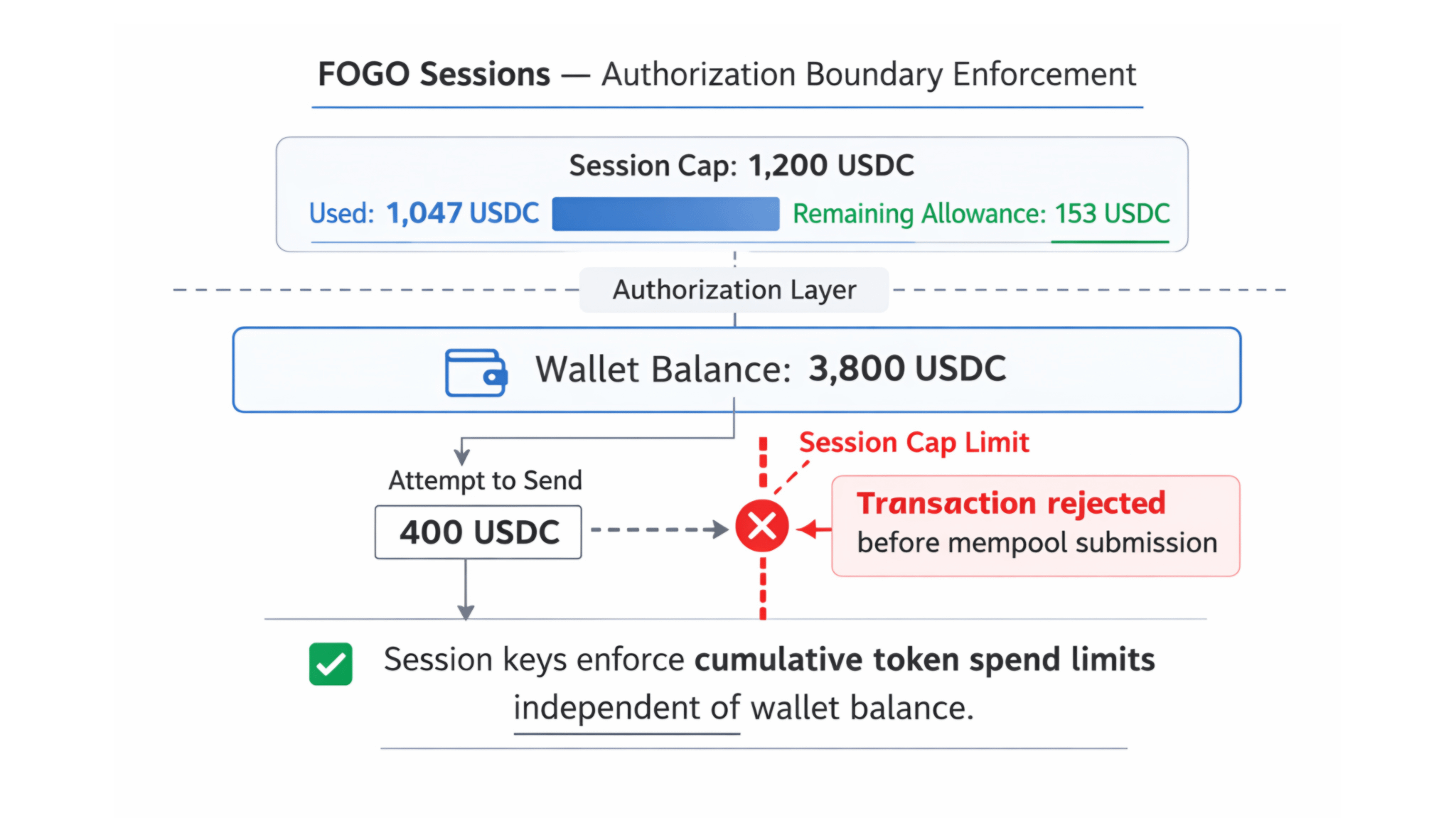
Cap: 1,200 USDC.
Used: 1,047.
Remaining allowance: 153.
She signed that authorization 46 minutes earlier when conditions were calmer. At the time, 1,200 felt like a comfortable boundary: enough to rotate size aggressively, small enough to limit risk if something went wrong with the DEX or the session key.
The first liquidation prints cleanly. The oracle flips underwater. Firedancer’s liquidation logic reads Pyth Lazer at slot cadence, and by Slot N+1 the collateral has already moved. That opportunity is gone.
But cascades don’t happen once. They stack.
A second position approaches threshold. Larger notional. Cleaner collateral. The spread is wide enough to justify size. She needs 400 USDC to execute the arb cleanly and absorb slippage.
She enters 400.
The interface blocks the trade.
Not a balance issue. She has over 3,800 USDC sitting in her wallet. Not a gas issue. The paymaster is still covering fees. The problem is the session cap.
The session key executing her trades does not see her wallet balance. It sees a pre-signed policy: up to 1,200 USDC for this DEX, for one hour.
1,047 already used.
400 requested.
The arithmetic exceeds the boundary.
The transaction never leaves the authorization layer.
She has two options: resize the trade to fit inside the remaining 153 USDC, or terminate the session and create a new one with a higher cap. Resizing means smaller profit and potentially losing queue position to bots operating at full size. Renewing the session requires a fresh wallet signature.
She chooses to renew.
Wallet opens. FaceID. Confirm. Cap set to 3,000 USDC. Sign.
The process takes 22 seconds.
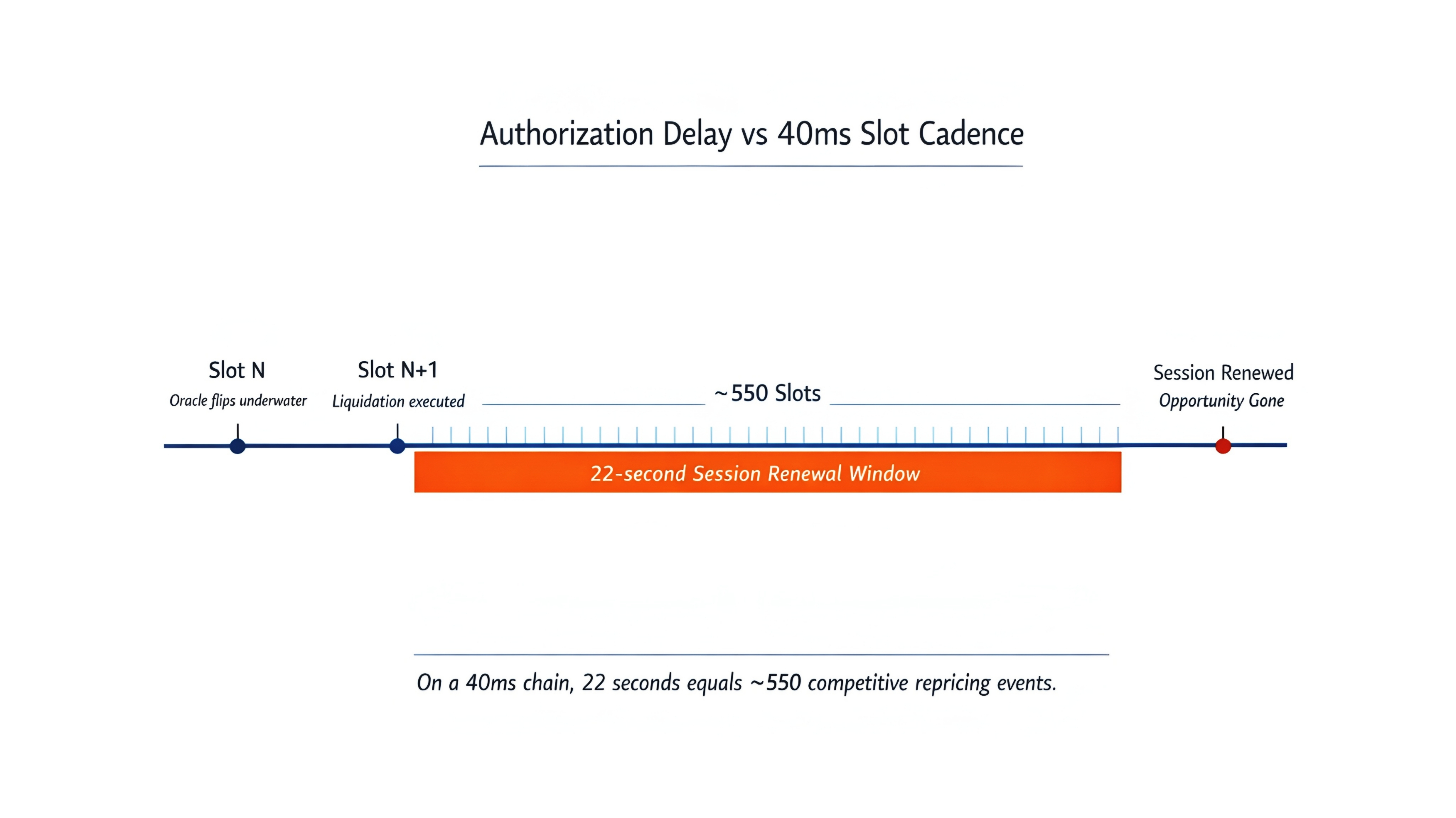
On FOGO’s 40ms cadence, that is roughly 550 slots.
By the time the new session key becomes active, the second liquidation has already cleared. The profitable window existed, but only inside a velocity she temporarily didn’t have permission to deploy.
She checks the delta after the cascade settles.
Primary missed arb: ~0.28 SOL.
Secondary partial missed during repricing: ~0.11 SOL.
Total opportunity cost: approximately 0.39 SOL in under a minute.
Nothing malfunctioned. The DEX was responsive. Firedancer continued producing clean 40ms slots. The liquidation engine executed deterministically at slot cadence. The session key enforced its boundary exactly as designed.
The system worked.
Her configuration did not.
That’s the subtle shift Sessions introduce on a chain this fast.
Spending caps are usually described as risk controls. They limit exposure if a key is compromised. They prevent runaway automation. They create bounded delegation at the token interaction layer while leaving staking, governance, and validator operations untouched.
All of that is true.
But on a 40ms chain, caps do something else.
They define capital velocity inside a volatility window.
On slower block times, renewing a session might cost one or two blocks. On FOGO, 22 seconds is 550 competitive repricing events. During liquidation cascades, 550 slots is the difference between early and irrelevant.
The cap did not protect her from loss.
It protected her from overexposure while simultaneously throttling deployable size at the exact moment size mattered most.
After the session renewal, she continues trading without interruption. The new 3,000 USDC boundary absorbs subsequent volatility cleanly. But the earlier opportunity does not return.
That’s when the calibration changes.
Session sizing stops being a comfort decision based on average flow. It becomes a volatility model. Too low, and you artificially constrain reaction velocity during cascades. Too high, and you widen the blast radius if the delegated surface fails.
On FOGO, speed isn’t only about execution.
It’s about authorization bandwidth.
Every boundary you set costs slots if you need to cross it mid-event. And slots, on a 40ms chain, are competitive units of time.
The liquidation didn’t beat her.
The cap did.
And the cap was working exactly as designed.