
Before speed becomes a user experience, it becomes a design constraint. On most blockchains, performance problems can hide behind vague bottlenecks: “the chain is congested,” “fees are high,” or “the network is slow today.” On Fogo, that ambiguity largely disappears.
Fogo shifts responsibility upstream. When execution is genuinely fast, architecture becomes the deciding factor. The question is no longer whether the chain can process transactions quickly, but whether applications are designed in a way that allows that speed to exist at all.
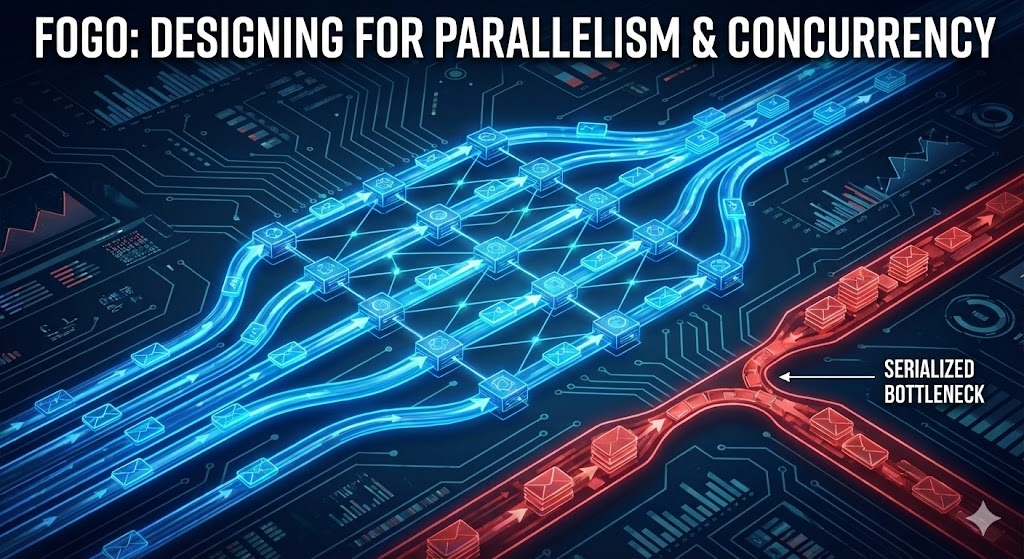
Parallel Execution Is a Design Filter
Fogo is built on an execution model where transactions are only parallel if they do not conflict over writable state. This sounds simple, but it has a sharp consequence: state layout becomes a concurrency policy.
Every writable account implicitly defines who must wait for whom. When too many actions touch the same state, parallelism collapses—not because the runtime failed, but because the application created its own bottleneck.
On Fogo, this effect is immediate. Applications that aggressively separate user state and localize shared components continue to scale smoothly. Applications that rely on centralized mutable objects experience contention long before the chain itself is under stress.
This is not a theoretical distinction. It is a practical one that shows up the moment real users arrive.
Why “Global Convenience” Becomes a Hidden Throttle
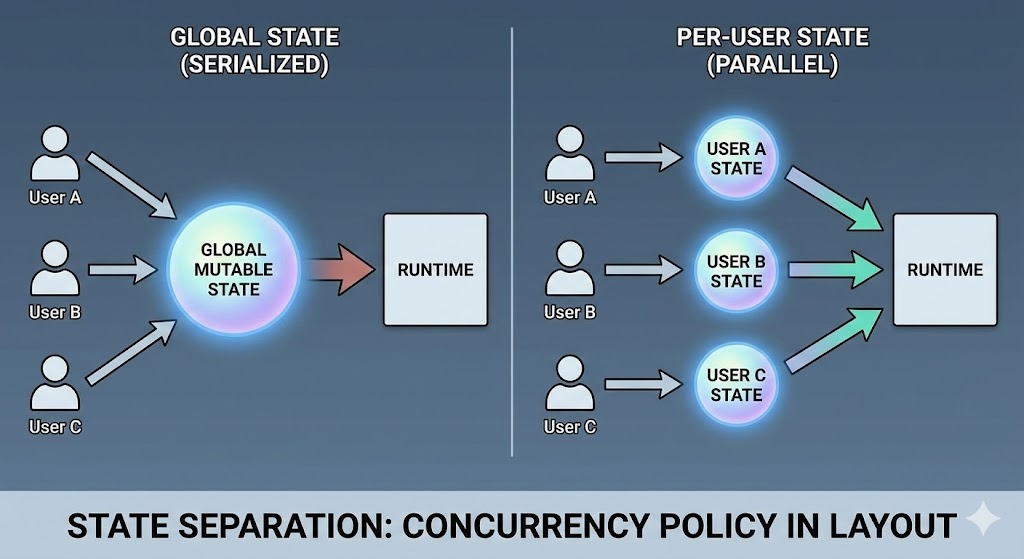
Many developers carry habits from sequential systems. A single global object feels safe. It simplifies analytics, centralizes logic, and creates a clean mental model. But on a parallel runtime, that convenience becomes expensive.
Global counters, shared protocol state, universal trackers—when these are written to on every interaction, they silently serialize execution. Independent user actions become dependent. The chain may be capable of parallel work, but the application has already forced everything into one lane.
Fogo does not prevent developers from doing this. It simply makes the cost impossible to ignore.
Performance Moves From Runtime to Layout
One of the most important mental shifts on Fogo is that performance no longer lives at the chain layer alone. It emerges from how state is partitioned.
Successful designs tend to follow the same pattern:
User actions primarily touch user-specific state
Shared state is minimized and deliberately scoped
Reporting and analytics data are decoupled from critical execution paths
This separation allows the runtime to schedule independent work confidently. When unrelated users no longer collide on writes, throughput becomes real rather than theoretical.
Trading Systems Reveal the Truth Fastest
Nowhere is this more visible than in trading-style applications. Trading concentrates activity, and concentration amplifies contention. If every trade mutates the same central object, the system will serialize under load regardless of block speed.
Fogo forces builders into harder, but better designs: narrower hot paths, partitioned markets, and localized settlement logic. These decisions are not optional optimizations—they are prerequisites for maintaining execution quality when volume increases.
The result is a clearer relationship between architecture and outcome. Speed is no longer promised; it is earned.
An Honest Constraint, Not a Hidden One
Fogo’s approach does come with trade-offs. Optimizing for execution quality requires stricter discipline in how systems are built and tested. Developers manage more state objects, reason about more interactions, and accept that concurrency is a real engineering problem, not an abstraction.
But this constraint is honest. Instead of masking architectural shortcuts, Fogo exposes them. Instead of attributing failures to the network, it points back to design choices.
Final Thoughts
Fogo does not make applications fast by default. It makes performance unavoidable as a design concern. In doing so, it changes the conversation from “how fast is the chain” to “how well is the system built.”
For builders willing to engage with that question, Fogo offers a runtime that rewards clarity, discipline, and intentional state design. For everyone else, it acts as a mirror—showing exactly where parallel execution quietly disappears.
Disclaimer: This article reflects personal analysis and is not financial advice. Always do your own research.