


I spent three days reading through Fogo’s documentation trying to figure out what they’re actually doing differently. Not the marketing site. The technical specs, the validator requirements, the zone rotation mechanics. And honestly, what struck me wasn’t what they’re promising. It’s what they’re refusing to promise.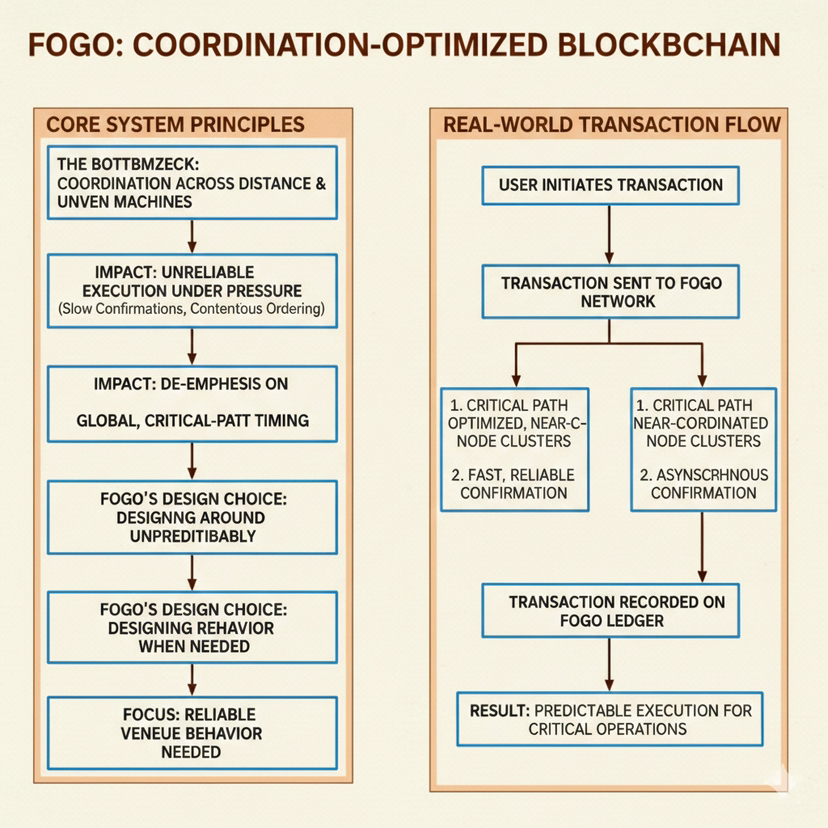
The Question Nobody Else Asks
Most blockchain projects I cover start with the same pitch. Faster transactions, lower fees, better decentralization. Pick your combination and add some buzzwords. Fogo’s entire approach starts somewhere else entirely.
They’re asking why blockchains fall apart exactly when you need them most. Not why they’re occasionally slow. Why they become completely unreliable the second real pressure hits. Why confirmation times suddenly stretch when volume spikes. Why ordering becomes a mess when everyone’s trying to execute at once.
I’ve watched this happen enough times to know it’s the right question. You don’t care that a blockchain does 50,000 transactions per second in a demo. You care whether it still works when everyone’s panic-selling at 2am on a Sunday.
Physics Doesn’t Negotiate
Here’s where Fogo’s design starts making sense, even if you don’t like the trade-offs. They looked at the fundamental coordination problem and decided most chains are lying to themselves about it.
You’ve got validators scattered across continents. Different hardware, different network conditions, different maintenance schedules. The slowest validator in your consensus quorum sets the pace for everyone else. That’s just physics. You can’t make light travel faster between Tokyo and New York.
So Fogo made a choice that makes people uncomfortable. Only one geographic zone participates in consensus during each epoch. The rest stay synchronized but don’t vote on blocks. They rotate which zone is active so no single region controls the chain permanently.
I talked to one of their architects about this. He said something that stuck with me: “We can’t make the planet smaller, but we can make the critical path smaller at any given moment.”
The Rotation Problem
That rotation piece is where things get interesting. Because the obvious criticism is: okay, so you’re just centralizing consensus and calling it innovation.
But watch how the rotation actually works. Zones switch based on epoch timing or time-of-day patterns. The system is still globally distributed. It’s just distributed across time instead of demanding global participation in every single block.
Whether you think that’s acceptable depends entirely on what you think blockchains are for. If you believe every transaction must be validated by nodes in every timezone simultaneously, this won’t work for you. If you think reliable execution under pressure matters more than symbolic global participation in every block, suddenly the trade-off looks different.
I’m not saying one view is right. I’m saying Fogo picked a side and designed accordingly instead of pretending there’s no trade-off.
Performance as a Requirement
Here’s where Fogo gets really opinionated. They don’t want an environment where ten different validator clients limp along at different speeds and everyone just tolerates it.
They’re pushing hard toward a canonical high-performance client. Firedancer is the destination. Frankendancer is the bridge getting there. They talk explicitly about architectural choices like pipeline tiles pinned to CPU cores to reduce jitter.
That’s venue thinking, not blockchain thinking. Traditional exchanges don’t let slow infrastructure drag down everyone’s execution. Fogo is applying the same logic.
The problem? Single client dominance reduces variance but increases systemic risk. One bad bug hits everyone. So the bet becomes: can operational discipline substitute for client diversity?
I asked a trader I know who’s been testing Fogo what he thought. He said: “I don’t care about client diversity when I’m trying to close a position. I care whether my transaction gets confirmed or not.”
Fair enough. But that systemic risk is still real.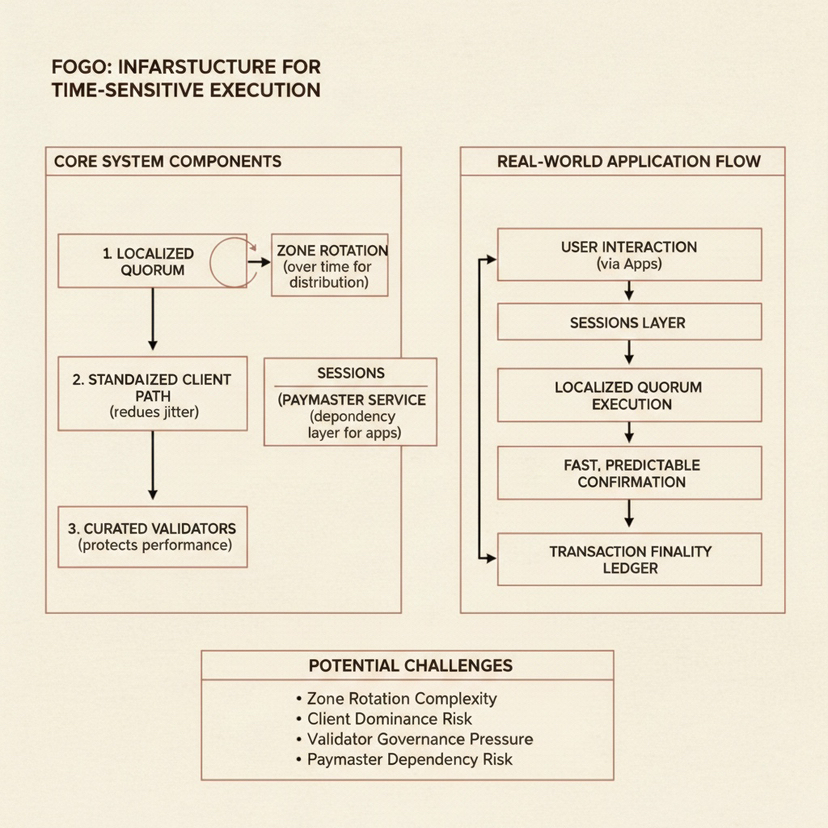
The Validator Curation Problem
This is where Fogo’s approach gets politically messy. They’re explicit about it: underperforming validators can sabotage network performance for everyone, so participation needs standards.
In traditional markets, this isn’t controversial. Venues have membership requirements because execution quality is the product. In crypto culture, this violates a core principle. Permissionless participation is supposed to be the point.
Fogo is saying permissionless participation is NOT the point if your goal is reliable real-time financial infrastructure.
I spent a week thinking about this tension. And here’s what worries me: governance becomes the attack surface. Once you curate who can validate, you create a capture vector. Politics, favoritism, informal cartels. It can all drift in if the rules aren’t transparent and consistently enforced.
The only way this works long-term is if removal criteria are clear and the project is willing to enforce them even when it’s unpopular. Markets price uncertainty instantly. If the rules change when it matters, traders notice.
What Real-Time Actually Means
Fogo gets attention for talking about very short block times. But I think people are focused on the wrong metric.
The problem with on-chain trading isn’t that blocks are 400 milliseconds instead of 40 milliseconds. It’s that users can’t trust how the chain behaves during stress.
I’ve talked to enough traders to know: reliability is a distribution problem, not an average problem. Nobody cares that you’re fast when nothing is happening. They care whether you stay stable when everyone’s trying to execute at once.
That’s why Fogo keeps obsessing over tail latency and variance. They’re trying to compress uncertainty, not win a speed trophy.
Sessions and the Smoothness Trade-off
Fogo Sessions is their attempt to fix the constant friction of blockchain interaction. Scoped permissions, paymasters handling fees, no pop-up for every action.
I tested this for a few days managing some test positions. And yeah, it’s noticeably smoother. You’re not performing a ritual every time you want to do something.
But here’s the part that makes me nervous. Paymasters are centralized today. They have policies, risk limits, business models. The smoothest path through Fogo might be mediated by actors with their own incentives.
That’s not automatically bad. Traditional finance runs on intermediated rails all the time. But it is part of the trust model, and people should think about it that way instead of treating it like pure UX improvement.
Token Distribution and Real Float
One thing I appreciated: Fogo has been specific about token allocations and unlock schedules. Part of the community distribution is fully unlocked at genesis.
This creates immediate selling pressure. I watched the price action in the first weeks and it was rough. But here’s why I think it matters: you avoid the fake float problem where price discovery happens on tiny circulation while massive overhang sits locked up.
If you want serious market participants to treat your asset like an instrument instead of a narrative, you usually have to accept uncomfortable price action early. It’s not pretty but it’s cleaner.
Where This Actually Gets Tested
So here’s how I’m thinking about whether Fogo’s thesis actually works. Forget the marketing metrics. Watch what happens during volatility.
Does confirmation timing stay steady when it’s noisy? Do applications that care about execution quality choose to build there because users can actually feel the difference? Does governance stay consistent when enforcement is unpopular?
And most importantly: do the smooth rails around Sessions become more open and competitive over time, or do they concentrate into a small set of gatekeepers?
Those questions determine whether Fogo becomes real infrastructure people rely on, or just another fast chain that looked impressive until the day it had to handle pressure.
The Fragility Question
When I look at the full design, I see coherence. Localize the quorum for speed. Rotate it for distribution. Standardize the client to reduce jitter. Curate validators to protect performance. Smooth interaction with Sessions so applications feel like products.
But coherence can also mean fragility if one piece doesn’t mature fast enough. Zone rotation adds operational complexity. Single-client dominance increases exposure. Validator curation becomes a governance pressure point. Paymasters introduce dependencies.
None of these are fatal individually. But they’re the exact places where this design either proves itself or gets exposed.
I’m watching. Not with pure optimism or pure skepticism. Just watching to see if the trade-offs they chose actually deliver what they’re designed to deliver when it counts.