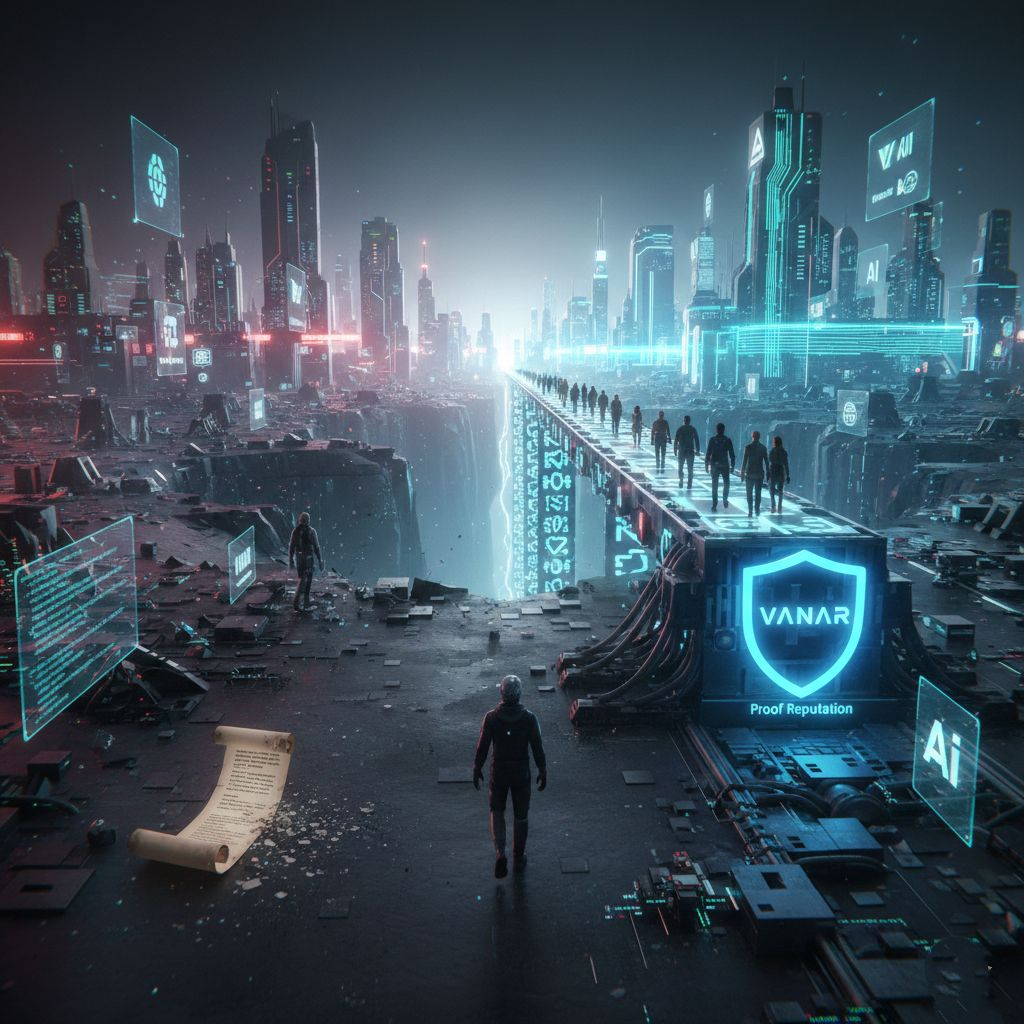
We don’t like admitting that.
We prefer to argue about throughput and fees and how many transactions per second something can handle. We debate decentralization as if it’s a badge you either wear proudly or not at all. We talk about ownership like it’s already solved.
But the uncomfortable truth is simpler.
A lot of Web3 infrastructure just doesn’t feel reliable.
Not in the boring, everyday sense. Not in the way the internet feels reliable. Not in the way banking apps, cloud storage, or even online games feel reliable. Those systems aren’t perfect. They fail too. But they rarely disappear. They rarely leave users stranded with no recourse and no explanation.
In Web3, things quietly break. Projects shut down. NFTs lose their metadata because a server went offline. Games launch with promise and then stall because the underlying infrastructure can’t handle real traffic. DAOs vote on proposals that never fully execute because the tooling around them is fragile.
We don’t talk about this enough.
The industry talks big. Decentralization. Ownership. Innovation. The next billion users. We’ve heard it all. We’ve repeated it. But if we’re honest, many of the systems we built were optimized for experimentation, not durability.
And that’s starting to show.
We’ve seen bridges collapse. We’ve seen networks halt. We’ve seen NFT platforms where the token lives on-chain but the actual content sits somewhere far less permanent. We’ve seen games promise persistent worlds, only for assets to become unusable when the backend logic fails or funding dries up.
It’s not always dramatic. Often it’s quiet. A Discord goes inactive. A roadmap stops updating. A dApp still technically works, but no one maintains it anymore.
And the users? They just move on.
The common response has been to add more layers. More middleware. More dashboards. More abstracted wallets. More “solutions.” But many of these fixes feel incomplete. They patch over symptoms without addressing the underlying issue: infrastructure that wasn’t designed from the beginning for real-world reliability.
We’ve relied heavily on trust. Trust that teams will maintain servers. Trust that token incentives will keep validators aligned forever. Trust that “decentralized enough” is good enough.
Sometimes it is. Often it isn’t.
If Web3 is going to support games, brands, entertainment platforms, AI integrations, and large communities, the base layer can’t behave like a weekend experiment. It has to behave like infrastructure.
That’s where projects like Vanar Chain become interesting. Not because they promise to change everything. Not because they market themselves as revolutionary. But because they seem to start from a different assumption.
Vanar is an L1 blockchain designed from the ground up to make sense for real-world adoption. That phrase gets used loosely in this space, but here it points to something specific: infrastructure built with the expectation that mainstream users will interact with it, not just crypto-native early adopters.
The team behind Vanar has experience working with games, entertainment, and brands. That matters. These industries don’t tolerate unreliable backends. A game that crashes constantly loses players. A brand that experiments with NFTs and sees them break won’t come back. Entertainment platforms need stability more than ideology.
Vanar incorporates products across gaming, metaverse, AI, eco, and brand solutions. Virtua Metaverse and the VGN games network are part of that ecosystem. The VANRY token powers the network. But the more important piece isn’t the token. It’s the underlying mechanics.
Reliability is boring. It’s validators that stay online. It’s predictable costs. It’s infrastructure that doesn’t require users to understand private key management just to participate in a branded experience. It’s accountability built into how the network operates.
Incentives matter here. Not in the abstract sense of “token rewards,” but in the practical sense of aligning validators, developers, and users around long-term function. A chain that wants to host games and brand ecosystems can’t afford to treat uptime as optional.
Consequences matter too. When infrastructure fails, there should be clear mechanisms for recovery, governance, and improvement. Too many Web3 systems treat failure as an unavoidable side effect of innovation. That might be acceptable in early experiments. It’s not acceptable when real users are involved.
For NFTs, this layer matters more than we admit. Ownership isn’t meaningful if the underlying chain becomes unstable or economically unsustainable. For DAOs, governance only works if proposals actually execute reliably. For games, asset ownership is meaningless if gameplay logic or network performance can’t support real usage.
The base layer sets the tone.
We often chase novelty. New token models. New staking mechanics. New “social” primitives. But long-term Web3 use will depend less on novelty and more on durability.
Vanar doesn’t present itself as a hero in a broken system. At least, not if you look closely. It looks more like a serious attempt to build infrastructure that doesn’t collapse under mainstream pressure. An attempt to bridge the gap between crypto experimentation and real-world expectations.
That’s a quieter ambition. It’s less exciting. It doesn’t generate headlines.
But it might be what we actually need.
If the next phase of Web3 is going to include brands, gamers, creators, and non-technical users, we can’t keep pretending that decentralization alone is enough. We need systems that function predictably. We need accountability embedded in incentives. We need infrastructure that can survive beyond a single market cycle.
Web3 doesn’t need louder promises. It needs fewer fragile systems.
It needs chains that are designed with the assumption that people will rely on them, not just speculate on them.
Growing up as an industry probably means accepting that the hard work isn’t glamorous. It’s maintenance. It’s thoughtful design. It’s building networks that don’t just launch well, but operate well.
Reliability isn’t a headline feature. It’s the foundation.
And maybe that’s the part we should have focused on all along.