
I noted in previous writings about the Fogo chain that it is extraordinarily fast, and that its constant block time of 40ms is the backbone of real-time DeFi applications such as Valiant DEX. Although most of that speed is bought by the highly optimised Firedancer client, software tuning is just a partial solution. The other one is a basic physics restriction the speed of light.
Suppose that Fogo is actually decentralised, and validators are located all over the globe in Tokyo and London and New York, how are they going to agree on the state of the blockchain within 40ms? It takes a very long time compared to that of a data packet to travel half the world.
The Latency Trap
To get the solution of Fogo we must first have a clear definition of the problem first. A super majority of validators would need to agree about a block before this is finalised in a typical Byzantine Fault Tolerant (BFT) consensus.
Consider that the block leader is located in Singapore and he offers a new block. The proposal has to move through undersea fibre optic cables in order to get to other validators. A validator in Zurich may later get it 150ms, a validator in Sao Paulo 250ms later. They then need to approve the block and send their vote back to the leader.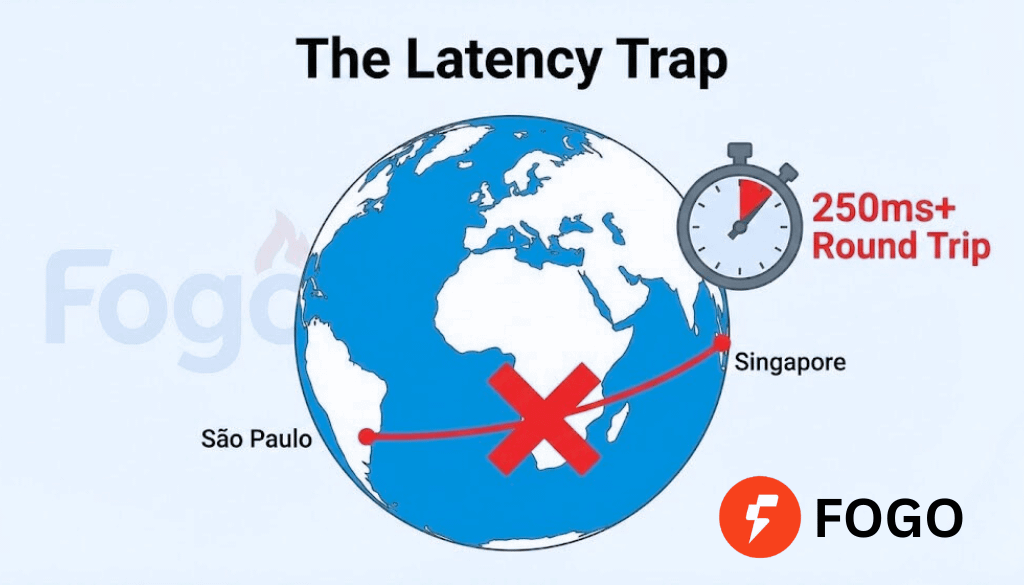
It is known as the Level of Geography Problem that restricts scalability of blockchain. Modifying it is tackled by most chains either by reducing the block time (into seconds, these can be spread globally and processed), or by increasing tight decentralisation (yes, they all need the same datacenter). Fogo refuses to compromise. Rather, it brought a breakthrough a Multi Local Consensus.
The round trip ping time that is the upper hard limit of speed in a network increases with the size of the network and becomes more and more physically dispersed. There is no use writing software that can help you get round the physical distance involved of data. That explains why a lot of high performance chains experience performance decline due to further decentralisation.
Enter Multi-Local Consensus
Fogo architects realised that physics is impossible to beat, and the validator organisation was therefore redesigned. Instead of on, huge and worldwide validator group attempting to accept everything at once, Fogo clusters of validators, such as an Asia Pacific cluster, a North American cluster, and an European cluster, etc.
Validators within one cluster are very close. The distance between a Tokyo node and a Seoul node takes a negligible amount of time fast enough to obtain a consensus within less than 40 0 ms.
Upon the initiation of a transaction by a user in Asia, it is redirected to an Asia Pacific cluster. That cluster can do what Fogo refer to as Local Finality almost immediately, by which the user can be deemed with the transaction complete. They are able to trade, supply liquidity or communicate with dApps in sub second responsiveness.
Asynchronous Global Sync
But how is this all the world concurring when various areas constitute their own blocks? It is the genius of the system.
Local clusters generate streams of local completed blocks. These streams are idly sent to the other parts of the global network. These last but not least local streams are given to a dedicated layer of the Fogo protocol, which stitches them together into one static world ledger.
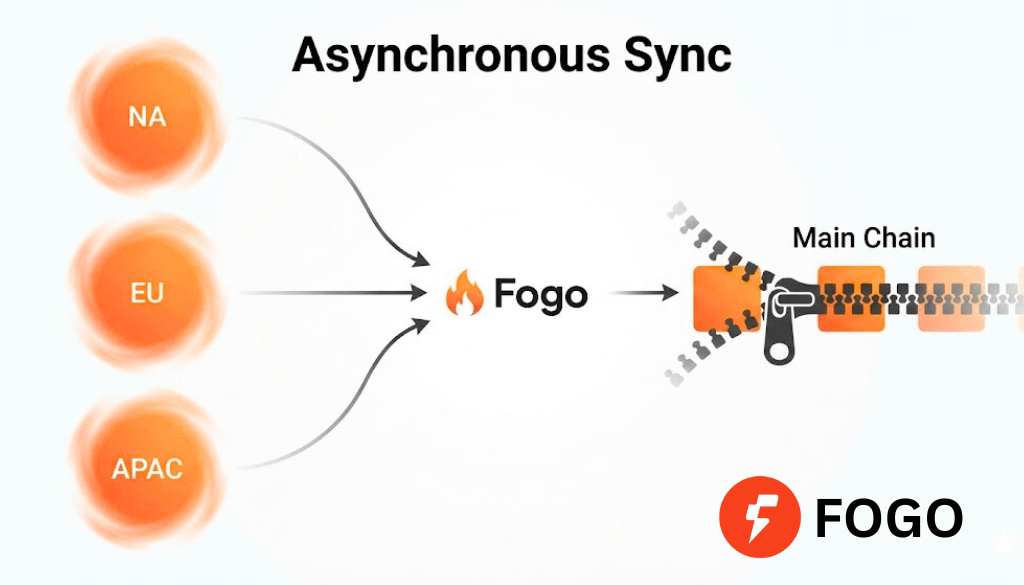
The global synchronisation can do with less bandwidth compared to traditional consensus since their corresponding local blocks are tested and ready, and finalised in their cluster. One does not need to reverify all the transactions, the sequence of pre verified blocks only needs to be specified.
This two level model separates the time within the transaction and global geographic limitations. The network retains the safety of global decentralisation but users are able to enjoy the speed of their local cluster.
The Real World Impact
To the end user and the developer, the intricacy of Multi local consensus can be entirely abstracted. They feel connected to the world of network which is extraordinarily fast regardless of the location they might be.
An HFT in London has a better 40 ms performance than a DeFi farmer in Singapore. Such levelling of the playing field is key to having a truly global financial system.
It also eliminates the centralization of validators incentive. In other high performance chains, validators are under contention to co locate in the same data centres in order to optimise the latency and this becomes a single point of failure. On Fogo, anywhere in the world, a validator can just be added to the closest regional cluster, enhancing network security without incurring performance cost.
Conclusion
Multi Local Consensus is not merely an ingenious device on the engineering side, but a realistic recognition of physical reality on the part of Fogo. Fogo has managed to resolve one of the most enduring blockchain architecture problems by acknowledging the speed of light constraints and working within them. It demonstrates that a distributed and decentralised network, spread all over the world, can be fast enough to support the needs of modern finance. The geography issue is been resolved.