
Vanar, or VANAR Chain, is not trying to look loud in a space that often rewards noise. What stands out when you spend time studying it is how much of its design is built around reducing friction rather than creating spectacle. It behaves more like infrastructure than a product. The kind of system that works best when nobody is talking about it.
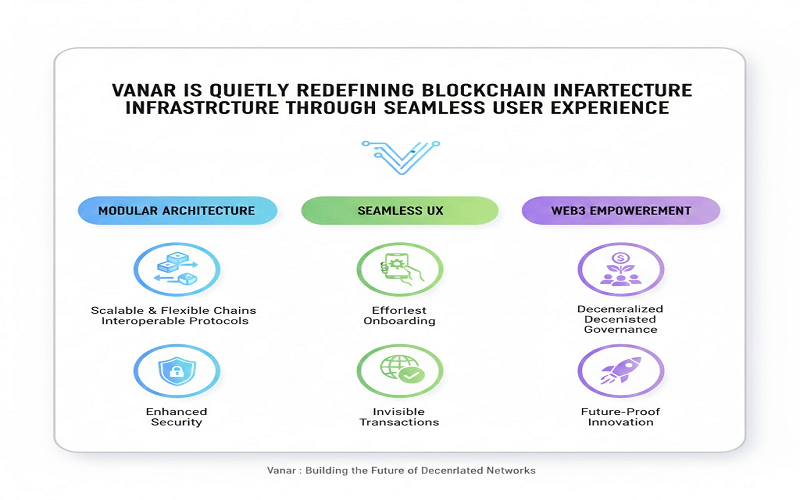
At its core, VANAR Chain focuses on making blockchain interaction feel invisible. That sounds simple, but it is not. Most blockchain platforms still expect users to understand wallets, gas mechanics, and transaction timing. For developers, the tooling can also be fragmented. Vanar approaches this differently. It tries to remove layers of visible complexity so that users interact with applications, not with the chain itself.
A useful way to think about it is like electricity in a building. People do not think about wiring when they turn on a light. They expect it to work. Vanar appears to be building toward that model for Web3 applications. The goal is not to make users aware of the blockchain. The goal is to make the blockchain fade into the background.
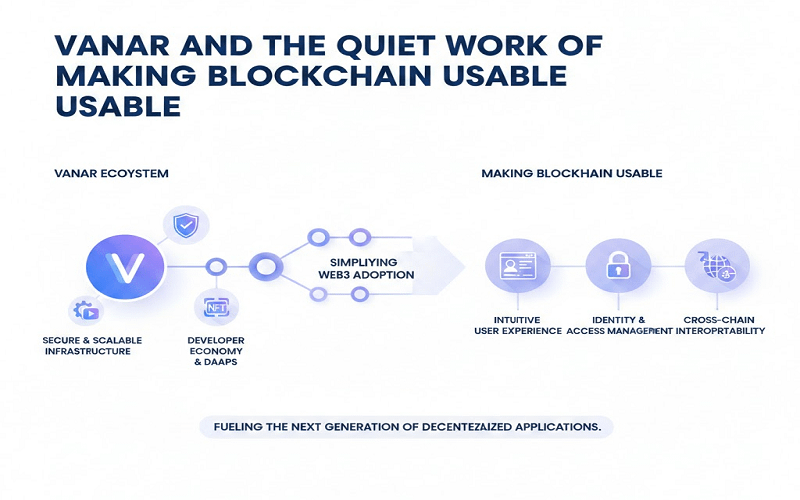
The token $VANRY functions as the economic layer of this system. It supports transactions, staking, and participation across the ecosystem. But unlike many projects where the token narrative dominates the conversation, here it feels more like a utility component. Infrastructure needs a fuel source. $VANRY plays that role.
This positioning matters. Many blockchain networks compete on speed or on bold claims of scalability. Vanar seems more concerned with user experience consistency. The difference is subtle but important. Speed can attract attention. Reliability and smooth onboarding tend to build long-term usage.
The official project account, @Vanarchain , often shares development updates and ecosystem highlights. What is noticeable is that the communication leans toward builders and integrations rather than hype cycles. That reinforces the sense that the chain is targeting real usage over short-term speculation.
The CreatorPad initiative, accessible through https://tinyurl.com/vanar-creatorpad, reflects this direction as well. Instead of focusing purely on token trading activity, the ecosystem is trying to encourage creation and deployment. When infrastructure projects support creators directly, it usually signals that they are thinking about application layers rather than price charts.
From a broader perspective, #Vanar and #vanar discussions often revolve around adoption pathways. The challenge for any infrastructure chain is simple to describe but hard to execute. Can developers build without friction? Can users interact without confusion? Can the system scale without degrading the experience?
There are also realistic limitations to consider. Competing with established Layer 1 and Layer 2 networks is not easy. Developer mindshare is limited. Liquidity concentration matters. Even a well-designed chain can struggle if ecosystem growth slows. Adoption requires both technical execution and sustained interest. Infrastructure only proves itself over time.
For those observing market structure around $VANRY, price levels should always be treated pragmatically. Based on typical volatility behavior seen in similar mid-cap infrastructure tokens, one might consider an Entry Point near strong historical support zones rather than chasing momentum. A Take Profit could be placed near prior resistance ranges where distribution previously occurred. A Stop Loss should sit below structural support to protect capital if the thesis weakens. These are risk management tools, not predictions.
In the end, what makes VANAR Chain interesting is not a headline feature. It is the quiet ambition to make blockchain less visible. If that vision holds, the most successful outcome would be one where users rely on the network without even realizing it is there.