
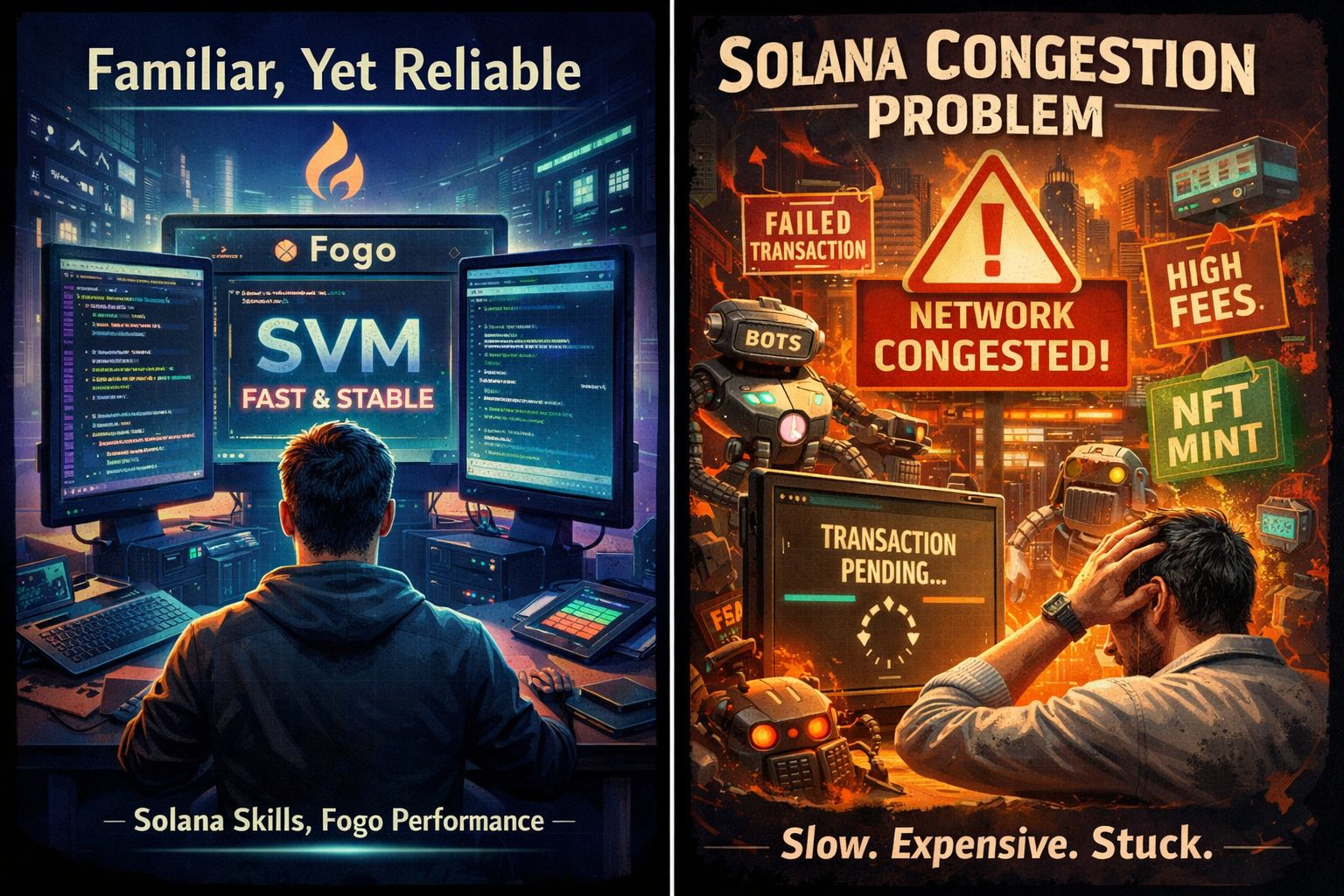
I almost scrolled past Fogo.
If you’ve been in crypto long enough, you know the feeling. Another week, another “revolutionary” Layer 1. Faster. Cheaper. More scalable. Supposedly different from everything that came before it.
So when I saw @Fogo Official describing a new chain built on SVM, promising speed and performance, I didn’t think much of it. We’ve heard it all before.
But I kept coming back to it. And that’s what made me pay attention.
Familiarity Isn’t a Weakness — It’s the Point
Most L1s try to reinvent everything. New virtual machines. New programming models. New assumptions. They ask developers to throw away what they know and start over.
Fogo doesn’t.
If you’ve built on Solana, Fogo feels familiar. Same SVM foundation. Similar execution patterns. The difference isn’t novelty — it’s control.
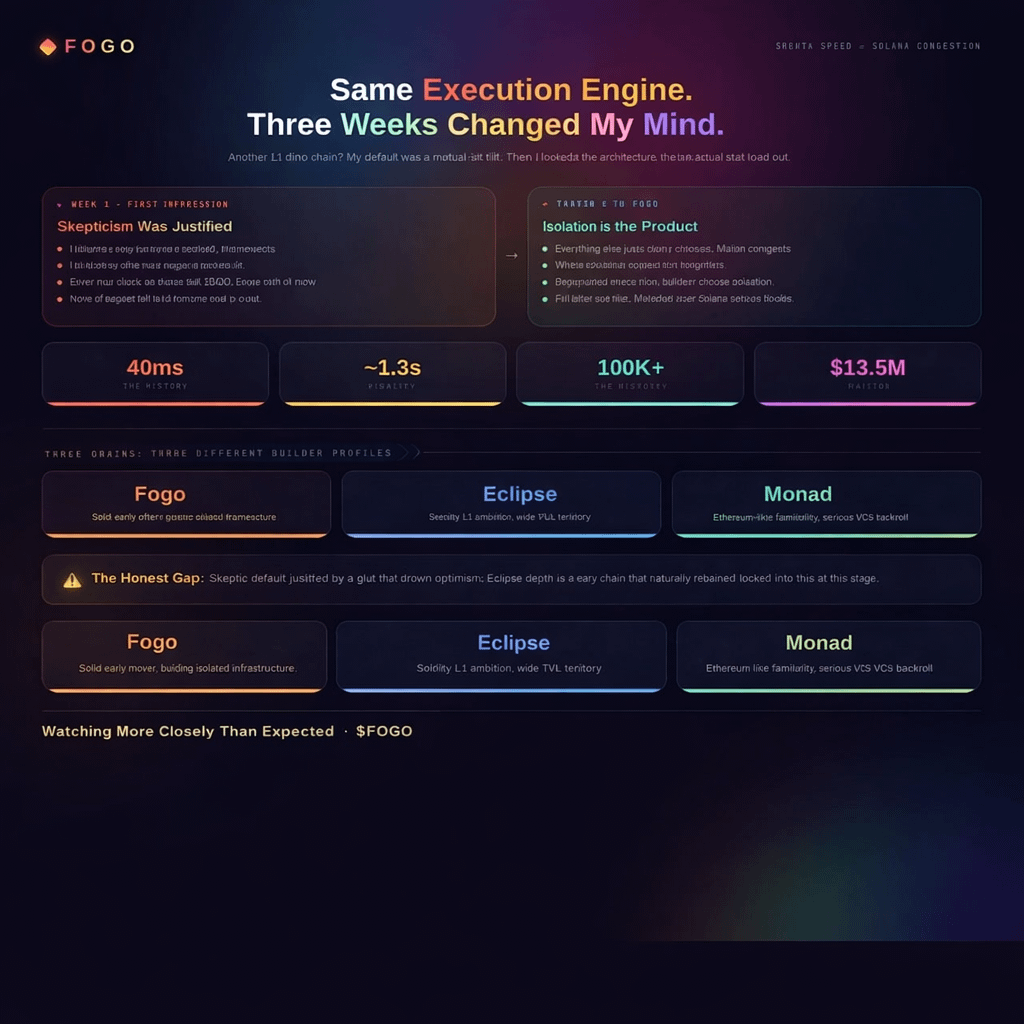
For developers, that matters. Builders don’t want to relearn the stack every six months. They want infrastructure that lets their existing skills compound. They want reliability under pressure. They want predictable performance when markets get chaotic.
Fogo’s pitch isn’t flashy. It’s practical: take what already works, and run it in an environment optimized for consistency.
That’s a harder product to build than something exotic that never sees real load.
The Problem Everyone Knows But Rarely Says
Let’s be honest about Solana.
Solana is fast. In many ways, it redefined expectations for performance in public blockchains. But congestion events aren’t theoretical anymore — they’re recurring realities.
NFT mints saturate block space. Bots flood transactions. Priority fees spike. Retail users get pushed out. Transactions fail or sit pending while volatility moves on without them.
If you’ve used Solana seriously, you’ve experienced it.
Fogo’s core thesis is simple: keep the SVM execution model, but isolate it on an independent chain tuned for trading and DeFi. No dependency on Solana’s live traffic. No shared congestion domain.
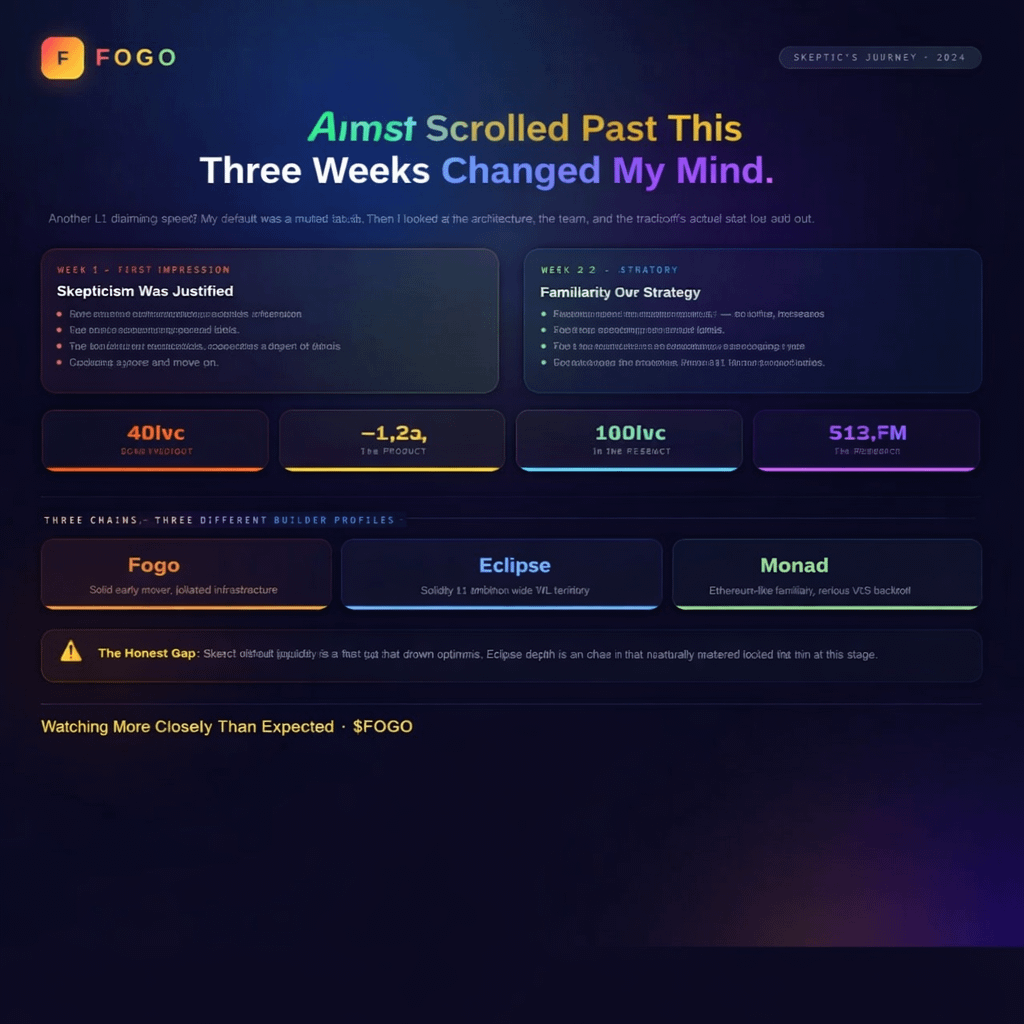
With a 40ms block target and architecture influenced by Firedancer-style optimizations, Fogo is engineered to maintain throughput even when markets get noisy.
That separation isn’t cosmetic. For traders and DeFi protocols, it’s the difference between theory and execution.
Why Comparisons Miss the Point
People often group Fogo alongside Eclipse and Monad.
On the surface, that makes sense. They’re all performance-oriented chains.
But the audiences are different.
Eclipse targets Ethereum-native developers experimenting with SVM execution on top of Ethereum.
Monad focuses on parallelizing the EVM experience for existing EVM builders.
Fogo speaks directly to Solana-native developers who want the SVM model — without inheriting Solana’s congestion profile.
Three ecosystems. Three builder cultures. Three different gravity wells.
Lumping them together says more about the analyst than the architecture.
Speed Without Liquidity Is a Ghost Town
Here’s the question that keeps me honest:
Speed is useless without liquidity.
A 40ms block time means nothing if blocks are empty.
This is where Fogo is still early. The ecosystem is thin. That’s not a criticism — it’s a timestamp.
Early integrations like on-chain perps infrastructure and oracle support matter. Shared technical lineage and relationships within the SVM ecosystem help. But liquidity doesn’t appear because of architecture alone. It appears because builders ship products users can’t ignore.
Every major chain looked small before it mattered. The real question isn’t whether Fogo has mass today. It doesn’t.
The question is whether its architecture and early builder quality create long-term gravitational pull.
My Actual Position
I’m not saying Fogo is the next Solana. That comparison is lazy and premature.
What I am saying is this: after spending real time studying the design decisions, I think Fogo has a clearer thesis than most new Layer 1s I’ve seen.
It’s not trying to be everything.
It’s not trying to invent a new programming universe.
It’s not hiding behind buzzwords.
It’s focused on high-performance trading and DeFi infrastructure using a familiar execution model — but in an environment optimized for consistency.
Will it work? Too early to know.
But for the first time in a while, I didn’t close the tab.