


Every new blockchain arrives with ambition. Faster execution, cheaper fees, better tooling, deeper liquidity. The list is familiar because the industry has been running variations of the same competition for years. However if we are honest, most users are no longer impressed by promises alone. They want to understand what specifically changes, and why that change makes participation more rational than before.
When I look at Fogo, the interesting part is not that it is new. The interesting part is the way it approaches early coordination.
Because launching infrastructure is not only a technical challenge. It is an economic and behavioral one. A network must convince validators to secure it, developers to build on it, and users to commit capital to it. All of this has to happen before large activity naturally exists.
That circular problem has killed many ecosystems.
So the real question becomes simple. How do you make early involvement logical instead of speculative?
Fogo seems to answer by focusing on commitment mechanisms from day one.
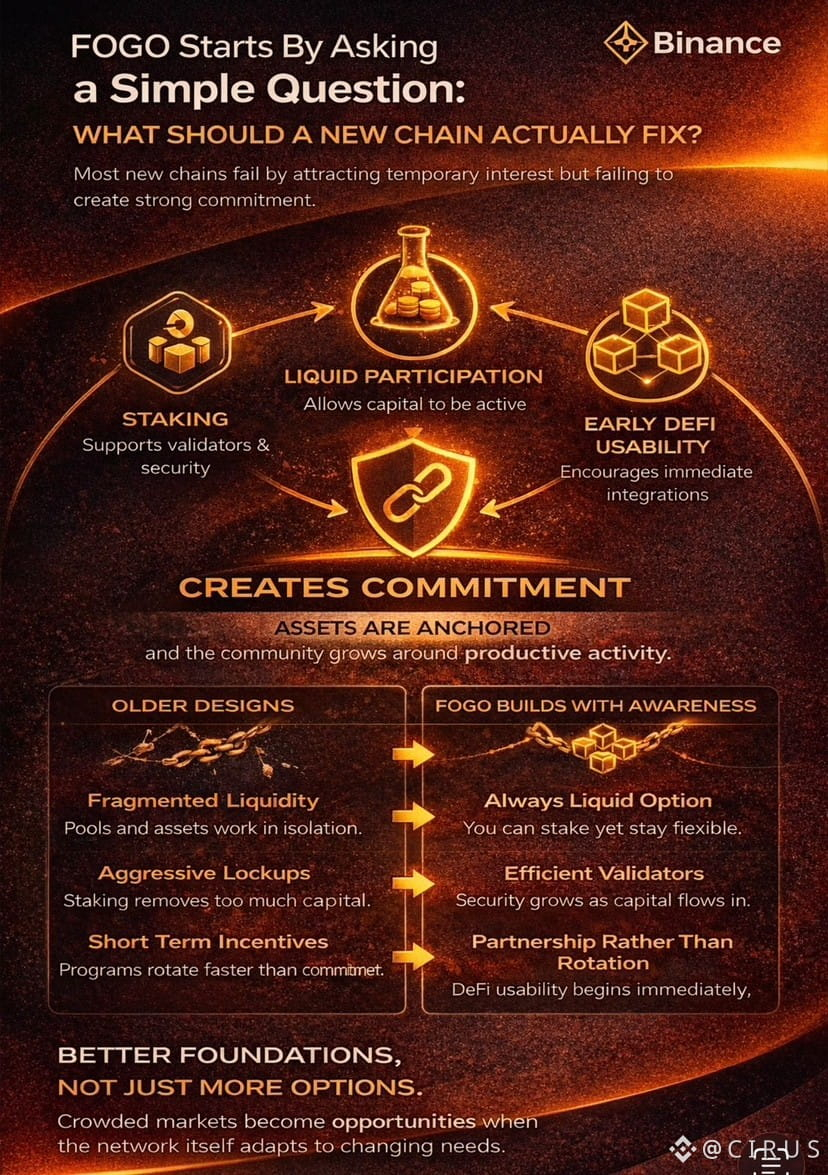
Rather than waiting for organic liquidity to magically appear, the chain is encouraging structured participation through staking programs, validator alignment, and immediate DeFi usability. Capital that enters is not idle. It becomes part of security, governance direction, and financial infrastructure at the same time.
This creates a feeling that entry matters.
When people see assets being locked, validators receiving delegation, and liquid representations like stFOGO spreading through applications, they understand that a base layer is forming. And base layers are powerful because future activity builds on top of them.
In contrast, networks that delay this stage often struggle. Users arrive, experiment briefly, and then leave because nothing binds them to the environment.
Fogo is trying to reduce that risk.
Another element I find important is clarity. Participants can easily understand what their tokens are doing. Stake supports validators. Liquid staking keeps funds usable. Integrations allow additional strategies. There are no complicated loops required to justify presence.
Simplicity lowers hesitation.
Moreover early transparency helps build social confidence. When growth metrics are visible, people coordinate around them. More stakers attract more builders. More builders attract more integrations. Momentum becomes easier to sustain.
Of course none of this guarantees success. Execution still matters. Tooling must improve. Applications must arrive. However strong foundations dramatically increase probability.
And that is where many observers underestimate young ecosystems. They look for finished products when they should be looking for structural alignment.
Fogo appears to be working on alignment first.
Validators gain stake. Users retain flexibility. Protocols receive productive assets. Incentives move in the same direction rather than competing with each other.
When that happens, expansion becomes smoother.
I also think this approach prepares the chain for more advanced activity later. Once liquid staking, delegation flows, and basic DeFi integrations become normal, adding derivatives, credit systems, or institutional participation becomes easier. Infrastructure layers stack naturally.
The early phase is about teaching the network how to cooperate.
From what I see, Fogo is attempting to build habits, not just numbers.
Habits outlast campaigns.
My take is that the real problem Fogo is trying to solve is not speed or branding. It is the fragility of early ecosystems. By encouraging users to anchor themselves through staking while still remaining liquid, it tries to create durability from the beginning.
If durability forms, growth can follow.
And in crypto, chains that survive their early months with committed participants often become the ones that matter years later.