
When I look at Fogo Coin, I don’t see just another blockchain trying to shout about higher TPS. I see a project that quietly asked a more important question: What actually limits performance in the real world? And instead of chasing headlines, it started solving those limits one by one.
At its foundation, Fogo builds on the architecture developed by the Solana Foundation. That means it doesn’t start from zero. It inherits Proof of History for synchronized timing, Tower BFT for fast finality, Turbine for efficient block distribution, and the Solana Virtual Machine (SVM) for executing smart contracts at high speed. These aren’t experimental systems. They’ve already been battle-tested.
What I appreciate most is that Fogo didn’t break compatibility just to feel different. It keeps full SVM compatibility, which means developers don’t need to rewrite their programs or relearn everything. Migration is smooth. Infrastructure doesn’t need to be rebuilt from scratch. In crypto, friction kills momentum. Fogo removes that friction instead of adding more.
To me, that shows maturity.
A lot of new networks try to stand out by redesigning everything. But innovation doesn’t always mean replacing the engine. Sometimes it means tuning it to perfection. Fogo feels like a performance upgrade rather than a complete rebuild.
One of the boldest decisions Fogo makes is around client implementation. Most blockchains support multiple clients for diversity. That sounds great in theory, but in practice it often means the network’s performance is limited by the slowest implementation. Fogo chooses a different path by standardizing around a high-performance client derived from Firedancer, developed by Jump Crypto.
Firedancer focuses heavily on optimization, parallel processing, efficient memory usage, deep hardware-level tuning. By aligning validators around a single high-performance standard, Fogo removes the hidden ceiling that multiple uneven clients can create.
Personally, I think this is a very honest design choice. In high-speed financial systems, milliseconds matter. If the goal is extreme performance, then every validator needs to operate at peak efficiency. Fogo embraces that reality instead of pretending diversity alone guarantees strength.
But the most fascinating part of Fogo’s design, in my opinion, is its multi-local consensus model.
Instead of spreading validators randomly across the globe at all times, Fogo introduces geographic “zones.” Validators operate in close physical proximity within a zone, which reduces latency dramatically. When machines are closer together, communication is faster. That’s just physics.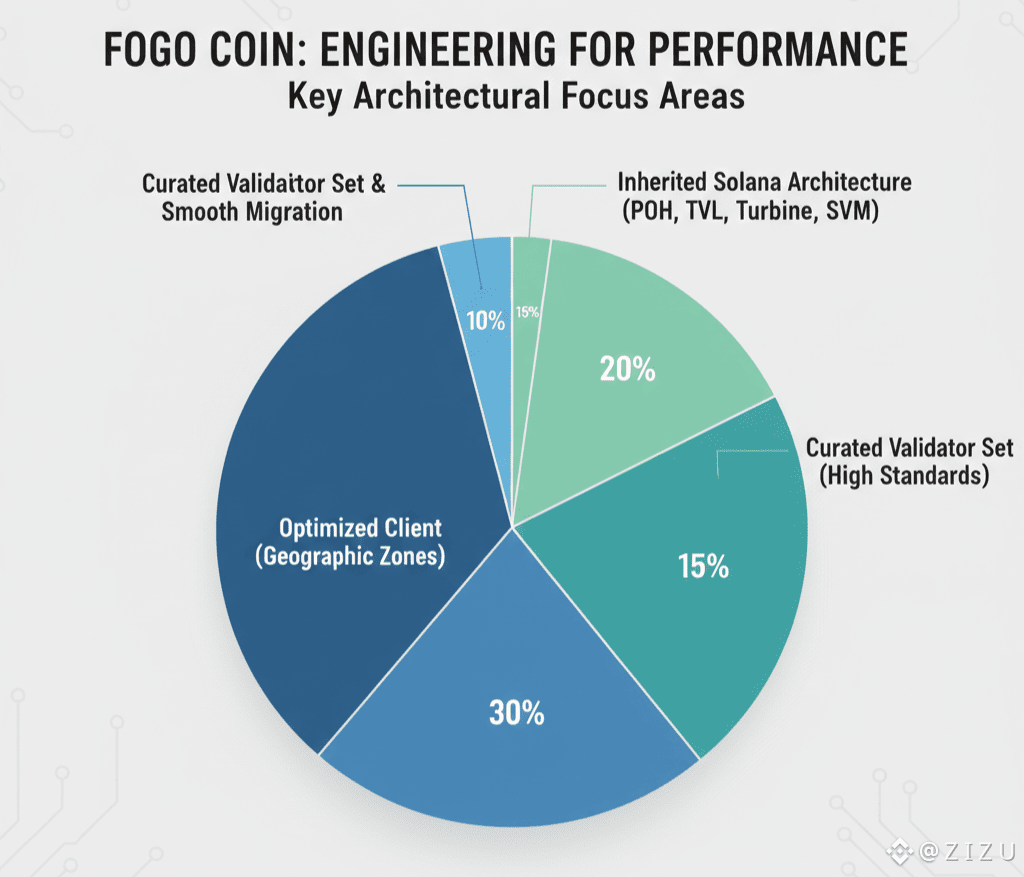
And this is what I love about Fogo, it designs around physics instead of ignoring it.
Of course, proximity raises questions about decentralization. Fogo addresses that through dynamic zone rotation. Validators vote on future locations and zones rotate across epochs. This prevents long-term jurisdictional concentration and protects against regional risks. It balances speed with resilience.
To me, that’s smart decentralization. Not just spreading nodes everywhere and hoping for the best but structuring decentralization intentionally.
Then there’s the curated validator set. Validators must meet both economic and operational requirements. In many networks, even a small number of poorly configured nodes can slow everything down. Fogo acknowledges that high-performance infrastructure cannot tolerate weak links.
Some might say curated sets reduce decentralization. I see it differently. In most proof-of-stake systems, power is already concentrated in major stakeholders. Fogo simply adds performance accountability to the equation. If you want to help secure a high-speed network, you need to meet high-speed standards.
And honestly, that makes sense.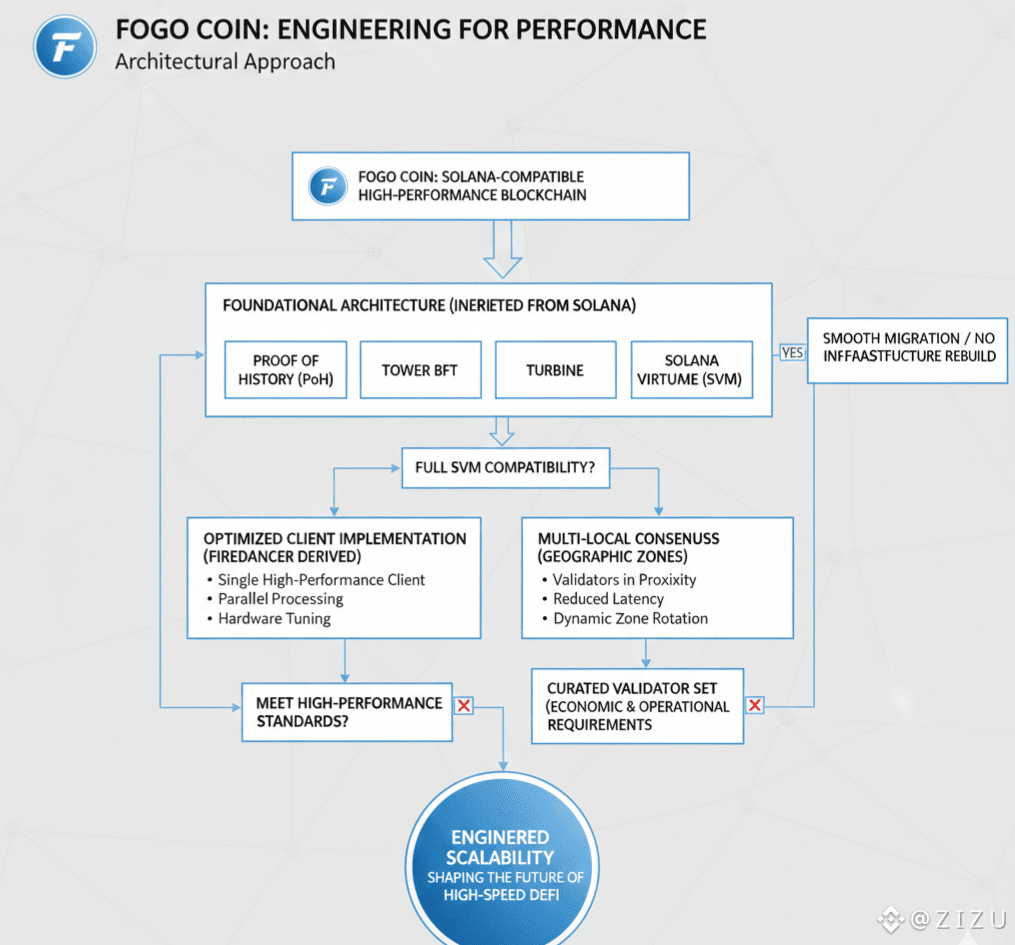
What stands out to me about Fogo Coin is that it feels engineered, not marketed. Every architectural decision connects back to a single theme: execution quality. Lower latency. Cleaner propagation. Higher stability. Better validator incentives.
It’s not trying to win by being the loudest. It’s trying to win by being the fastest in a way that is sustainable.
In a competitive landscape of Solana-compatible chains, many projects compete on ecosystem size or hype cycles. Fogo competes on refinement. If it succeeds in consistently delivering ultra-low block times and stable throughput, it could quietly set a new benchmark for performance-focused networks.
From my perspective, Fogo represents a shift in mindset. It moves away from theoretical scalability and toward engineered scalability. It respects existing infrastructure while pushing it closer to physical limits. And in an industry where microseconds can determine profit or loss, that focus on real-world efficiency could matter more than bold promises.
Fogo doesn’t feel like a gamble. It feels like optimization and sometimes, optimization is where the real breakthrough happens.