
I’ve deployed and tested a small app on both Fogo and Arbitrum. At first glance, the experience feels similar: fast confirmations, lower fees than L1, and smooth enough UX that most users wouldn’t notice meaningful latency. On the surface, both meet the baseline standard of a modern Layer 2.
However, once complexity increases — heavier contracts, more interactions, testing under higher load — differences begin to emerge. And that’s when it becomes clear: the real question isn’t “how fast,” but where the architecture chooses to absorb bottlenecks.
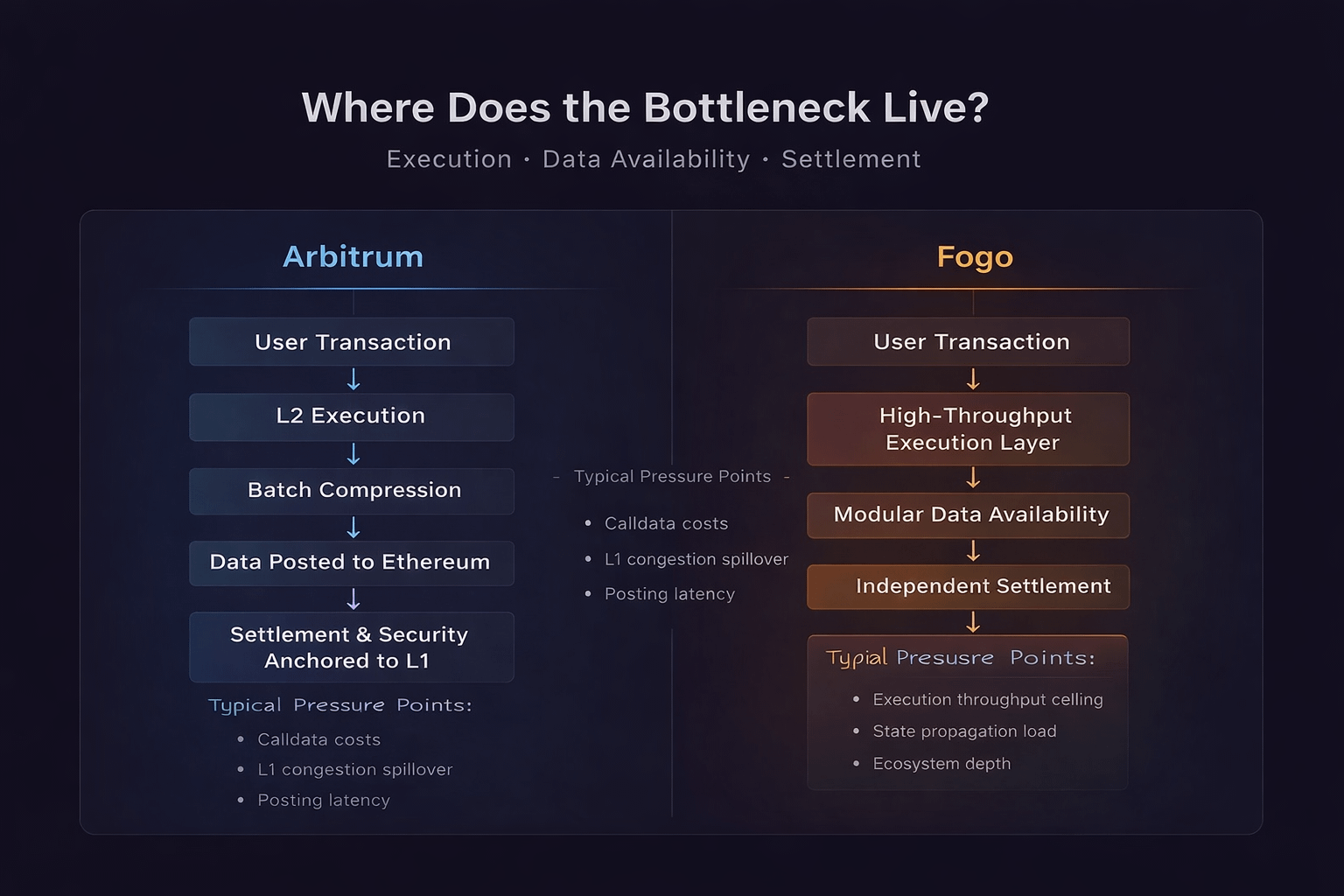
1. Execution: Similar Feel, Different Philosophy
Arbitrum is an optimistic rollup. Execution happens on L2, but settlement and security are anchored to Ethereum, with a dispute window mechanism. The model is clear: optimize performance at L2 while ultimately inheriting L1 guarantees.
Fogo gives a different impression. Its execution path and data flow design feel more modular, as if the system was structured from the ground up to reduce friction within the execution layer rather than iterating on the traditional rollup model.
Using Arbitrum feels like interacting with a mature system: robust tooling, predictable flows, and minimal surprises. Fogo feels more architectural — designed with throughput and internal execution efficiency as first-class concerns. Neither is objectively “better,” but the design philosophy clearly differs.
2. Under High Load: Where Does the Bottleneck Surface?
This is where the comparison becomes more interesting. With Arbitrum, as load increases, factors such as calldata costs, posting data to Ethereum, and settlement dependency become more relevant. Even though execution happens on L2, the ultimate constraint still tends to reflect back toward L1.
With Fogo, the bottleneck doesn’t anchor to settlement in the same way. The emphasis shifts toward execution throughput and how state is handled and propagated internally. That doesn’t eliminate trade-offs — it simply relocates them.
Arbitrum trades flexibility for Ethereum-level security guarantees.
Fogo trades anchoring dependency for architectural control over performance optimization.
Both approaches are valid; they just prioritize different constraints.
3. Ecosystem vs Architecture
From a pragmatic standpoint, Arbitrum currently holds a clear advantage: deep ecosystem, strong liquidity, mature tooling, and well-established infrastructure. If the goal is to launch a DeFi product that needs immediate liquidity and user access, Arbitrum is the safer choice.
Fogo, on the other hand, is more compelling from an architectural perspective. Its approach to execution and data flow is conceptually interesting, especially within a modular blockchain framework. However, its ecosystem is not yet as dense, which directly impacts network effects and adoption.
So the comparison isn’t purely technical — it’s also about ecosystem gravity.
4. UX and Predictability
One subtle but important factor is predictability. On Arbitrum, fees are relatively stable, finality feels consistent, and system behavior is largely predictable. For mainstream users, this reliability often matters more than marginal performance gains.
Fogo delivers smooth execution, but because the architecture is newer, there’s occasionally a sense of interacting with a system still refining its operational edge. This isn’t a fundamental flaw, but it does shape long-term perception.
Builders may find architectural differentiation exciting.
Everyday users typically prioritize stability and liquidity.
5. Personal Take
At this stage, I don’t see this as a race about raw speed. Most modern L2s are already fast and inexpensive enough for typical use cases.
The more relevant question is: under real scale, how does the system manage state and data? Does the bottleneck sit at execution, settlement, or data availability? And when pressure increases, does the architecture remain stable?
If I were building a product that needs liquidity today, I would choose Arbitrum for its pragmatism. If I wanted to experiment with execution-layer design and reduced settlement dependency, I would explore Fogo.
Neither “wins” outright. But the way each approaches bottleneck management reveals its architectural philosophy — and in the long run, architecture matters more than marginal speed.