
I’ll be honest — when I first heard about Fogo, I assumed it was another chain competing on speed metrics.
We’ve seen that playbook before: Higher TPS. Lower block time. Cleaner benchmark screenshots.
But after spending real time analyzing Fogo’s structure, it became clear this isn’t about marketing numbers. It’s about architectural positioning.
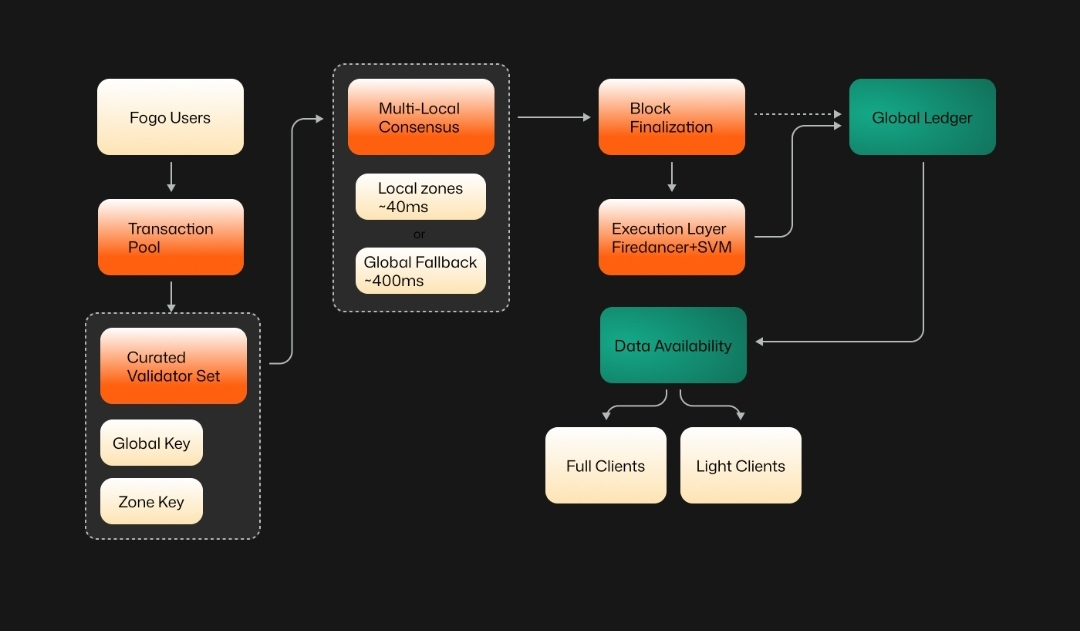
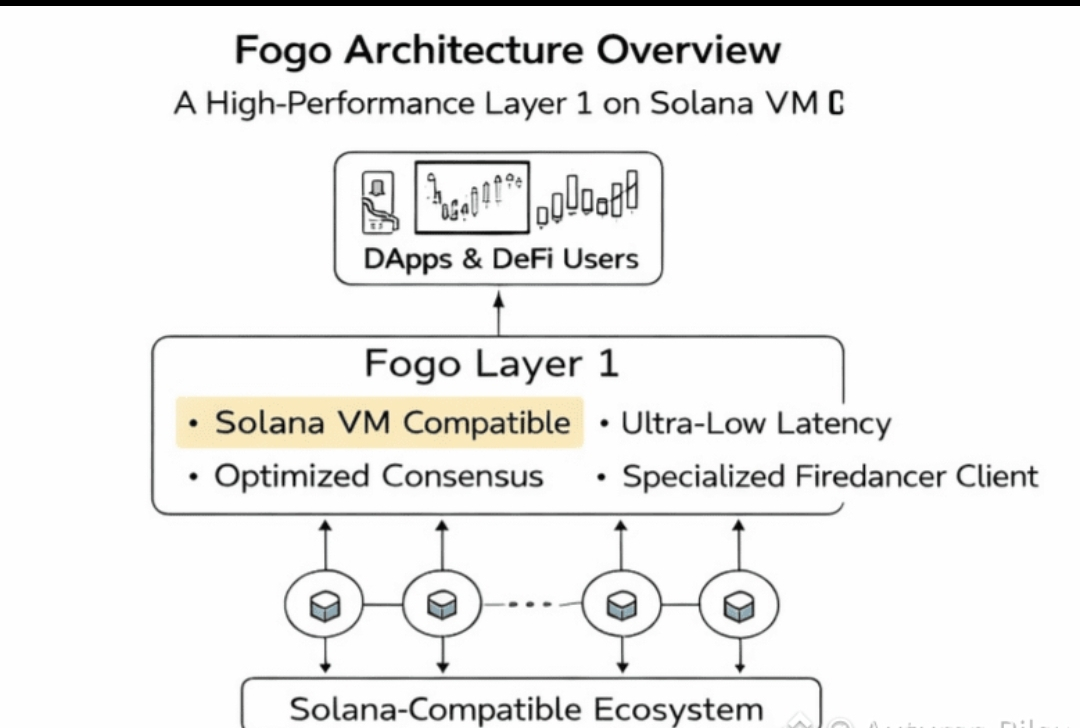
Fogo is a high-performance Layer-1 built on the Solana Virtual Machine (SVM). That decision alone tells you something. They’re not reinventing execution or forcing developers into a new language ecosystem. They’re leveraging a proven runtime and focusing their differentiation elsewhere.
And that “elsewhere” is consensus.
The Question Most L1s Avoid
Here’s what I’ve learned after reviewing multiple L1 architectures:
Speed isn’t limited by code.
It’s limited by distance.
Validators spread across continents introduce unavoidable communication delay. Light through fiber isn’t instant. When coordination spans thousands of kilometers, latency becomes embedded in consensus.
Most chains design around this after the fact.
Fogo designs around it from the start.
Their Multi-Local Consensus model concentrates validators into optimized zones, reducing coordination delay and tightening finality variance. Instead of allowing the slowest geographic link to define block production timing, they narrow the active coordination environment.
That’s not maximalist decentralization.
It’s deterministic performance engineering.
And I actually respect that clarity.
SVM Compatibility Without Shared Bottlenecks
Another detail I paid attention to:
Fogo runs the Solana Virtual Machine independently.
That means: • Same execution model
• Familiar tooling
• Developer portability
But separate validator set and state.
So if congestion hits Solana, Fogo doesn’t inherit it.
That separation is strategic. It lowers friction for builders while preserving independent performance dynamics.
It’s ecosystem-aligned without being ecosystem-dependent.
Who This Is Really Built For
After evaluating the design choices, I don’t think Fogo is trying to capture every type of user.
It feels engineered for environments where latency has economic consequences:
• Real-time derivatives markets
• On-chain auction systems
• Institutional liquidity routing
• High-frequency DeFi infrastructure
In those settings, consistency matters more than ideological dispersion.
And that’s the tradeoff Fogo openly makes.
My Take After Reviewing It Properly
I used to judge L1s by TPS charts.
Now I ask: How geographically distributed are validators? What happens to finality under sustained load? Is performance predictable or just peak-test optimized?
Fogo is one of the few chains I’ve studied that feels built around those questions from day one.
It may not satisfy decentralization purists. It may not be optimized for meme cycles.
But it is structurally aligned with a future where on-chain markets behave like real markets.
And that’s a serious bet.