

AI. Web3. Metaverse. Gaming. Entertainment. Speed. Scalability. Adoption. Consumer-oriented infrastructure.
These are the pillars most chains build their narratives around today.
We say Web3 is here. It isn’t — not in the way real users experience technology. AI is accelerating. Gaming economies are expanding. Digital entertainment is evolving. But truly consumer-oriented infrastructure — the kind that removes friction instead of adding new layers of complexity — is still rare.
Speed and scalability are measurable. Adoption is marketed.

But consumer experience is felt.
Pushing AI forward isn’t about making a smarter interface. It’s about building systems that can think and execute while leaving the user in control — without exposing them to gas mechanics, routing errors, or wallet friction.
That’s the real race.
And that’s where Vanar positions itself differently.
The Chains That Win Won't Be the Loudest. They'll Be the Ones You Forget Are There.
I spent a long time dismissing consumer-focused L1s as marketing dressed up as architecture.
The pitch always felt the same: fast, cheap, friendly. But fast and cheap don't solve the problem of users who don't want to think about blockchains at all. Friendly doesn't mean anything when the UX still leaks crypto complexity at every edge.
Vanar changed how I think about this — not because of a single feature, but because of what the infrastructure assumes about the person using it.
The Real Adoption Problem Isn't Speed
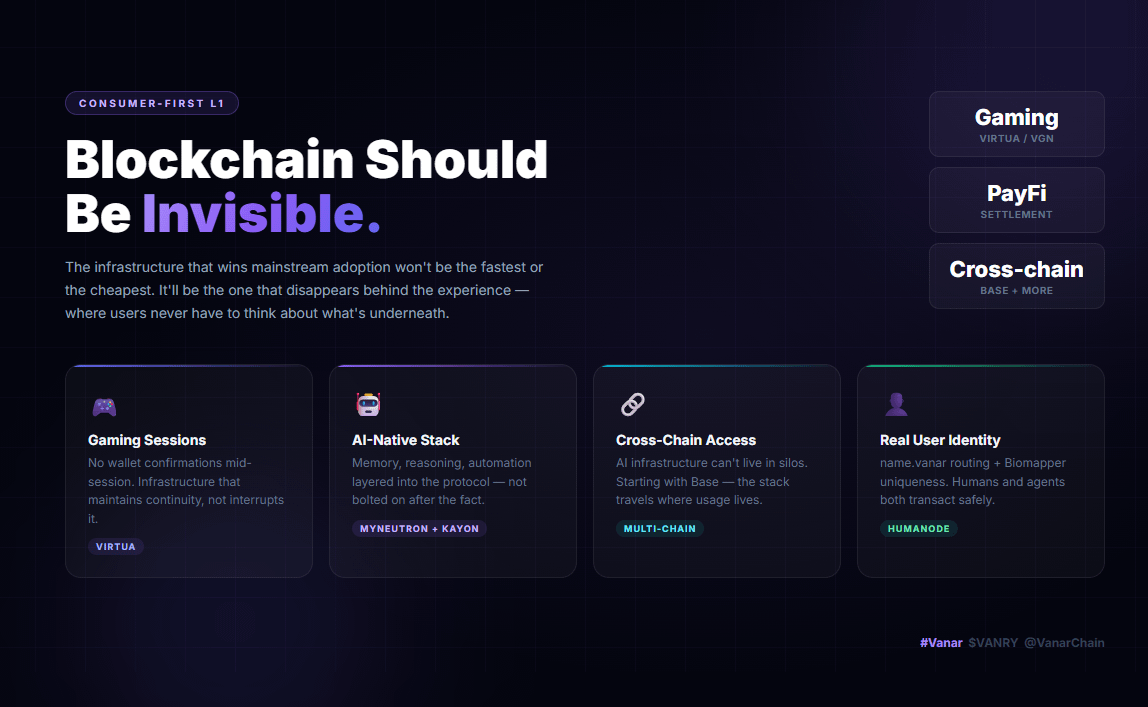
Most chain conversations obsess over TPS. I've stopped caring about TPS as a primary metric because the bottleneck in consumer adoption was never throughput. It was friction.
A gaming session that breaks to ask for wallet confirmation isn't slow — it's broken. A brand experience that requires a user to understand gas before interacting isn't complex — it's abandoned. The chains that reach the next wave of users will be the ones that make the underlying infrastructure invisible where it matters most.
That's the assumption Vanar appears to be building from.
Not "how fast can we settle" but "how little does the user need to know to keep going."
AI Agents Need Infrastructure That Doesn't Assume Human Reflexes
Here's where my thinking shifted on the AI side.
Most chains that claim AI readiness mean they can host an endpoint. That's not AI-native infrastructure — that's a server with branding. Real agent-ready infrastructure has to solve different problems entirely.
Agents don't pause. They don't re-confirm when gas spikes. They don't catch a routing error mid-execution. If the settlement layer isn't predictable and the identity layer isn't reliable, agents operating at scale don't produce efficiency — they produce compounding errors at machine speed.

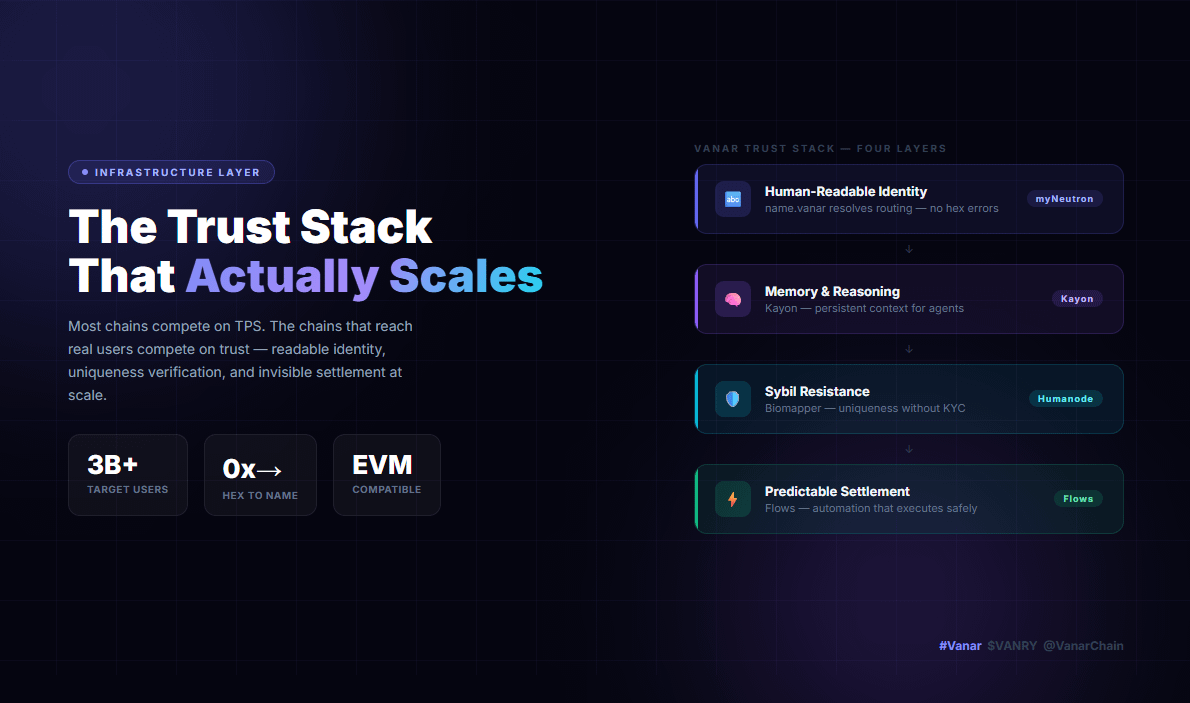
This is why the Vanar stack reads differently to me than most. Memory at the infrastructure level through myNeutron, reasoning and explainability through Kayon, automation rails through Flows — this isn't a chatbot bolted onto a dashboard. It's a layered architecture that treats intelligence as a base expectation rather than an added feature.
Memory → reasoning → automation → settlement. That sequence makes structural sense for agents that need to operate economically, not just computationally.
Identity Is the Guardrail Nobody Talks About Until It Fails
The conversation around AI agents on-chain skips past the most immediate risk: irreversible errors at scale.
Hex addresses are machine-readable and human-hostile. A careful person makes copy-paste mistakes. An agent moving value across hundreds of transactions doesn't make fewer mistakes — it makes them faster and with no confirmation prompt in between.
Human-readable routing, name-based resolution like .vanar style addressing, reduces this. Not completely, but meaningfully. And meaning matters when errors are permanent.
Then there's sybil resistance. Without it, every incentive layer, every reputation system, every agent service becomes a target. Biomapper from Humanode brings privacy-preserving uniqueness verification to dApps without forcing KYC that kills adoption. You prove you're a unique human without exposing who you are. That balance — uniqueness without surveillance — is the only version of identity infrastructure that scales into consumer markets.
The trust stack that actually works for real users looks like: readable identity, uniqueness verification, predictable settlement. Vanar is building toward all three simultaneously, which is unusual.
Consumer-First Isn't a Positioning Choice. It's a Technical Constraint.
If your target user is a gamer, a brand audience, or someone who has never touched a crypto wallet, then every infrastructure decision has to be made with that person in mind.
Vanar's background in gaming and entertainment — Virtua, VGN — isn't incidental. Consumer-scale environments expose failure modes that developer-focused chains never encounter. Sessions that need continuity. Experiences that need to feel uninterrupted. Users who will leave the moment something feels like work.
That operational exposure matters. Infrastructure that disappears behind the experience isn't a design preference — it's the only way these environments function.
Cross-Chain Access Is Practical, Not Tribal
AI systems cannot operate in silos. Agents that can only access one chain are limited by definition.
#vanar expanding cross-chain, starting with Base, isn't about claiming territory. It's about making the stack accessible wherever the usage is. VANRY underpinning that execution layer means adoption isn't constrained to a single ecosystem — it follows where intelligent systems need to operate.
That's pragmatic infrastructure thinking, not narrative building.
My Honest Take
The chains that mainstream users actually end up on won't be the ones that won the TPS race. They'll be the ones that solved for trust, continuity, and invisible execution — the things that don't make good headlines but determine whether someone comes back tomorrow.
@Vanarchain isn't the loudest chain in the room. It's building toward the version where the room itself becomes optional.
That's the infrastructure bet I find credible.
