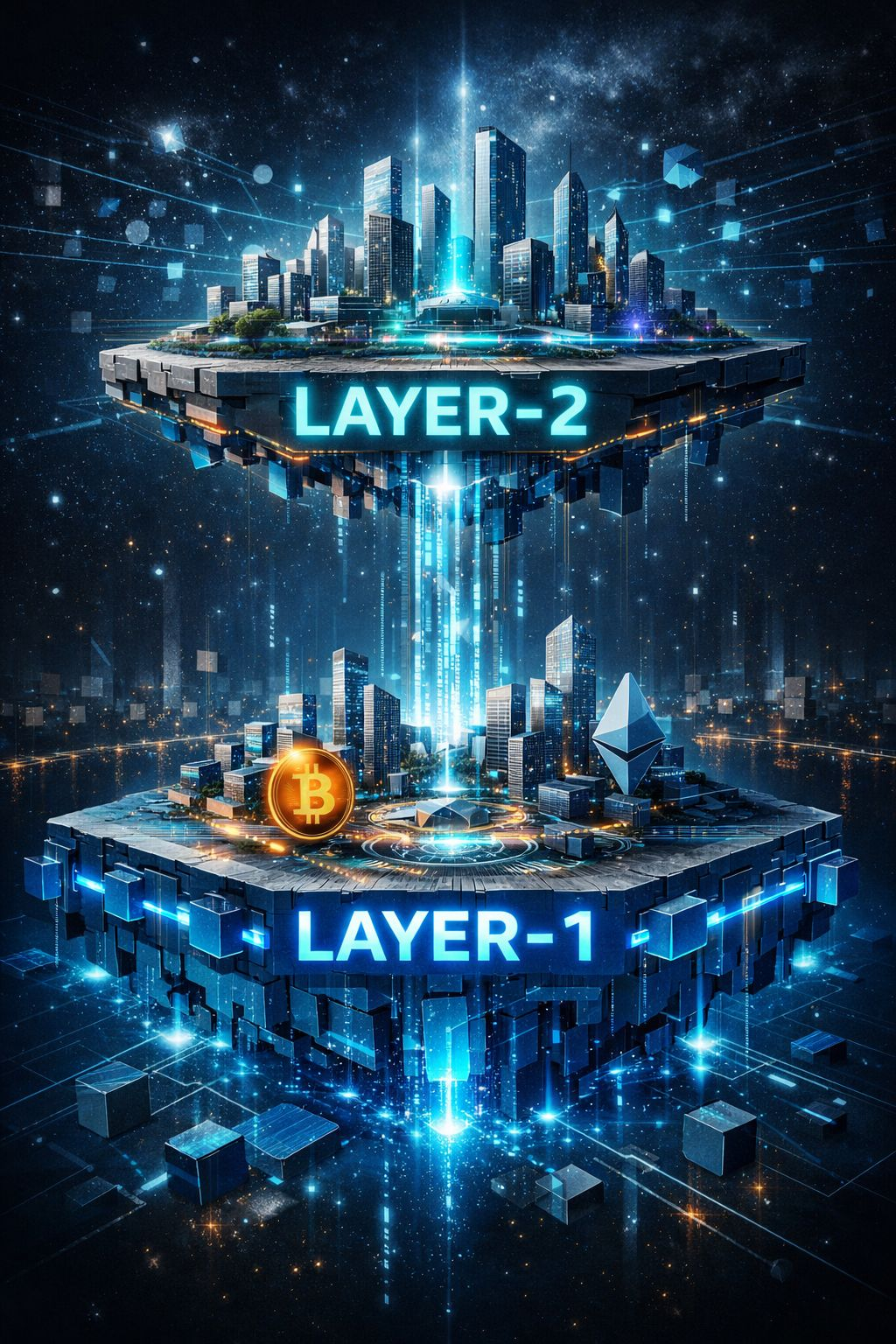
Blockchain is no longer an experiment. It is infrastructure.
And like any serious infrastructure, its strength depends on its architecture.
At the core of today’s crypto ecosystem lies a fundamental structural distinction: Layer-1 and Layer-2. Understanding the difference between them is not optional for serious participants — it is essential.
I. Layer-1: The Sovereign Base Layer
A Layer-1 blockchain is the foundational network. It is where consensus happens, blocks are produced, and transactions achieve final settlement.
Leading examples include:
Core Attributes:
Independent consensus mechanism (PoW or PoS)
Native validator network
Own security model
Native token securing transactions and incentives
Final settlement layer
Layer-1 chains prioritize security and decentralization. However, scalability is naturally constrained by protocol design — block size, block time, and validator throughput.
When network activity surges, congestion and higher fees often follow.
II. Layer-2: The Scalability Engine
A Layer-2 solution is built on top of a Layer-1 blockchain. Its purpose is simple but critical: increase transaction throughput and reduce costs without weakening the base layer’s security.
Notable Layer-2 ecosystems include:
Polygon
Operational Model:
Layer-2 networks process transactions off-chain, aggregate them, and periodically submit cryptographic proofs or transaction data back to the underlying Layer-1.
The result:
Higher throughput
Lower fees
Reduced congestion
Preserved security guarantees
Layer-2 does not replace Layer-1 — it amplifies it.
III. Structural Comparison
Dimension
Layer-1
Layer-2
Blockchain Status
Independent network
Built on existing Layer-1
Security
Native & autonomous
Inherited from Layer-1
Scalability
Protocol-limited
Enhanced via aggregation
Fees
Higher under heavy load
Significantly reduced
Primary Role
Settlement & consensus
Execution & optimization
IV. How to Identify Them Clearly
To classify a project, examine three factors:
Does it operate its own validator network?
Yes → Likely Layer-1.
Does it rely on another blockchain for final settlement?
Yes → Layer-2.
Is its token securing an independent chain, or powering a scaling framework?
Independent security → Layer-1.
Dependent scaling → Layer-2.
The difference is architectural — not promotional.
V. The Strategic Reality
The future of blockchain is not a battle between layers. It is a layered stack.
Layer-1 provides sovereignty, neutrality, and finality.
Layer-2 delivers performance, efficiency, and usability.
Together, they form a scalable digital infrastructure capable of supporting global finance, tokenized assets, DeFi, gaming, and enterprise systems.
True scalability is not about raw speed.
It is about expanding capacity without sacrificing decentralization.
That balance — not hype — will define the winners.
#Layer1 #Layer2 #CryptoInfrastructure #Ethereum #bitcoin