
Blockchains have spent years optimizing throughput, latency, and fees, yet one friction point remains stubbornly human: interaction. Clicking, signing, confirming, repeating. Even when the chain is fast, the user experience often feels slow, not because execution is delayed, but because intent is fragmented.
Fogo approaches this problem from a different angle. Instead of asking how fast transactions can be processed, it asks how clearly user intent can be expressed—and how long that intent should remain valid.
Transactions Are a Poor Proxy for Intent
On most chains, every action is treated as a standalone transaction. Each one must be individually authorized, individually validated, and individually confirmed. This model is secure, but it forces users to constantly restate intent.
“I want to trade.”
“I still want to trade.”
“I want to trade again.”
The chain never sees the bigger picture. It only sees isolated commands.
Fogo challenges this by separating intent declaration from execution repetition. Instead of signing every action, users define boundaries once and allow execution to occur freely within them.
Sessions Turn Authorization Into a State, Not a Moment
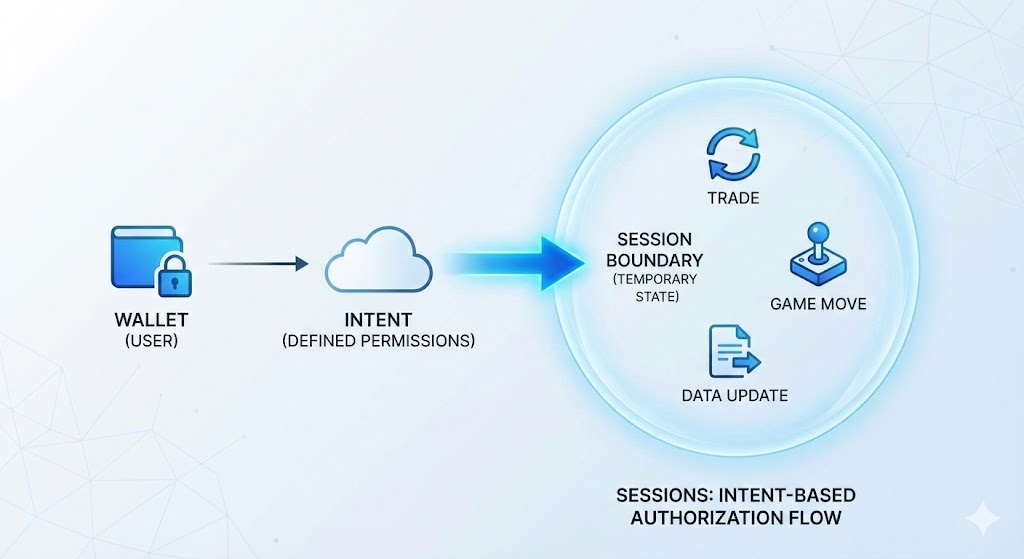
Fogo Sessions introduce a subtle but powerful shift. Authorization is no longer a single event that expires immediately after execution. It becomes a temporary state with clearly defined limits.
A session encodes:
What actions are allowed
Which assets can be used
How long the permission exists
Under which conditions it expires
This turns security into a scoped surface rather than a repeated interruption. The chain enforces constraints continuously, not reactively.
Why This Matters for High-Frequency Environments
The impact of this design becomes obvious in environments where speed and continuity matter. Trading, automated strategies, games, and real-time applications all suffer when interaction overhead dominates execution time.
By removing redundant authorization steps, Fogo allows applications to operate closer to their natural cadence. The system is no longer paced by how often a human can sign, but by how efficiently intent can be enforced.
Crucially, this does not weaken security. It narrows it. A session can do less than a wallet, not more. If compromised, its blast radius is intentionally small.
Intent-Based Design Fits Parallel Execution
There is a deeper architectural alignment here. Parallel execution rewards systems where independent actions remain independent. Sessions support this by localizing authority.
Instead of every action touching the same wallet state, execution flows through session-specific accounts with narrowly defined permissions. This reduces unnecessary contention and keeps parallelism intact.
Intent, in this model, becomes another layer of state partitioning—one that benefits both user experience and execution performance.
Rethinking UX Without Hiding Complexity
What makes this approach compelling is that it does not pretend complexity disappears. Constraints still exist. Rules still matter. The difference is that complexity is handled structurally rather than repeatedly.
Users express intent once. Developers design boundaries carefully. The chain enforces both without constant interruption.
This is not about making blockchain feel invisible. It is about making interaction intentional.
Final Thoughts
Fogo’s contribution here is not just faster execution, but a clearer interface between humans and machines. By treating intent as a first-class concept, it reduces friction without reducing control.
If the next generation of on-chain applications is going to feel continuous rather than fragmented, models like this will matter. Not because they are flashy, but because they respect how users actually behave when speed becomes real.
Disclaimer: This article reflects personal analysis and is not financial advice. Always do your own research.