
People call something a clone when it feels familiar at first glance, and I understand why that happens with Fogo because the moment you hear it’s SVM compatible your brain wants to file it away as “same thing, new label,” but that is a surface reaction, and Fogo’s real argument lives underneath the surface where most chains either struggle quietly or collapse loudly, because they’re not trying to prove they can run programs in a recognizable way, they’re trying to prove they can stay calm when everything turns chaotic, when activity surges, when bots hit the network like a storm, when users are rushing and emotional, and when the slowest parts of the system start controlling the whole experience, and that is why they keep the execution layer familiar on purpose while they reshape the base layer as if stress is the normal condition rather than an exception.
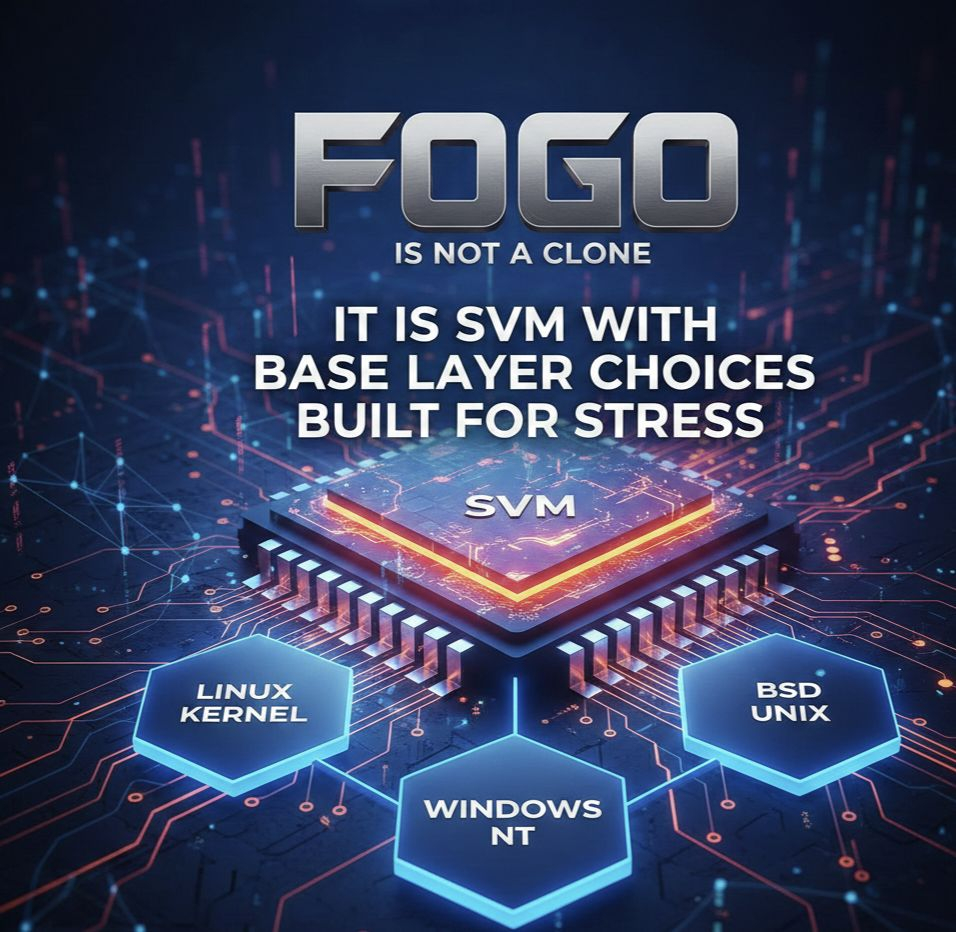
The heart of the design is simple to say and hard to build: keep the Solana Virtual Machine style execution so developers can move without rewriting their world, then rebuild the foundation so the chain behaves differently under pressure, because compatibility is not the same as identity, and this is where a lot of people get stuck, since they think the virtual machine is the chain, but the VM is only the part that runs code, while the base layer decides how quickly transactions move through the network, how blocks are produced, how agreement is formed, how predictable confirmation feels, and how much the system gets dragged around by geography, jitter, and weak infrastructure, and I’m seeing Fogo treat those base layer realities like the main product, almost like they’re saying, “We’ll meet you where you already are on execution, but we refuse to accept the usual base layer pain that shows up when demand gets wild.”
If you want to feel how it works step by step, picture a single transaction from the moment someone presses a button, because the journey tells you what the chain values: first the transaction reaches an access point and gets forwarded into the validator network, then it enters a pipeline where signatures are checked, duplicates are filtered, and valid transactions are staged for inclusion, and when a validator is selected as leader it packs transactions into blocks and executes them through the SVM model where parallel processing is possible because transactions declare the state they touch, which lets independent work run at the same time instead of queuing behind unrelated activity, then the new block is propagated and other validators observe it and vote, and over successive confirmations the block becomes harder to reverse until it is effectively final, but the difference Fogo is chasing is not the existence of this flow, because many chains share a version of it, the difference is the consistency of the flow under stress, because in the real world a system can look clean in diagrams and still feel unstable when the network is busy and the slowest messages become the true metronome.
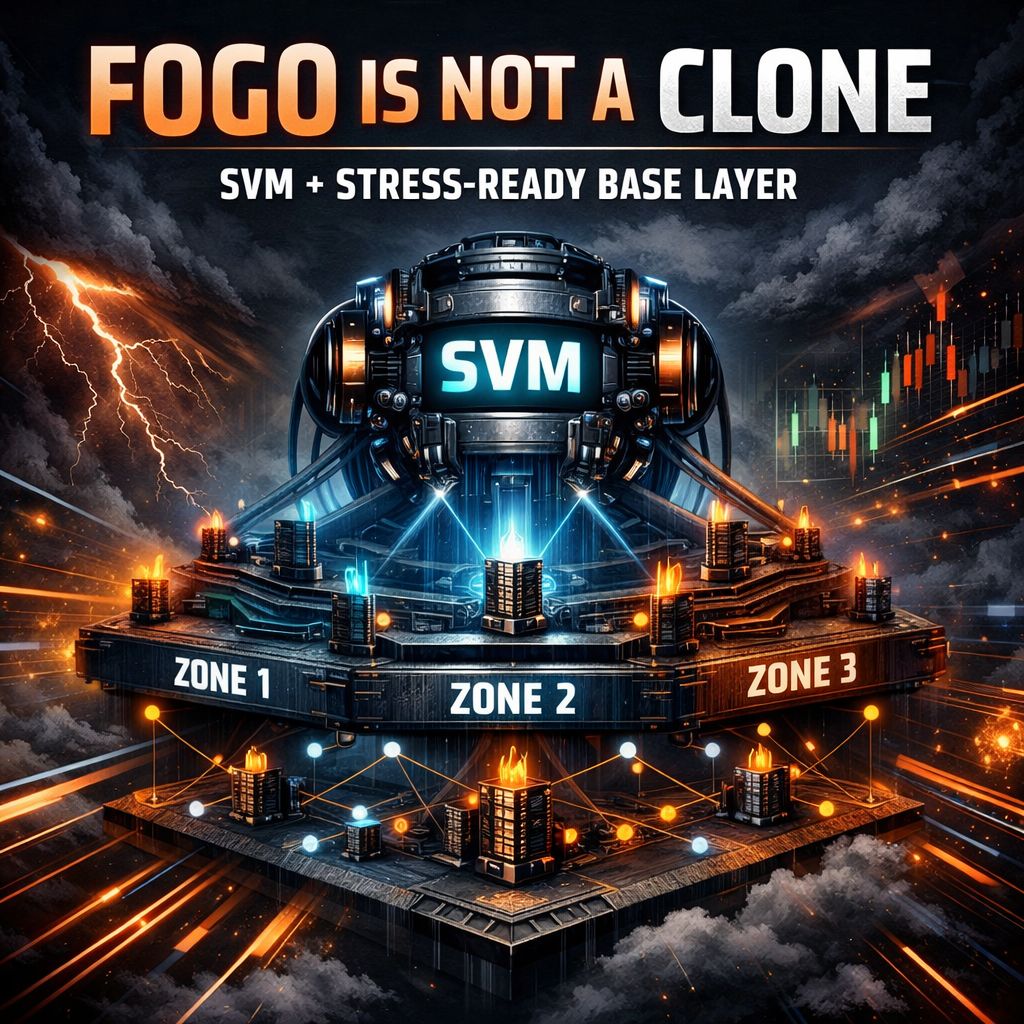
That is why the most defining base layer move in Fogo is the way they think about distance and consensus, because global networks pay a physical price that marketing cannot erase, and consensus has to move messages back and forth across a quorum, so even if most validators are fast, the slowest routes and the slowest machines can control the timing, and what Fogo tries to do is reduce that penalty by organizing validators into zones where a single zone becomes active for consensus during a period, meaning the voting set is intentionally close enough to reduce the round trip delays that create ugly tail latency, while other zones remain part of the broader network for rotation and resilience, and this is not a cosmetic optimization, it is a philosophy that says predictable finality matters more than feeling globally spread out in every second of every epoch, because in on chain finance a few extra unpredictable moments can change who gets filled, who gets liquidated, and who gets stuck, and if it becomes a chain that people trust for serious DeFi, it will be because the worst moments remain manageable, not because the best moments look impressive.
The second major choice is how they approach validator software and performance consistency, because under stress the network often becomes the sum of its weakest participants, so if a meaningful slice of validators runs slower implementations, slower configurations, or simply less disciplined operations, the whole system inherits their limits, and Fogo pushes toward a canonical high performance client path that is designed like a low latency pipeline, with the mindset that predictable throughput is achieved by controlling jitter, minimizing unnecessary overhead, and keeping the execution path tight from packet intake to verification to scheduling to block production, and this is where the “not a clone” idea becomes more grounded, because a chain can share an execution environment and still feel totally different depending on how the validator stack is engineered, how it handles bursts, and how it keeps performance stable when the network is noisy, and they’re basically choosing to standardize the performance envelope so the chain does not get pinned to the slowest edge of its own ecosystem.
The third choice is the one people debate the most, which is stricter validator standards and a more curated approach early on, and I’m not going to pretend that doesn’t raise questions, because open participation is part of what makes blockchains meaningful, but Fogo’s view is that a chain built for stress cannot pretend that every validator is equally capable of meeting tight latency and throughput targets, so they start with stronger requirements to reduce the risk that a small fraction of underperforming nodes drags down the experience for everyone, and whether someone agrees or disagrees, the logic is consistent with the goal, because they’re designing for a world where performance is not a luxury, it is safety, and if the chain becomes unreliable during volatility, users don’t just get annoyed, they can lose money, and they can lose trust, and once trust breaks it is hard to rebuild.
Now, a chain can be brilliant at consensus and still feel broken if users cannot reliably reach it, and this is where I’m seeing Fogo treat the edge layer like part of the core product, because stress often kills access first, not consensus, so they lean into smoother interaction models that reduce repeated friction, and they talk about session style experiences where a user can authorize intent once within defined limits rather than signing every single step, which matters because every extra prompt and every extra fee management step becomes a drop off point when the market is moving, and as soon as users start failing and retrying and spamming, the network load gets worse, so reducing friction is not only about comfort, it is about preventing feedback loops that turn congestion into a self amplifying mess, and if we’re seeing anything mature in modern chain design, it’s the recognition that good user experience is not decoration, it is congestion control at the human level.
If you want to judge whether this stress built story is real, you have to watch the right metrics, and the first rule is that averages are easy to manipulate and easy to misunderstand, so I focus on distributions and worst case behavior, especially confirmation latency at the high percentiles, because that is where panic begins, then I watch block production stability and skipped leadership performance, because spiky block production makes applications feel unreliable even when raw throughput looks high, then I watch congestion behavior through fee pressure and prioritization dynamics, because a healthy system under load should feel like a predictable market for inclusion rather than a chaotic lottery, and I also watch access reliability through timeouts, error rates, and degraded responses, because users experience the chain through the edge, and if the edge collapses, the chain feels offline even if blocks keep moving, and the most honest test is not a benchmark day, it’s a day when everyone is shouting and the system still keeps its rhythm.
The risks are real and they come from the same choices that create the advantage, because zoning and co location can create centralization pressure over time if the operational reality concentrates power in a small cluster of well funded operators, and a canonical client path can increase monoculture fragility if a critical bug hits the dominant implementation, and stricter validator participation rules can become a governance trust issue if the criteria ever feels unfair or captured, and session based convenience can create new dependencies and new targets if the sponsorship and authorization layers are not built with extreme care, so the project’s long term success is not only about speed, it is about discipline, transparency, and the willingness to harden every layer with the mindset that adversaries and chaos are not hypothetical, they’re guaranteed.
What the future could look like, if the thesis holds, is actually something quieter than people expect, because the real win is not loud numbers, it is boring reliability, where developers can bring familiar SVM style programs and ship quickly, where users stop fearing peak hours, where on chain markets behave more like engineered systems than fragile experiments, and where the network’s identity is proven by how it performs on the worst days rather than how it looks on the best days, and I’m not saying any of this is guaranteed, but I am saying the design choices form a coherent story, and coherence matters, because if it becomes successful it won’t be because someone said “not a clone,” it will be because people tried it during stress, felt the difference in stability and timing, and came back not out of hype, but out of trust, and that kind of trust grows slowly, then suddenly, and once it exists, it changes everything in a way that feels almost simple.