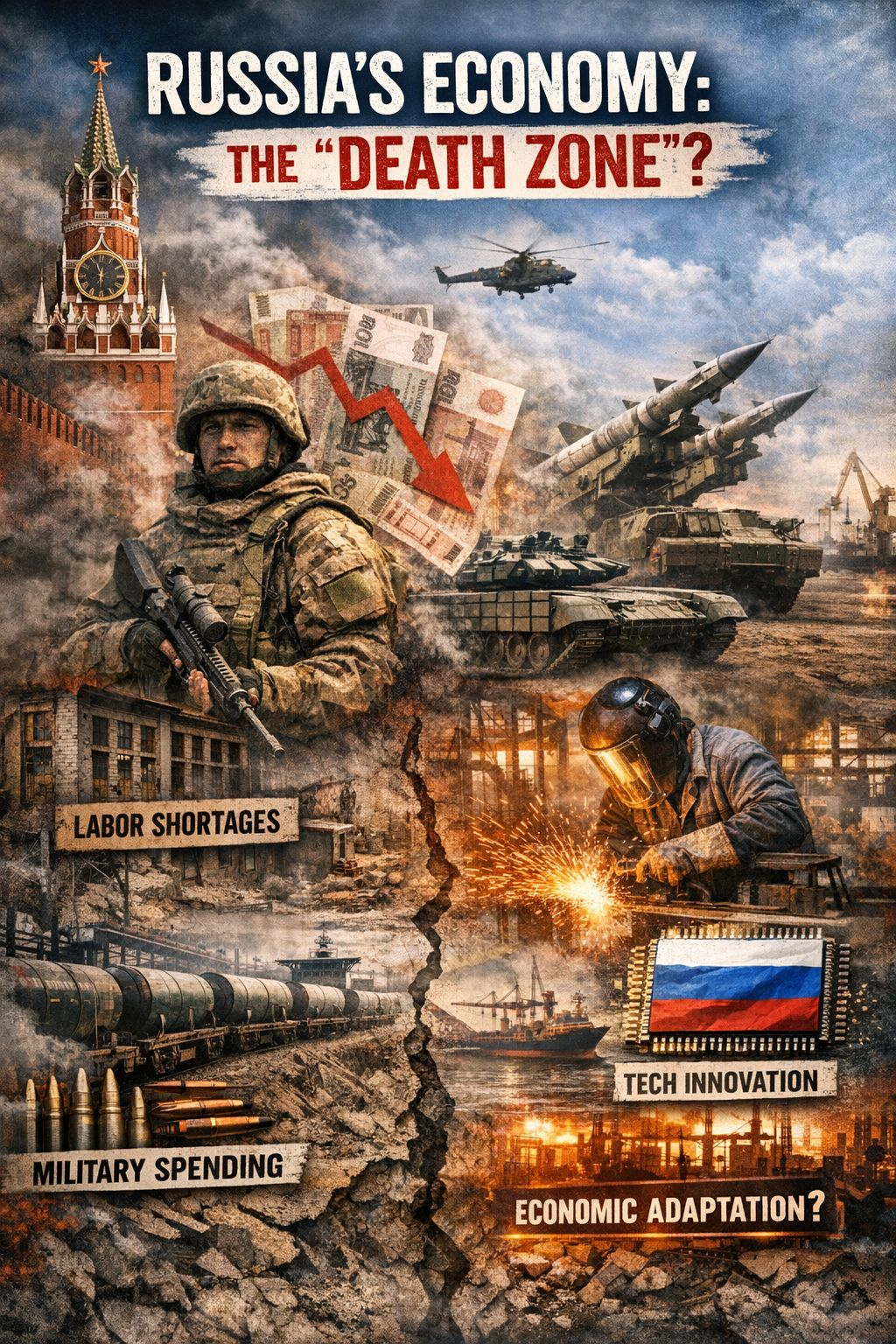
For nearly two years, Russia has operated under extraordinary economic pressure following the escalation of the conflict in Ukraine in 2022. Sanctions from the United States, the European Union, and their allies were designed to cripple Moscow’s financial system, isolate its industries, and cut off access to global capital.
At first glance, the strategy appeared to fail. Headline GDP numbers showed resilience. The ruble stabilized after its initial collapse. Energy exports continued flowing eastward.
But headline data rarely tells the full story.
Beneath the surface, the Russian economy is undergoing a profound structural transformation — one that carries both severe long-term risks and unexpected strategic opportunities.
This is not a story of sudden collapse.
It is a story of compression, adaptation, and long-term trade-offs.
I. The “Death Zone” Thesis: Structural Strain Beneath the Surface
1. Monetary Tightening at Extreme Levels
The Central Bank of Russia raised benchmark interest rates to 16% and beyond in response to inflationary pressures and currency volatility.
Such levels are not neutral policy tools — they are emergency brakes.
High interest rates:
Suppress consumer borrowing
Freeze mortgage growth
Discourage private investment
Increase corporate refinancing stress
While necessary to stabilize the ruble, they simultaneously restrict long-term economic dynamism. An economy cannot sustainably expand when the cost of capital remains prohibitively high.
2. Labor Market Shock
The conflict and outward migration triggered a demographic squeeze.
Mobilization efforts and emigration of skilled professionals — particularly in technology and finance — created shortages in critical sectors. Industrial production may be running at capacity, but in many regions, factories face worker deficits, not demand shortages.
Wage inflation has followed.
In the short term, rising wages support household consumption. In the long term, they feed cost-push inflation — especially when productivity gains do not match compensation growth.
3. The Fiscal Reallocation Toward War
Roughly 35–40% of federal expenditures are now directed toward defense and security sectors.
This wartime fiscal model artificially supports GDP. Military production counts as economic output. Defense contracts keep factories busy. Employment remains high.
But military goods do not generate productive civilian returns.
Tanks do not build infrastructure. Ammunition does not increase long-term human capital. Missiles do not modernize healthcare.
When such a large share of fiscal stimulus is channeled into non-productive capital, the long-term multiplier weakens.
4. Inflationary Pressure
Despite tight monetary policy, inflation remains persistent.
The core issue is structural: supply chains have been reoriented toward Asia, often at higher cost. Import substitution programs are still developing. Domestic production has not yet fully replaced Western inputs in high-tech sectors.
Printing money to sustain wartime output while supply remains constrained creates classic inflationary tension.
This is the slow suffocation model — not collapse, but erosion.
II. The Counter-Argument: Adaptation and Strategic Realignment
Yet declaring economic “death” may be premature.
History shows that externally pressured economies often undergo forced innovation cycles.
1. Industrial Rebirth Through Necessity
After Western firms exited the market, domestic producers moved quickly to fill gaps.
Import substitution has accelerated in:
Agriculture
Food processing
Light manufacturing
Defense technology
Industrial machinery
Small and medium enterprises are expanding. Regional production clusters are emerging. While efficiency may lag Western standards, dependency is declining.
2. Eastern Pivot and Infrastructure Expansion
Sanctions accelerated Russia’s economic pivot toward Asia.
New pipelines, expanded rail corridors, Arctic shipping routes, and port modernization projects are linking Russia more deeply with China, India, and broader Asian markets.
Energy exports — especially oil — continue to generate hard currency, even if sold at discounted prices.
The geopolitical realignment may permanently shift Russia’s trade architecture for decades.
3. A Hardened Financial Architecture
Unlike heavily indebted Western economies, Russia maintains a relatively low debt-to-GDP ratio.
A tight monetary stance, while painful, demonstrates institutional willingness to defend currency stability.
Additionally, the country has accelerated development of:
Alternative payment systems
Bilateral trade settlements in local currencies
Digital financial infrastructure
Over time, these measures may reduce vulnerability to external financial sanctions.
4. Human Capital Under Pressure
Historically, Russian society has demonstrated resilience under economic hardship.
Labor shortages are pushing wages higher. If managed properly, this could strengthen domestic demand.
Moreover, heavy investment in military R&D has created a generation of engineers, programmers, and technicians. In post-conflict scenarios, such technical talent could pivot toward aerospace, heavy machinery, AI systems, or civilian technology sectors.
Wartime innovation has historically seeded peacetime industries.
III. The Crossroads: Cannibalization or Reinvention?
The core question is not whether Russia is collapsing.
The question is whether wartime momentum can convert into peacetime productivity.
If military industrial output remains dominant for years, capital misallocation could erode long-term growth potential. Infrastructure, healthcare, education, and civilian innovation would continue absorbing fiscal strain.
However, if the conflict stabilizes — whether through a frozen front or negotiated settlement — Russia could redirect:
Military manufacturing capacity into dual-use technologies
Energy profits into infrastructure modernization
Technical expertise into export-driven civilian industries
At that point, today’s “Death Zone” could resemble a painful but transformative transition phase.
Final Verdict
Russia is not facing immediate economic annihilation.
But it is operating inside a high-pressure economic corridor where:
Monetary policy is restrictive
Fiscal spending is militarized
Labor supply is strained
Inflation remains persistent
This model can survive in the short term.
The long term depends entirely on strategic pivoting.
If oil revenues fund missiles, stagnation deepens.
If oil revenues fund modernization, diversification becomes possible.
The difference between collapse and reinvention will not be decided by GDP headlines — but by capital allocation choices once the geopolitical dust settles.