

Hey fam, gather around because today we’re diving deep into something that has been quietly buzzing behind the scenes in our ecosystem conversations. I’m talking about FOGO. Not just hype or price chatter. I want to unpack what’s actually happening with this project right now in a way that feels real, human, and useful for all of us who are genuinely curious about where blockchain tech is headed.
If you’ve been following the blockchain space at all you know that everyone is talking about new chains popping up. But not all chains are created equal, and FOGO is one of those networks that is trying to do something different. It is not just another Layer 1 chain trying to copy what others have done before. FOGO is aiming at a very specific corner of the market, lightning fast trading and financial utility, with performance that feels like it was built for professional traders first and everyone else second. And I’m here to break all of that down for you in a way that makes sense.
Let’s jump in.
Why FOGO Matters Right Now
At its core, FOGO is a high speed Layer 1 blockchain. That means it’s a base layer protocol, the foundation, but it has performance goals that are genuinely ambitious compared to most chains out there today. We’re talking block times around 40 milliseconds. For context, that is blazing. When you are building trading applications or financial systems on chain, latency matters. Every millisecond counts when you’re setting orders or executing strategies. FOGO’s team has optimized for that from the start, building on what’s called the Solana Virtual Machine architecture, which is already known for speed but then pushing it even further with custom optimizations.
But beyond just raw numbers, take a moment to consider what that means if you are a developer or a trader. Imagine interacting with a decentralized exchange on a blockchain where the delay between clicking swap and seeing the block confirm is almost imperceptible. That’s the kind of experience FOGO is going after. It is almost CEX level responsiveness but on decentralized rails.
And that is the core narrative here, performance without compromise.
FOGO Mainnet Is Live and People Are Using It
A lot of projects talk about performance in theoretical terms. FOGO took that promise live earlier this year with its mainnet launch. Officially going public in January 2026 was a massive milestone because it meant the network was no longer just a test or a demo. It was a real, functioning blockchain running in the wild. With that came the token distribution and the beginning of actual on chain activity, including trading, staking, and other early ecosystem use cases. 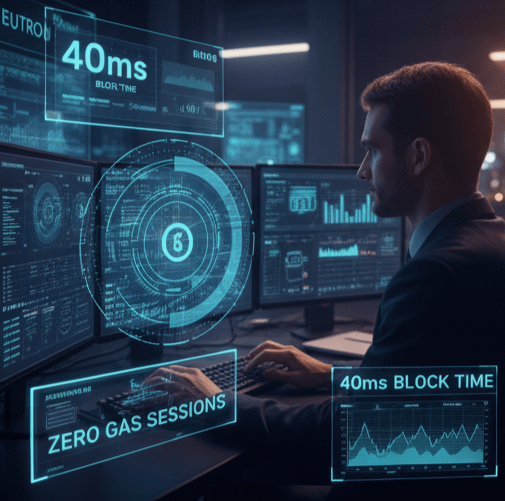
In practical terms that means:
Real users interacting with real applications
Transactions moving on a network that is proving its capabilities
Liquidity and trading happening on both centralized and decentralized platforms
Early on chain data we can start to observe and analyze
A growing picture of what adoption looks like beyond the hype cycle
That transition from testnet to mainnet is where projects either start to sink or start to live. FOGO is now in that phase where we are watching how people actually use it outside the controlled environment of developers and early testers.
What Sets FOGO Apart from Other Chains
Let’s get real for a second. The blockchain space is crowded. Every other week a project claims to be faster or smarter. But FOGO isn’t just talking about throughput for random apps. This project is positioning itself deliberately as a trading and financial utility infrastructure. That means it’s not necessarily trying to be everything for everyone. It’s optimized for people and systems that need real time execution, deep liquidity access, and predictable performance.
Here’s how that shapes up practically:
Super low latency: Block times that feel instantaneous.
Compatibility with other ecosystems: Systems built for solana can come over theoretically without massive rewrites.
Curated performance validators: The initial part of the network is designed to support high performance over wide decentralization early on.
Financial primitive focus: Spot markets, decentralized exchanges, derivatives, liquidations, on chain order books, all things that benefit hugely from extremely low latency.
Make no mistake, FOGO isn’t trying to rehash what the masses are doing. It is carving out a niche where performance is king, and that focus is something that resonates with certain parts of the ecosystem, especially traders and high frequency market participants.
Ecosystem Going Beyond Just a Chain
With any fresh blockchain launch, a major part of adoption is what gets built on it. FOGO has already started that. Early decentralized applications are popping up focused on trading infrastructure like order books, lending and borrowing protocols optimized for speed, and zero gas fee trading sessions, a really neat innovation that lets users interact more smoothly.
Some of the things the community is already talking about include:
Gas free sessions, Making it easier for new users to interact with apps without worrying about transaction costs.
Decentralized spot and perpetual DEXs, Trading interfaces designed for high throughput.
Limit orders and complex order types, Not just swap and go.
Lending and borrowing optimized for a fast network, Reducing the friction of DeFi actions that normally take time elsewhere.
Security and risk tools, Tools that help protect traders and ensure price feeds and automated risk parameters work reliably.
These pieces are coming together to make FOGO not just a super fast blockchain but a financial toolkit ecosystem that feels alive, adaptable, and genuinely useful for the audience it is targeting.
Token Utility That Actually Matters
One of the most important parts of any blockchain project is the token, in this case the $FOGO token. And unlike coins that are purely speculative or just a placeholder, FOGO’s token has real functions baked into the network.
Here’s what it’s being used for today:
Network fees: Anyone interacting with the chain pays fees that are settled using $FOGO.
Staking and security: Validators and even everyday token holders who delegate can participate in securing the network and earn rewards.
Governance participation: FOGO holders get a say in future protocol upgrades and ecosystem decisions.
Utility in ecosystem services: Some applications and tooling within the FOGO network use the token as a medium for discounts or advanced access.
And importantly, as more activity happens on chain, whether through trading, DEX usage, or other financial primitives, that utility grows. Token use is not an abstract concept here. It’s a practical tool in the growing ecosystem.
Bridges and Liquidity Are Coming Together
Another huge piece of the puzzle that many people are just now waking up to is interoperability. FOGO integrated with major bridge infrastructure when the mainnet launched, which means liquidity from other ecosystems could flow in easily. That’s a big deal because chains don’t exist in isolation anymore. You want users from other chains to be able to bring assets in and out without friction.
That’s not just good for traders. It’s good for developers who are thinking about multi chain strategies and gives FOGO a fighting chance for real adoption beyond its immediate community.
Market Volatility Is Real But That’s Normal Too
Look, when we look at price movements the numbers can feel dramatic. The token saw volatility right around launch, with dips and rises that reflect the early trading environment and the challenges of liquidity dynamics. But that is completely normal for any new network token. Early supply unlocks, trading pairs emerging, and price swings are all part of the ecosystem finding its natural balance.
What matters more than short term price action is adoption and usage metrics, like active addresses, total value locked, number of transactions, and how real people use the chain over time.
And those metrics are where FOGO is starting to show promise.
So What Does the Future Look Like?
In the blockchain world of 2026 and beyond, the projects that thrive are going to be the ones that:
1. Deliver real performance that solves real problems
2. Build ecosystems where utility matters more than speculation
3. Have tokenomics that encourage long term participation
4. Grow organically with an engaged community
5. Bridge seamlessly to other networks so liquidity flows freely
FOGO, with its focus on speed, financial tooling, and trader experience, ticks those boxes in a way that feels intentional and grounded. It’s not out to be the world’s everything. It wants to be the world’s fastest and most reliable financial playground on blockchain. And for that specific niche, it’s building very purposeful infrastructure.
Final Thoughts
If you’re like me and you’re not satisfied with surface level hype or paper promises, FOGO is one of those projects worth watching closely. It is rare to see a blockchain launch out of the gate with real performance claims, a working mainnet, real applications, and tangible utility.
We are still early. There’s work to be done. Bugs will get squashed. Ecosystem growth takes time.
But what’s happening right now, moving from promise to usage, is exactly the moment where the real story begins.
Stay curious, stay engaged, and keep an eye on how the ecosystem evolves over the coming months. This could be one of those chapters we look back on and say we were there at the beginning.
Let’s see where it goes.