


I have read a lot of next-generation L1 pitches they start with TPS, end with a token chart and in between say they are enterprise-ready as though they are a switch. There is another reason why I was attracted to Vanar. They do not say something with the most sincere intentions, but it is an attitude.
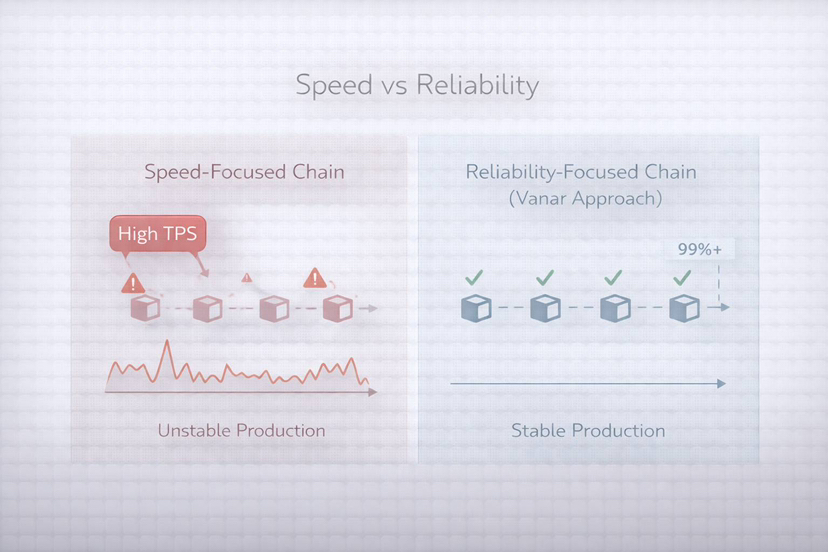
Vanar would like to be a system that can be used in the real world. Not only does it work well in an ideal setup, but it even works with a failure of nodes, endpoints halting, traffic bursts, and real users demanding the app to keep running.
It might not be very interesting, but it is. Adoption lives exactly here.
The most adopted truth that most of the people would not want to believe is the fact that reliability is the product.
Most networks sell speed. However, when launching the real applications, teams do not select a chain simply because it is the fastest. The question that they pose is which chain will not shock them when it comes to production.
Shockers kill products, budgets and good faith.
The latest report by Vanar regarding the upgrade of V23 protocol is centered on resilience and operations as opposed to pure performance. Various articles distributed by the media indicate that it was not a normal update. It was developed with a payments-grade ethos, and a federated agreement model based on the Stellar vision of consensus and focusing on stability in the event of failure.
Although you are cutting the marketing later, it still counts: We design to up, not to applause.
A network, which will consider infrastructure validators and not only stakers.
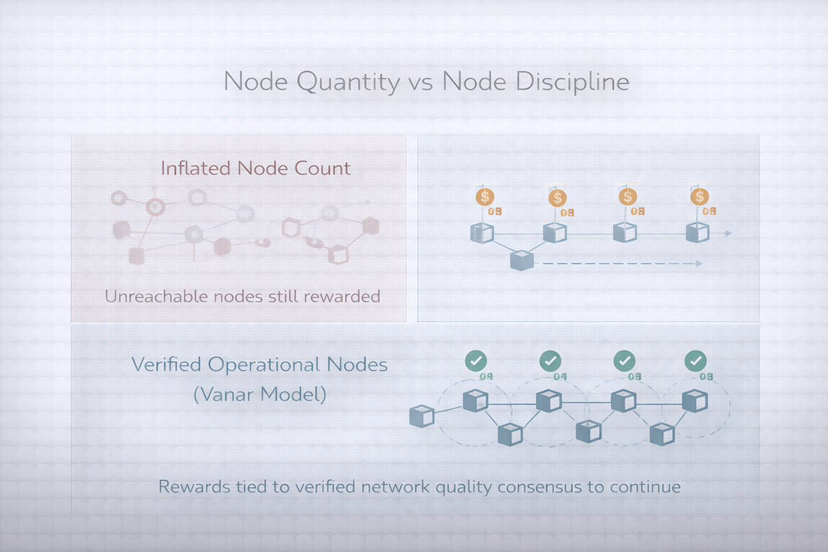
Most people miss this. Most networks make it a game to participate in, join, stake, earn. Your node is not consistently considered to be healthy, reachable and useful by the network. That will result in inflated node count, unreliable uptime, and a deceive of decentralization.
Vanar discusses a more practical problem: open-port verification which is the inclusion of node reachability in the security model and the attaching of rewards to the fact of reachability. The concept is also straightforward: when your node is not reliably reachable, it should not be rewarded in such a way that it is contributing.
It is not a crypto innovation in the sense that it is a production principle: the rewards must not be based on claims only, but on actual service.
That is where the network does not feel that it is a token economy but rather SRE playbook.
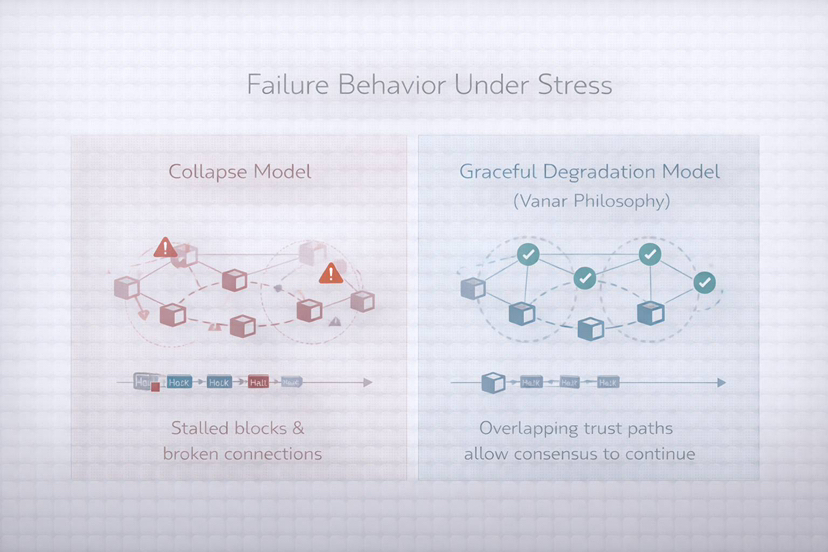
Scaling does not imply that it never fails, it means graceful degradation.
Live systems break down - networks, hardware, and humans do not set things up straight. It is not a question of whether the failures occur it is whether the chain collapses when they occur.
The V23 messaging of Vanar highlights resilience several times, with a further consideration on the existence of consensus, the increased fault tolerance, and the recovery.
I do not mean by this that distributed systems are magically solved--nothing is. But Vanar is choosing the appropriate field of battle: the battle of confidence.
It is an uncommon move in this industry.
The dullness that really trains developers.
Frankly speaking, the simplest method to estimate, whether a chain is trying to be adopted in the first place, is to look at its onboarding journey, rather than the whitepaper or hype video.
The onboarding path.
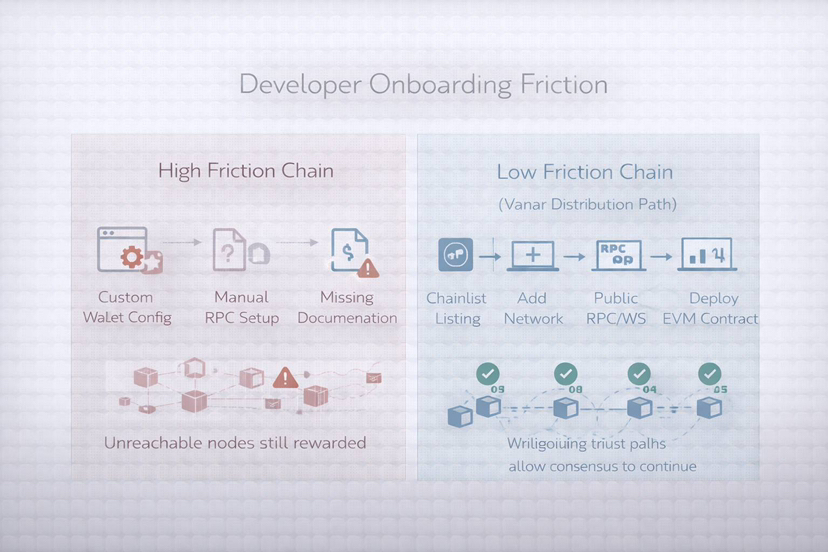
Chainlist and thirdweb are the primary locations where builders are present as of now: Vanar. Chainlist provides chain configuration to wallets which can add it through a normal flow. Vanar mainnet and the chain ID are displayed in a format that teams can use instantly by Thirdweb.
Then consider the official network information: there is a public RPC endpoint, there is a public WebSocket endpoint, there is chain ID and there is a clean and normal explorer.
That is important since developers do not like the novel rituals; they prefer to have the same ones. A network that is stepwise eliminates drop-off.
So when I see:
RPC: https://rpc.vanarchain.com
WS: wss://ws.vanarchain.com
Chain ID: 2040
I don’t just see endpoints. I observe a network that is attempting to become user friendly.
The actual stress test is payments and Vanar is leaning into it.
In the event that any of the categories present poor infrastructure, it is payments. Checks discard quaintness, lengthy queues, and leave till later.
The collaboration between Vanar and Worldpay is among the limited crypto measures that indicate the willingness to fulfill actual rails. Worldpay is the company that handles more than 2.3 trillion transactions every year in 146 countries, which is the magnitude that Vanar will be operating at.
Here enterprise-ready no longer is a phrase, but an obligation.
The mention of the words payments implies a requirement of reliability, compliance, predictable behavior and clean failure handling.
Vanar stooping into that arena is not the prudent thing to do, but it is the grave thing.
Why the number of nodes will not impress me, but will the discipline of the nodes.
Numerous initiatives boast of a giant node count. However, I pose an even more pointed question, how many of those nodes are healthy, accessible, and actually a part of a healthy network?
More recent Vanar write-ups assert that approximately 18,000 on-chain nodes were under network after V23, and the network continued to have a very high transaction success rate despite a high daily volume.
I do not have such numbers as a prize; I have them as a challenge-claim.
This is why open-port check is important: it demonstrates that Vanar is not only worried about the quantity of nodes but their quality.
Pointlessly stated: in order to achieve enterprise adoption, you should not execute your validator set as a vibes-based community; you require standards.
The Hidden Distribution Edge: Operation Familiarity.
It may be in simple terms: winning chains are not necessarily the most advanced. Their friction is normally minimal.
Vanar does not just distribute its strategy, but it targets to be part of the tools developers already have at their disposal. It provides network-set up flows, which are comparable to other EVM chains and also offers publicly available endpoints that can be tested immediately without requesting permission to access the team.
This acquaintance develops unobtrusively. Developers experiment the first time because it is easy, the next developer duplicates it, and a small project is deployed by a group of developers and is soon added to the list of supported networks.
It is the growth of ecosystems, this is not done through big announcements but by repeated low-friction decisions.
My opinion: Vanar Sells Confidence, and That Matters.
In retrospect, I would have Vanar portray the chain as being like a reliable infrastructure rather than a dice gambler casino.
This is reflected through the operational resilience emphasis in V23, its verification of nodes as a real operator, its obvious network structure and open endpoints, and its association with a payments giant such as Worldpay, where failures are a tangible business risk and not a simple bug.
The story is unlike AI, metaverse or speed-focusing chains. It is more expensive to raise since trust cannot be declared, it needs to be earned.
Conclusion: The Chains That Last Are the Chains You Can Work.
I do not believe that the feature count will be the determinant of the next wave of adoption. It will be determined by the ones that make builders and businesses feel safe to remain.
In my opinion, the biggest bet made by Vanar is no a headline feature. It is a working philosophy: it is a production machine in which reliability, verification, predictability are more than a hype.
They are not merely developing tech when they continue to lean into that. They’re building trust.