@Fogo Official Sessions: The Manual Nobody Wrote But Everyone Needed
You're mid-game. An action fires. A trade executes. An agent completes a task.
You didn't sign anything.
You didn't see a popup.
You didn't pay gas.
👉 That's not a bug. That's #Fogo Sessions working exactly as designed.
What Most Chains Get Wrong
The industry spent years obsessing over TPS. Faster. Higher. Record-breaking numbers posted on launch day, benchmarked under ideal conditions, announced to audiences who mostly just want things to work.
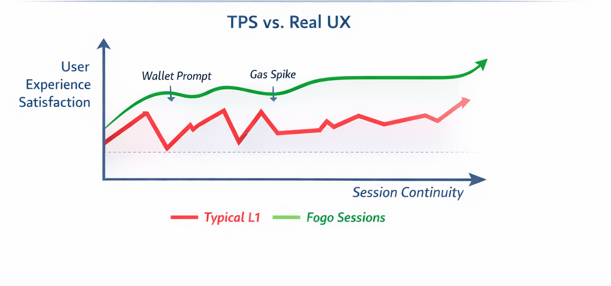
Here's the uncomfortable truth: TPS was never the bottleneck for real users.
The bottleneck was the moment your wallet asked you to sign. Again. The moment gas fluctuated and your transaction stalled. The moment an AI agent paused because it needed human input to proceed.
The bottleneck wasn’t whether my transaction could process 0.000001 seconds faster, or even 0.1 seconds faster 😅.
The real friction hit when:
“Please sign in” popped up… again.
“Did you really want to sign in again?” appeared… again.
“Solve 10 captchas, do 2FA, and send us your third cousin’s grade report from 3rd grade to confirm your identity” — all after five minutes.
That’s what kills UX. That’s what Fogo Sessions solves.
Real usage doesn't look like a stress test. It looks like a gamer who quits the moment friction appears. It looks like an agent workflow that breaks the second it needs a confirmation that never comes. It looks like a DeFi user who abandons a session because the UX made them feel like they were operating a command line, not a product.
Fogo Sessions was built as the answer to that problem.
What Fogo Sessions Actually Are
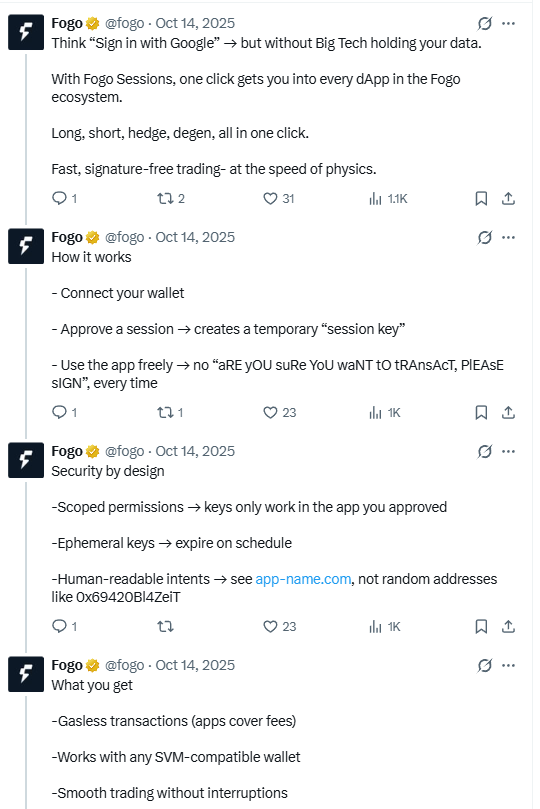
At its foundation, Fogo Sessions is an Account Abstraction layer — but that phrase doesn't do it justice on its own.
Here's the cleaner way to think about it:
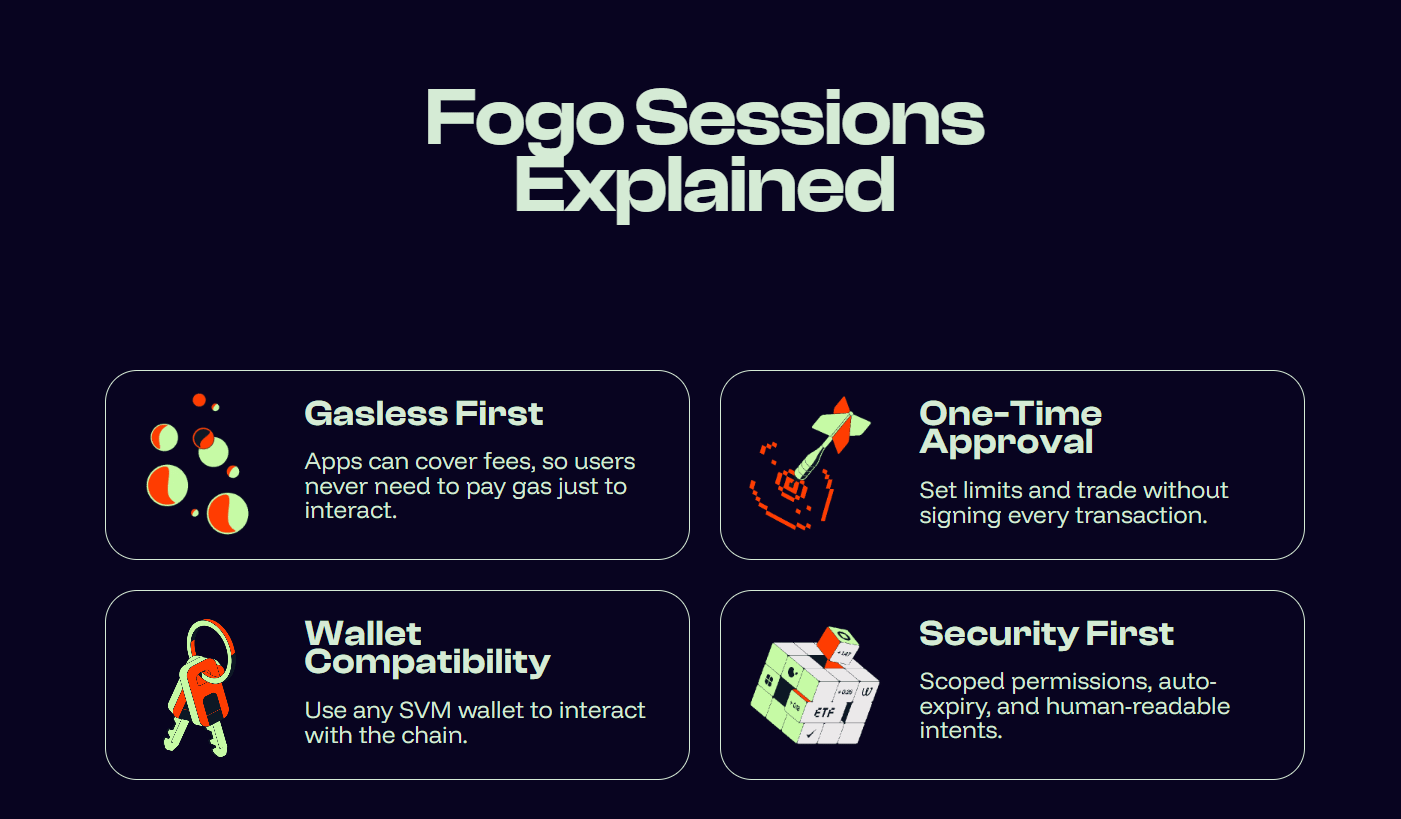
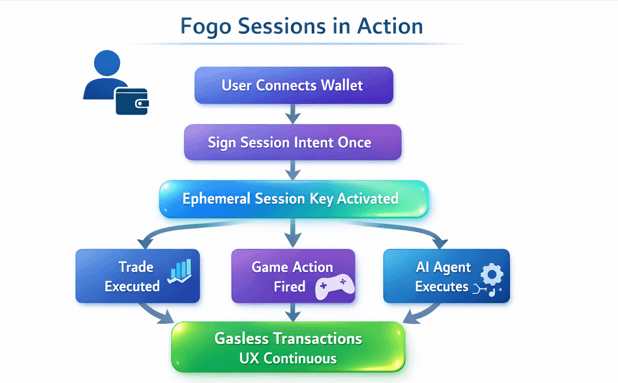
You sign once. A temporary session key takes over from there. Every action within your authorized scope — trades, in-game moves, agent executions — gets handled automatically, without pulling you back to the wallet for each one.
Combined with Gasless Transactions, where fees are covered by the app or a paymaster rather than deducted from your wallet mid-session, the result is an experience where the blockchain infrastructure becomes genuinely invisible.
Users interact with the application. The mechanics happen underneath. Nobody has to care that it's on-chain unless they want to.
That's the UX goal. Not a smoother confirmation dialog. The absence of one entirely.
Why SVM Makes This Possible at Scale
Fogo runs on the SVM — the Solana Virtual Machine — which gives it a specific execution environment that developers already understand and contracts can already target.
This matters for Sessions because account abstraction only works when the underlying execution is predictable. If the chain congests unpredictably, if fees spike mid-session, if confirmation times vary wildly — the session model breaks down. Ephemeral keys firing transactions into an unreliable environment produce unreliable results.
SVM compatibility paired with Fogo's performance architecture means sessions can fire in sequence, at volume, without the inherited congestion problems that make account abstraction fragile on other chains.
For real usage — not demos, not testnet runs, actual users doing actual things — that reliability is what separates a feature from infrastructure.
How to Use Fogo Sessions: Step by Step
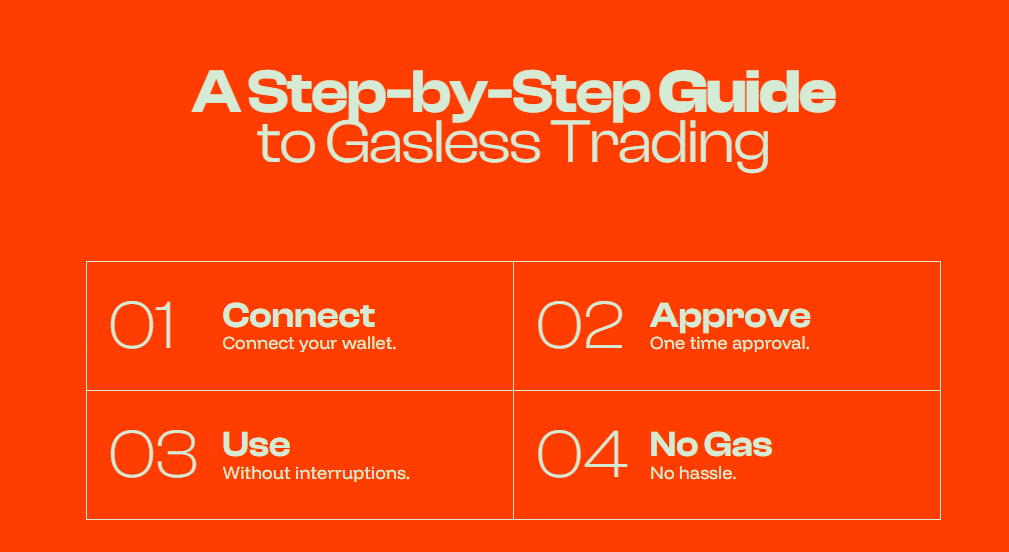
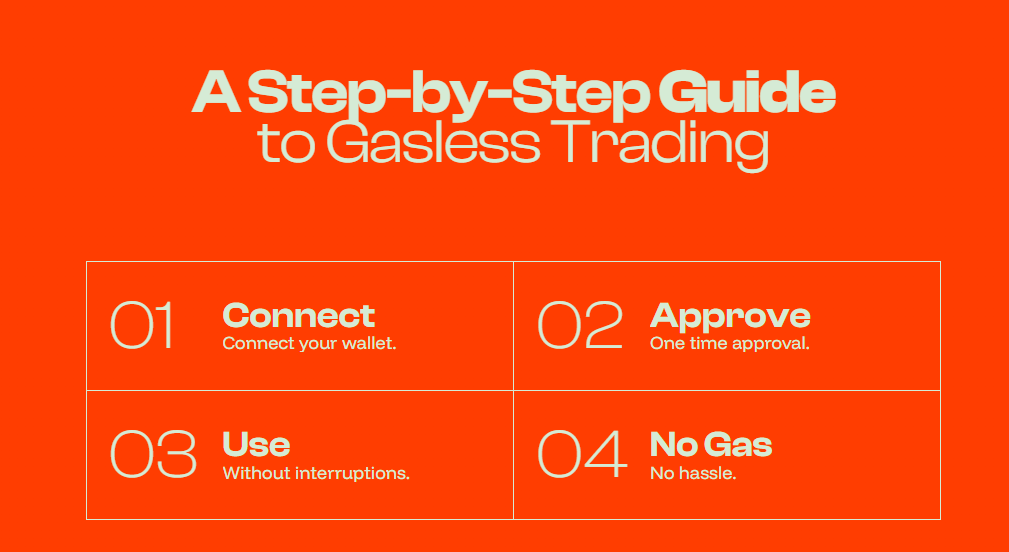
Step 1 — Connect your SVM-compatible wallet
Standard connection. Nothing unusual here. Phantom, Backpack, or any wallet familiar to the Solana ecosystem works.
Step 2 — Sign a session intent message
This is your one-time authorization. You define the scope — which app, which actions, what limits. You sign once. That's it.
Step 3 — Let the session key take over
From this point, the ephemeral key handles everything within your authorized scope. Trades execute. In-game actions fire. Agent tasks complete. No interruptions.
Step 4 — Session expires automatically
Security is maintained because sessions aren't permanent. When the session ends — either by time limit or user action — the key expires. You're back to standard custody. Nothing lingers.
For developers:
Sessions can be scoped tightly, fees can be sponsored to enable fully Gasless Transactions for end users, and the entire flow runs on SVM-compatible contracts without requiring new tooling.
Who This Is For
Gamers and metaverse users — sessions mean uninterrupted play. The blockchain does its job without interrupting yours.
DeFi users running strategies — automated execution without repeated approvals. Your position manages itself within the parameters you set.
AI agents and autonomous systems — this is the big one. Agents require infrastructure that doesn't need human confirmation at every step. Fogo Sessions gives agents the ability to execute reliably, repeatedly, and predictably. That's not a convenience — it's a requirement for agent-driven real usage at scale.
Developers building consumer apps — the UX problem is solved at the infrastructure level. You don't have to engineer around wallet friction because the friction isn't there.
Before and After
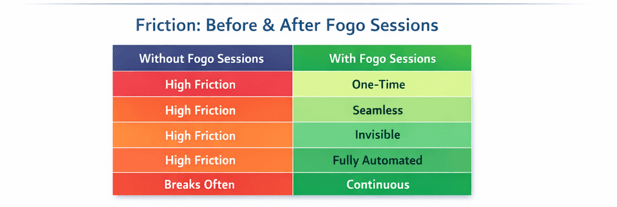
Without Fogo Sessions:
User connects → action → wallet prompt → gas approval → wait → confirm → action → wallet prompt → repeat
Every step is a dropout risk. Every prompt is a user who might not come back.
With Fogo Sessions:
User connects → signs once → everything else happens
That's the entire difference. And in consumer products, that difference is everything.
📚Glossary
Fogo Sessions — An account abstraction system that lets users authorize a session once, after which a temporary key handles all subsequent authorized actions automatically.
SVM (Solana Virtual Machine) — The execution environment Fogo uses. Familiar to Solana developers, predictable in execution, and capable of supporting high-throughput session-based interactions.
TPS (Transactions Per Second) — A measure of chain throughput. Important, but not the primary friction point for real users. UX and session continuity matter more at the product level.
Account Abstraction — Infrastructure that separates the user's identity from the mechanics of transaction signing, enabling automated, scoped execution on their behalf.
Gasless Transactions — Transactions where the end user doesn't pay gas directly. Fees are handled by the application or a paymaster, removing a major friction point from the user experience.
UX (User Experience) — How a product feels to use. In blockchain context: how many times a user has to think about the fact that they're using a blockchain. Good UX minimizes that number.
Real Usage — Actual network behavior under normal conditions — real users, real traffic, real edge cases. Not benchmarks. Not demos. The thing that determines whether a product survives past launch.
The Bottom Line
Fogo Sessions isn't a feature announcement. It's a position statement about what blockchain infrastructure should feel like for the people actually using it.
The chains that reach mainstream adoption won't be the ones that posted the highest TPS on launch day. They'll be the ones that made Gasless Transactions feel normal, made Account Abstraction invisible, and built UX that didn't require users to understand what SVM means before they could enjoy what it enables.
Real usage doesn't happen at benchmarks. It happens when people stop noticing the infrastructure and start focusing on what they came to do.
Fogo Sessions is the mechanism that makes that possible.
Did I forgot to mention its gasless?
No gas.
Gas free.
Gas is not your problem with fogo sesions.
Gas free - let that sink in 🔥!