


Let me tell you something strange. The blockchain world doesn’t move in straight lines. It moves in waves, hype, silence, then sudden explosions of progress that most people only notice when it’s already too late. Fogo feels like one of those moments. Quiet. Building. Heating up under the surface.
You and I have seen this story before. A new Layer-1 shows up claiming speed, scale, and a better future. Most fade. Some survive. Very few matter. So when I first heard that Fogo runs on the Solana Virtual Machine, I didn’t jump out of my chair. I leaned back. Curious. Because speed alone is cheap. Real performance is not.
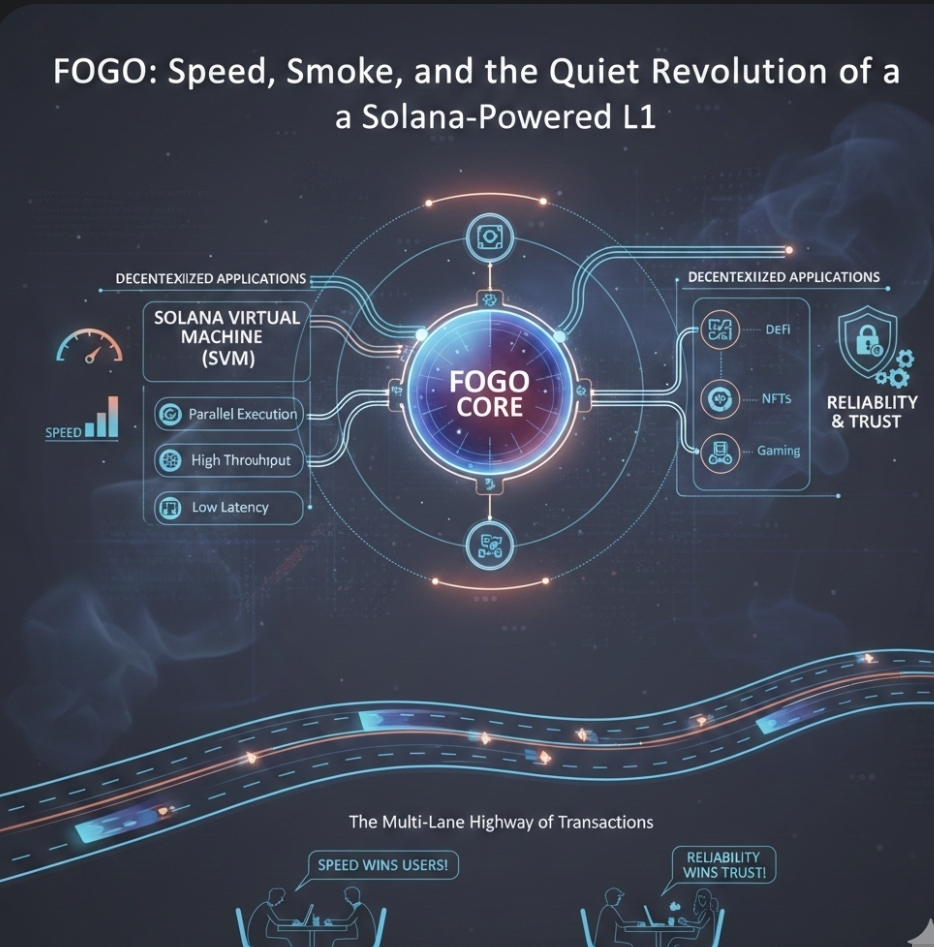
Here’s the thing. The Solana Virtual Machine isn’t just a piece of tech, it’s a philosophy. Parallel execution, high throughput, low latency — words that sound technical, almost cold, until you imagine a crowded highway suddenly turning into ten open lanes with no traffic lights. Cars don’t stop. They flow. That’s the promise. And Fogo? It’s trying to build an entire city around that highway.
But technology is only half the story. Always is.
I want you to picture a small café. Morning light. Two developers hunched over laptops, arguing about block time like it’s life or death. One says speed wins users. The other says reliability wins trust. Both are right. That tension lives inside every serious blockchain. Fogo included. Fast chains break if they rush. Slow chains die if they hesitate. Somewhere in between, a sweet spot exists. Hard to find. Harder to hold.
So why does this matter?
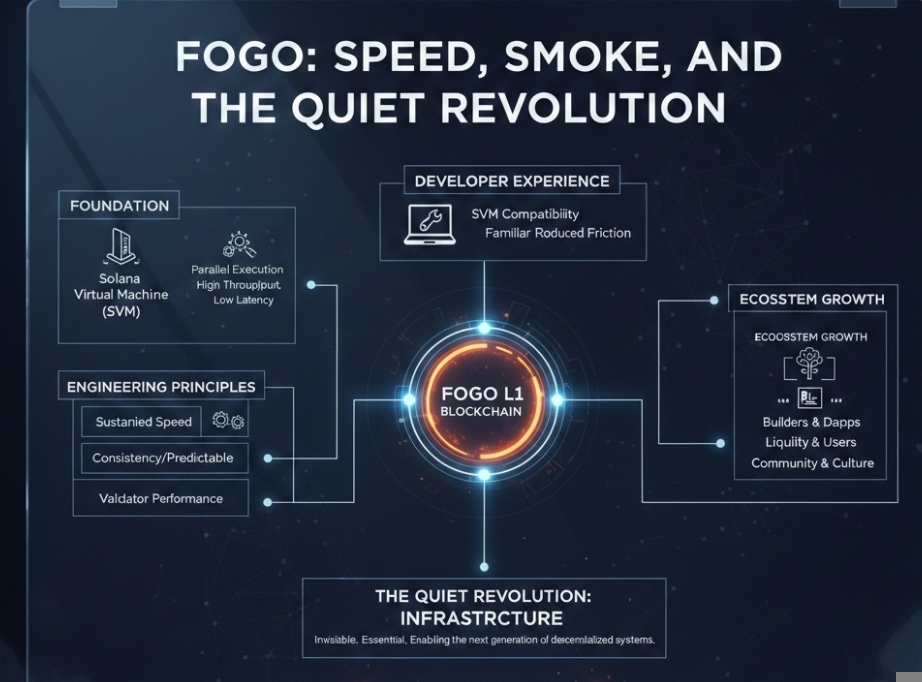
Because infrastructure decides the future long before users arrive. You don’t see the foundation of a skyscraper, but without it the building collapses. Fogo is working on that invisible layer — execution efficiency, validator performance, system throughput — the boring words that quietly decide whether millions of users can exist on a network without chaos. Not sexy. Critical.
And here’s where it gets interesting.
Using the Solana Virtual Machine means Fogo isn’t starting from zero. It’s stepping into an ecosystem already shaped by speed-focused design. Developers familiar with Solana tools don’t feel lost. Code doesn’t feel foreign. Imagine moving to a new country and discovering everyone speaks your language. You settle faster. Build quicker. Dream bigger. That’s the advantage of compatibility. It reduces friction, and friction is the silent killer of innovation.
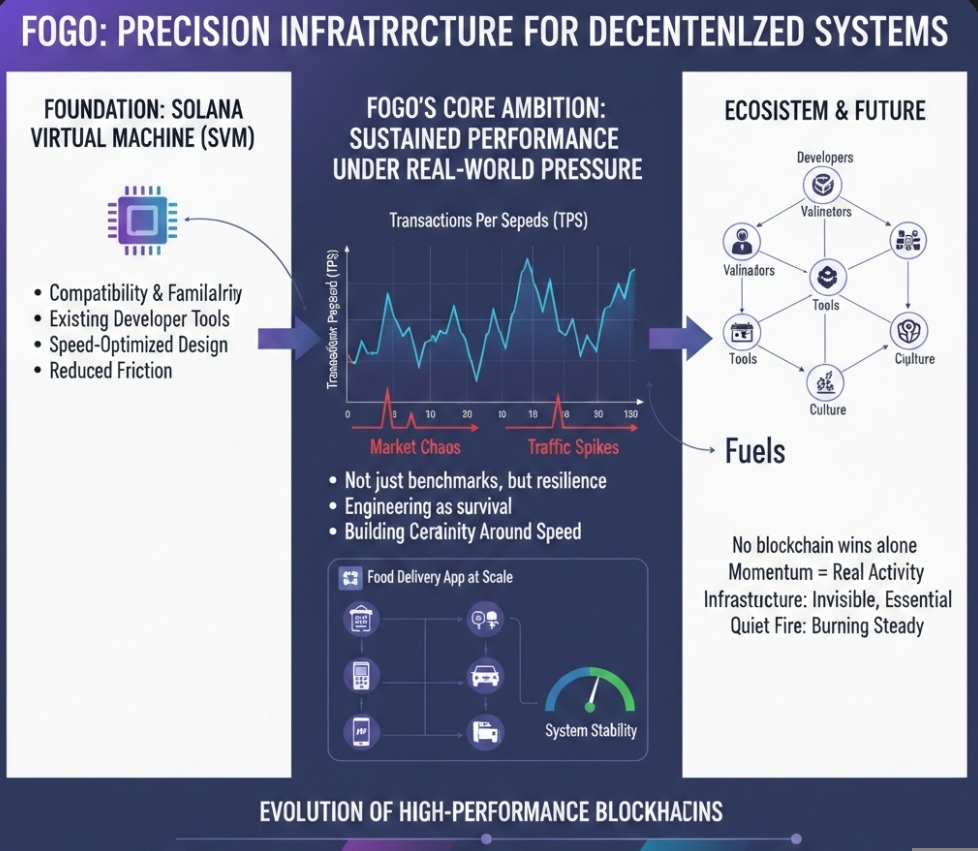
Still, raw performance alone won’t change the game. Many chains are fast in empty conditions. Few remain fast under pressure. Real pressure. I’m talking thousands of transactions hitting at once, bots competing, users panicking, markets moving like storms. That’s when truth appears. Systems either glide… or crack.
Fogo’s ambition is simple to say, difficult to achieve. Sustain speed. Always. Not just in benchmarks, not just in controlled demos, but in messy real-world chaos where humans behave unpredictably and markets refuse to stay calm. This is where engineering stops being theory and becomes survival.
Let me explain with a small story.
Imagine a food delivery app during a massive football final. Orders flood in. Restaurants update menus. Drivers move everywhere. Payments process nonstop. If the system slows by even two seconds, frustration begins. Five seconds? People leave. Ten seconds? The platform collapses into complaints and refunds. Now replace food orders with financial transactions worth millions. That’s blockchain at scale. Speed isn’t luxury. It’s oxygen.
But here’s the deeper layer most people miss.
Performance isn’t only about transactions per second. It’s about consistency. Predictability. Confidence. Users don’t ask, “Is this chain theoretically fast?” They ask, “Will my transaction go through right now?” Trust is built in milliseconds. Lost even faster. Fogo’s real challenge is not building speed, but building certainty around speed.
And you know what makes this journey fascinating?
We are still early. Very early. The architecture of high-performance blockchains is evolving like the early internet once did messy, experimental, sometimes fragile, occasionally brilliant. Some ideas fail loudly. Others quietly become standards. Fogo is part of that experiment, pushing the idea that execution-focused design can support the next generation of decentralized systems without sacrificing usability.
But let’s pause. Reality check.
No blockchain wins alone. Ecosystems win. Developers, validators, users, tools, liquidity, culture all of it matters. A chain can be technically perfect and still irrelevant if nobody builds on it. This is where momentum becomes everything. Not hype. Real activity. Real builders solving real problems.
And honestly, this is where I lean forward a bit.
Because if Fogo manages to combine sustained performance, developer familiarity through the Solana Virtual Machine, and real ecosystem growth, it won’t just be another fast chain. It could become infrastructure the kind people use without thinking, like electricity or the internet itself. Invisible. Essential.
But nothing is guaranteed. Ever.
Technology evolves. Competitors adapt. Markets change direction overnight. The blockchain space is ruthless to projects that slow down even slightly. Fogo must keep optimizing, keep attracting builders, keep proving that its speed is not temporary but structural. A promise repeated is marketing. A promise consistently delivered becomes reality.
So where does that leave you and me?
Watching closely. Not blindly believing, not instantly dismissing. Observing progress, adoption, resilience. Because in this space, the loudest projects are rarely the most important. Sometimes the real shift happens quietly, under layers of code and engineering decisions most people never see.
Fogo feels like one of those quiet fires. Not exploding. Burning steady. Preparing.
And maybe, just maybe, one day people will look back and say the next phase of high-performance blockchain infrastructure didn’t arrive with noise… it arrived with precision.