
There’s a particular kind of silence that falls over you when a transaction doesn’t go through in time.
It’s not loud. It’s not dramatic. It’s just a subtle sinking feeling in your chest. The market moves. The chart shifts. The opportunity you saw — the one you calculated, believed in — slips away while your screen still says “pending.”
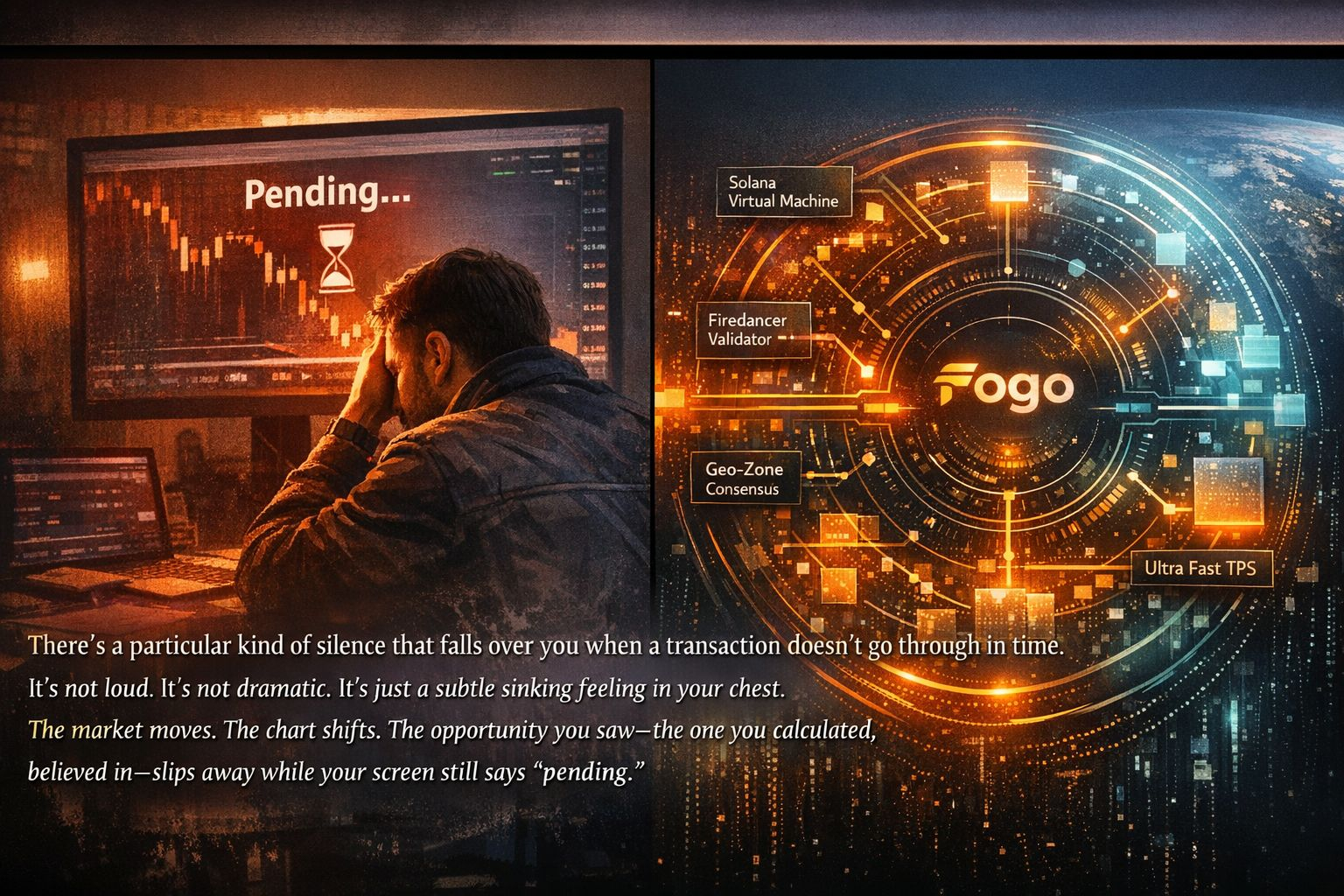
For years, we’ve learned to live with that feeling in crypto. We’ve told ourselves that decentralization is supposed to be slower. That freedom requires patience. That if you want trustlessness, you must tolerate delay.
But somewhere along the way, that explanation stopped feeling satisfying.
That quiet dissatisfaction is the emotional backdrop behind Fogo — a high-performance Layer-1 built on the Solana Virtual Machine, originally engineered by Solana Labs. Fogo isn’t just a technical iteration. It’s a response to a shared frustration — a refusal to accept that decentralized infrastructure must feel like it’s constantly catching up.
The Solana Virtual Machine (SVM) changed the conversation around blockchain execution by allowing parallel processing. Instead of transactions lining up one after another like cars stuck in traffic, they can execute simultaneously when they don’t conflict. It was a shift from sequential bottlenecks to computational highways. Fogo takes that highway and widens it further, optimizing for environments where milliseconds aren’t theoretical — they’re consequential.
Because in markets, time is emotional.
A few milliseconds can mean the difference between profit and regret. Between precision and slippage. Between confidence and hesitation. Fogo leans into this reality with block times measured in tens of milliseconds and throughput designed to support serious financial activity — order books, derivatives, high-frequency trading, automated strategies. It is infrastructure built with the understanding that financial systems demand responsiveness.
But what makes Fogo different isn’t just speed. It’s how it thinks about distance.
Global decentralization is powerful — but geography still exists. Validators scattered across continents must communicate across oceans. Even light has a limit. Fogo experiments with a rotating, zone-based validator leadership model, clustering validators geographically during consensus epochs and rotating leadership across regions. It’s a subtle but meaningful acknowledgment that physical reality cannot be ignored, even in digital systems.
There’s something deeply human about designing around limits instead of denying them.
Underneath the architecture is ruthless efficiency. Execution pipelines are refined to reduce idle cycles. Networking layers are optimized for minimal propagation delay. Predictable finality becomes a goal — not just eventual confirmation, but consistency. When systems behave predictably, users trust them differently. They stop bracing themselves. They stop doubting whether the network will keep up.
And then something shifts emotionally: interacting with the chain stops feeling like a gamble.
Fogo also rethinks interaction itself. Through session-based mechanisms, users can delegate limited permissions for a defined window of time, reducing the constant need to re-sign every action. It’s not about weakening security. It’s about respecting human flow. When using decentralized applications feels seamless rather than ritualistic, the experience becomes less intimidating and more intuitive.
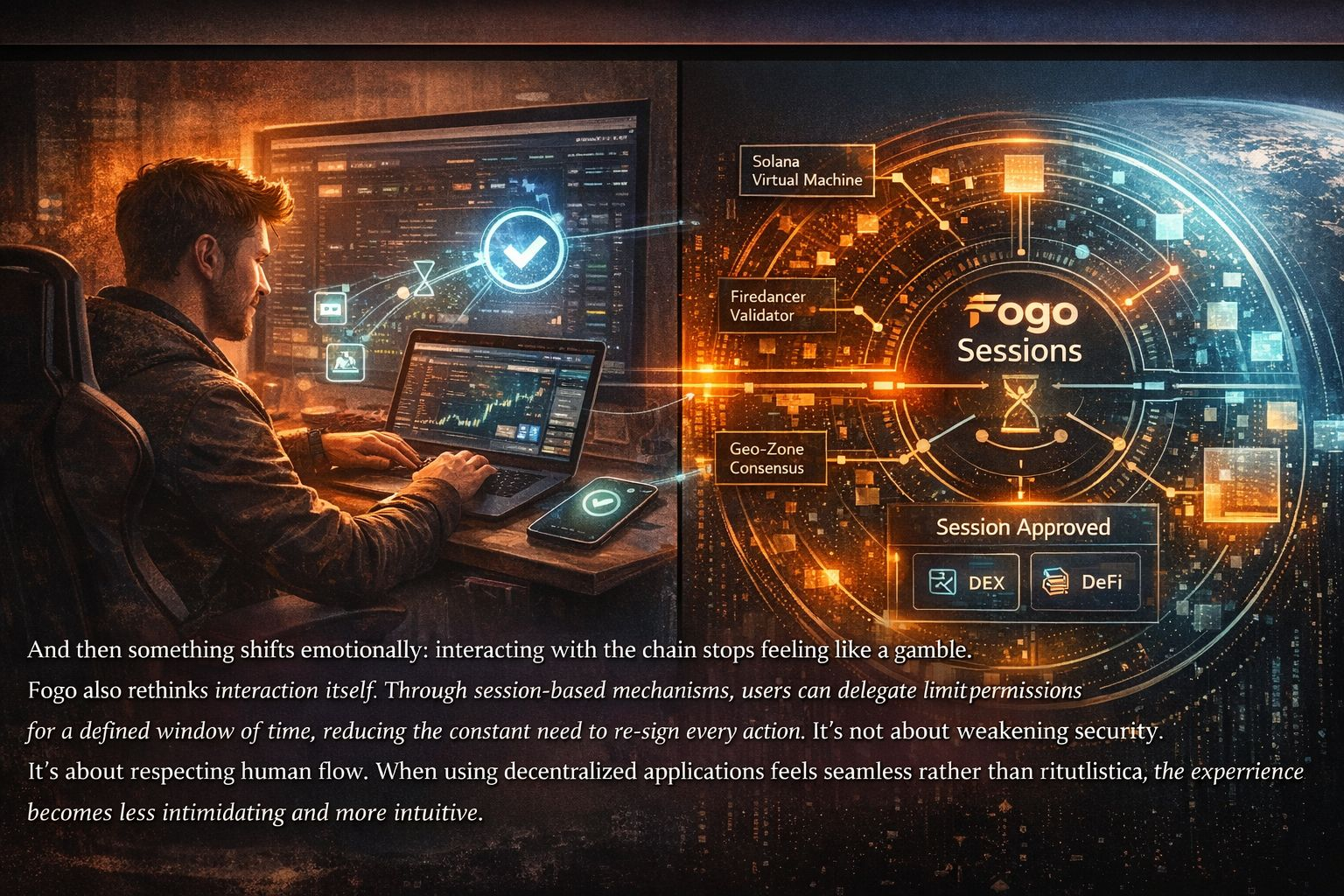
That matters more than most technical metrics.
Because adoption isn’t driven by TPS alone. It’s driven by how a system makes people feel. Safe. Fast. In control.
The network’s native token plays its part quietly but critically — securing consensus, aligning validators, paying for computation. It’s not positioned as decoration. It’s fuel. Participation in governance and validation becomes not just technical involvement but emotional ownership. A sense that this infrastructure belongs to its users.
Of course, ambition at this level carries weight. Pushing performance to the edge means there’s less room for inefficiency. The network must withstand volatility spikes, malicious actors, validator churn, and real-world economic stress. High-performance systems are tested hardest when markets are chaotic. That’s when architecture either proves itself — or cracks.
Fire, after all, doesn’t just illuminate. It tests what can survive heat.
And maybe that’s why the name feels fitting.
Fire transforms raw material into something stronger. It strips away excess. It forces evolution. In a similar way, Fogo represents an attempt to burn away an old assumption in crypto — that decentralization and performance exist in permanent tension. That you must choose between ideals and execution.
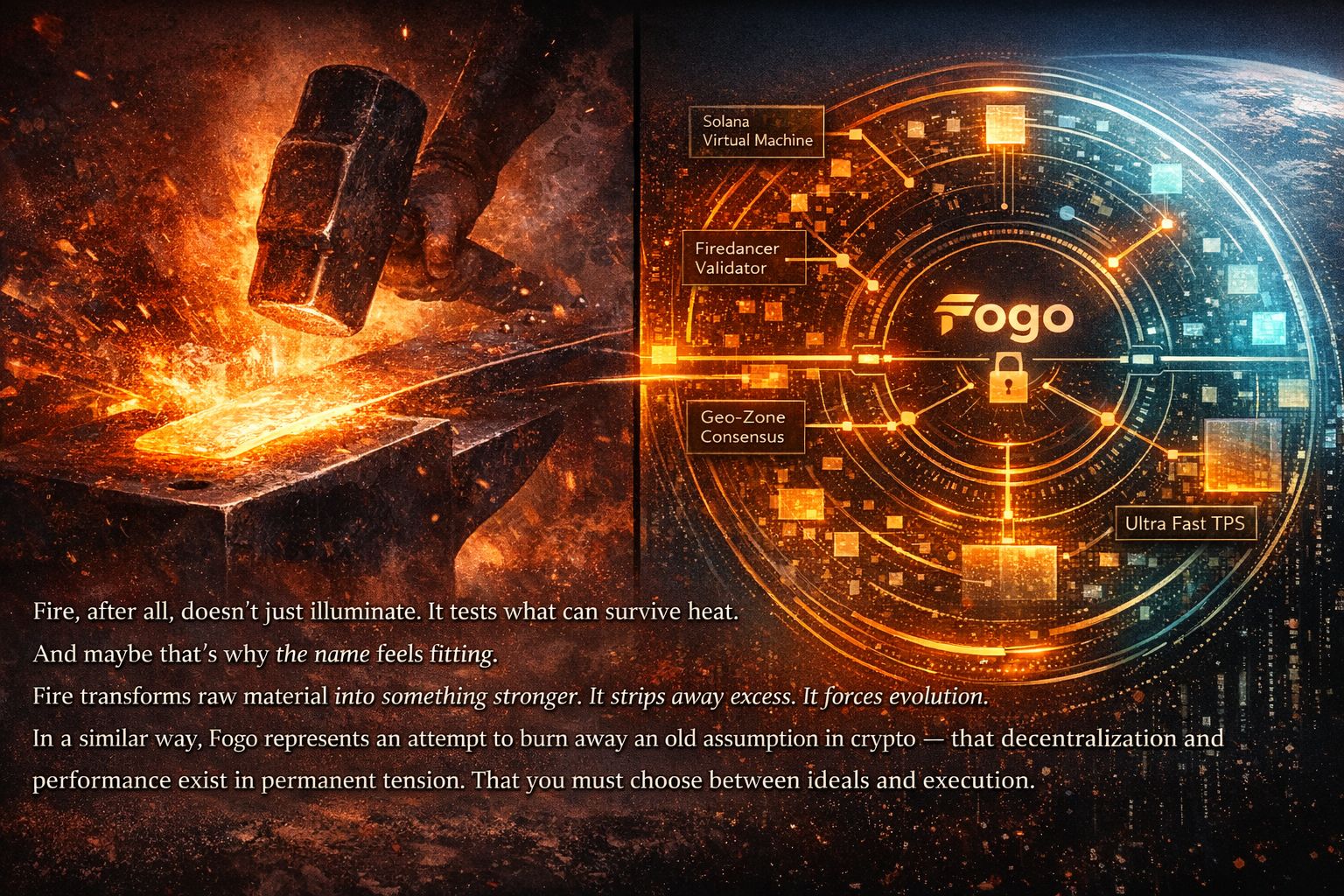
What if you don’t?
What if placing an order on a decentralized exchange feels as immediate as tapping a button on a centralized one? What if on-chain trading doesn’t require emotional patience? What if financial sovereignty moves at the pace of thought instead of the pace of confirmation?
These are not just technical goals. They are psychological ones.
Because the deeper issue isn’t latency — it’s confidence. When a network responds instantly, users feel heard. When it behaves consistently, builders feel empowered. When infrastructure keeps up with intention, trust deepens.
For too long, we’ve tolerated friction in the name of principle. Fogo challenges that compromise. It suggests that autonomy doesn’t need to feel heavy. That decentralization can be fluid. That cryptographic integrity and real-time responsiveness don’t have to live on opposite sides of a trade-off.
It’s still early. Every Layer-1 must earn its place through resilience and real adoption. Whitepapers don’t determine longevity — usage does. Markets do. Community does. But there’s something undeniably powerful about a project that dares to reimagine not just how blockchain works, but how it feels.
Because in the end, technology that aligns with human tempo stops feeling like infrastructure.
It feels like momentum.
