
I keep thinking about how most “high-speed” chains talk like speed is a software feature, when it’s really a geography problem. You can optimize the VM all day, but the moment your validators are spread across oceans, your users are waiting on fiber, routing, congestion, and the slowest tail of the network.
What feels different about Fogo is that it says the quiet part out loud: latency is the base layer, and the slowest slice of the network decides what “fast” means in real life. The litepaper even puts numbers on the physics transatlantic round trips are often ~70–90 ms, and New York Tokyo can be ~170 ms which is basically a reminder that “instant” is a marketing word unless you design around distance.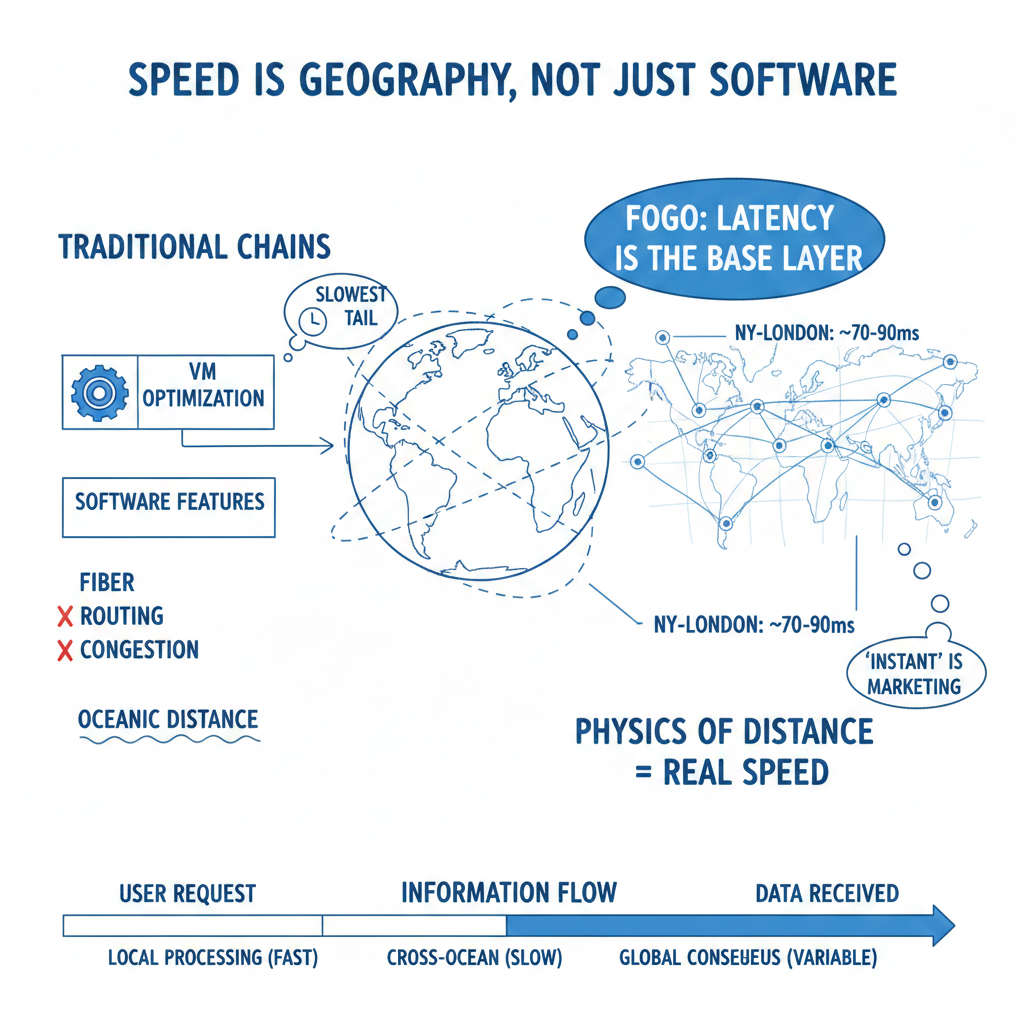
So yes, Fogo uses the Solana Virtual Machine, and that matters because it keeps the execution model familiar and compatible, but the more interesting part is where it puts its energy: not “new syntax,” not “new buzzwords,” but the ugly operational stuff most people avoid network topology, validator variance, and the critical path that determines how confirmations feel.
When I try to explain Fogo to a friend, I don’t start with “it’s SVM.” I start with an image: a global team trying to approve every decision on a single group call. The call quality is your consensus. The worst connection is your finality. Fogo’s zoned design is basically saying: “Stop forcing every block to be a planet-wide argument.”
The litepaper describes a validator zone system where only one zone is active for consensus during an epoch, and the active zone can rotate over time. In human terms, it’s like shifting the “meeting room” so the people who must agree right now are closer together, instead of pretending distance doesn’t matter.
That idea naturally creates a second requirement: if you want the network to behave like a real-time system, you can’t let performance be a lottery. Fogo leans into “performance enforcement” as a philosophy standardizing around high performance validation so the network’s behavior is less dictated by random slow outliers and more by a predictable quorum path.
The latest update that matters is that this isn’t just theoretical anymore. Fogo launched its public mainnet on Jan. 15, and reporting around the launch says it was running ~40 millisecond block times and more than 1,200 transactions per second with its first mainnet application.
It also follows a token sale that offered 2% of supply at a $350M valuation, raising roughly $7M for the foundation.
Here’s why I care about those numbers in a non hype way: they’re not trophies, they’re stress tests. A claim like 40 ms only becomes meaningful if it stays calm when the world is messy when congestion hits, when bots compete, when routing is weird, when the market is moving and people aren’t forgiving. That’s the moment you find out whether “fast” is a demo or a property the chain can defend.
And if I’m being honest, the part I watch most closely isn’t even raw block time. It’s whether Fogo’s design choices keep the experience stable without quietly concentrating power. Zoned consensus is a strong opinion. It reduces the distance on the critical path, but it also raises real questions about how zones are configured and how the active set stays credibly neutral over time. The point isn’t that this is a flaw the point is that it’s the real work, and Fogo is at least building in the direction where those trade offs are explicit instead of hidden.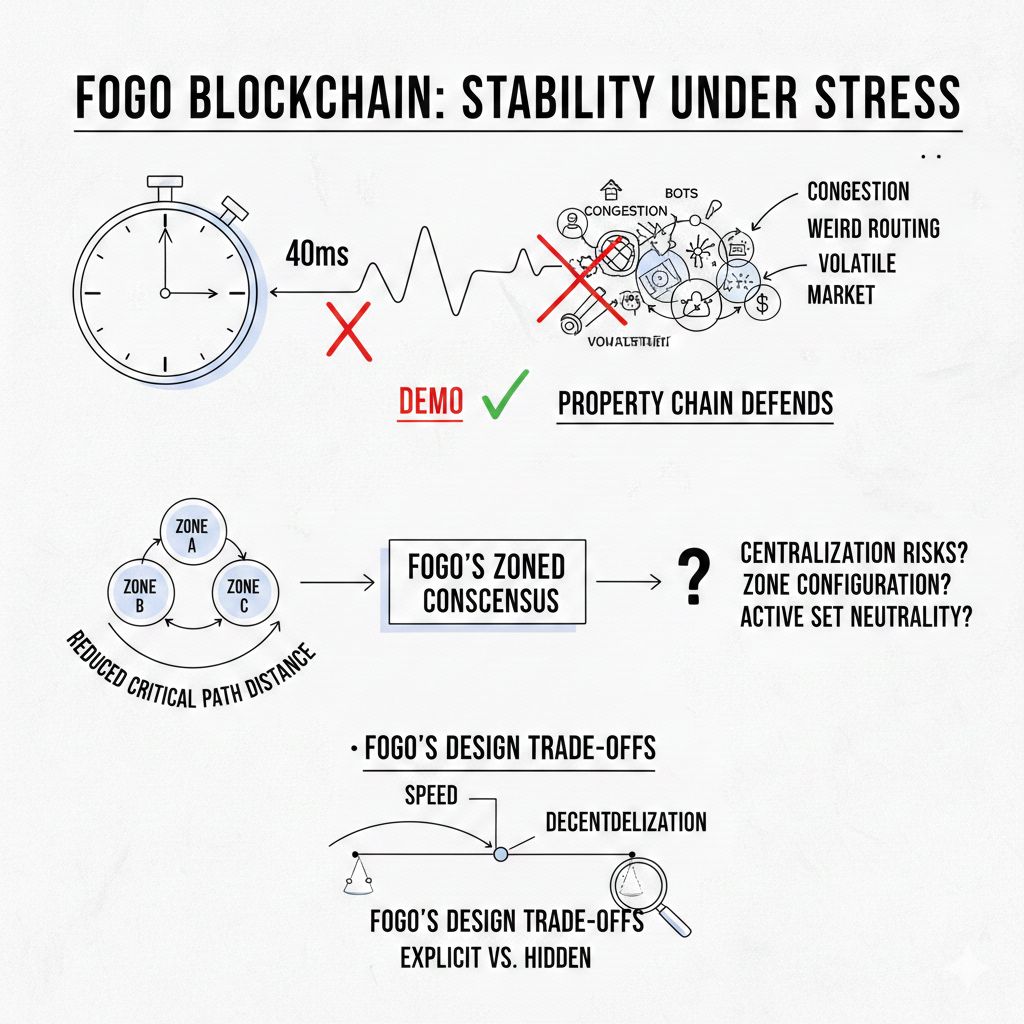
If the project succeeds, it won’t be because it found a new slogan for speed. It’ll be because it treated speed like an engineering constraint you design around physics, topology, variance and then shipped a network that stays responsive when users actually need it most.
