
Most people first hear about a performance chain through a number: TPS, latency, block time. That was also my first exposure to Fogo. Everywhere I looked, the conversation stopped at speed. Fast chains are easy to describe and extremely hard to build — but the more interesting question came later: what happens when nobody is watching the benchmark?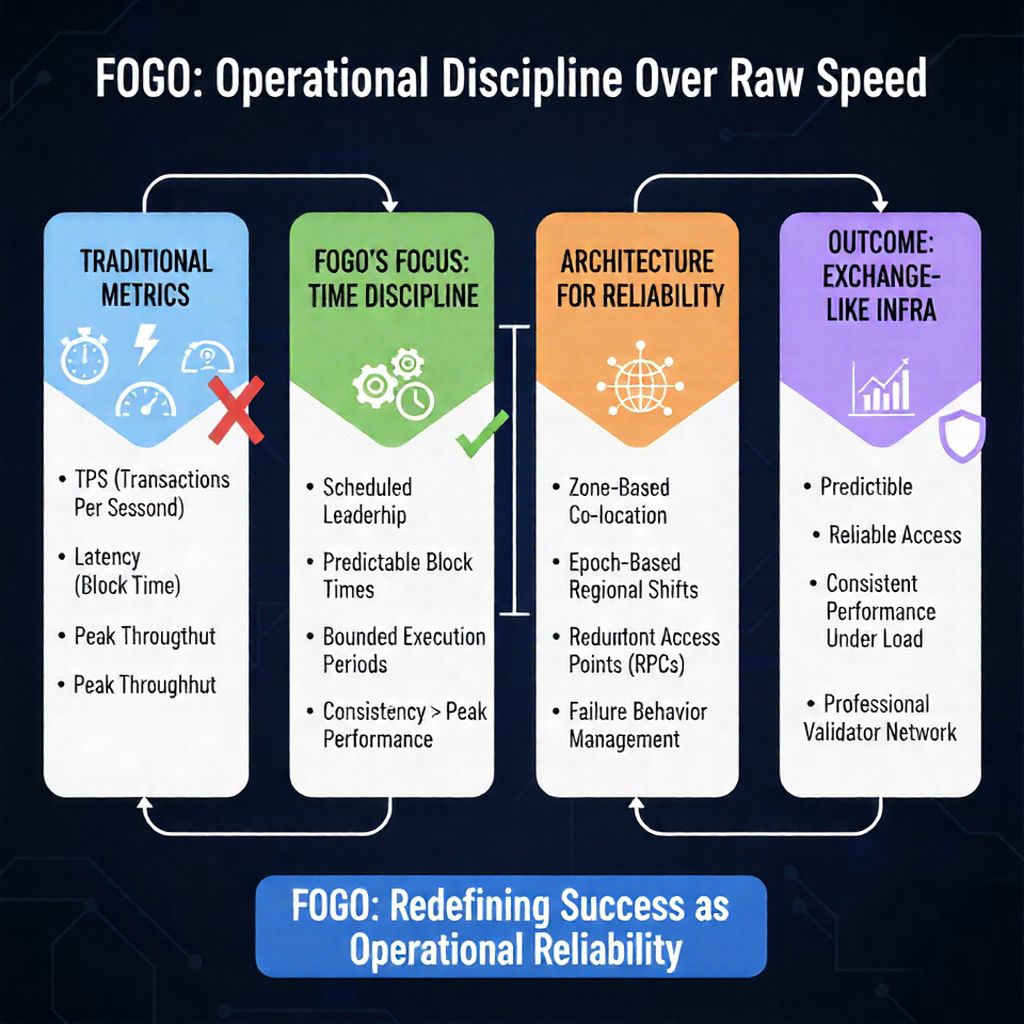
Not marketing dashboards, but actual operation. Who leads block production? How predictable is leadership? What happens when validators fail? Can developers rely on infrastructure at scale? At that point Fogo stopped looking like a typical crypto project to me and started resembling an operating system for trading infrastructure.
The conclusion I reached was simple: Fogo is not optimizing for speed, it is optimizing for time discipline. Speed is a moment; discipline is a behavior. The network defines explicit timing parameters even in testnet form — short block times and rapidly rotating leadership where a validator produces blocks briefly and then hands control to the next participant. Leadership is scheduled, repeatable, and bounded. That matters more than raw throughput because trading systems rarely fail due to lack of speed; they fail due to unpredictability. In real markets execution quality comes from consistency, not peak performance.
Traditional finance quietly understands something crypto often ignores: execution quality improves when systems are physically closer together. Exchanges rely on co-located infrastructure to minimize latency variance. Fogo openly accepts this reality through zone-based architecture where validators operate within close geographic spans to reduce consensus delay. But the more important detail is not co-location — it is rotation. Consensus shifts across regions on scheduled epochs. Each region gains the performance advantage for a period and then relinquishes it. Instead of pretending geography does not exist, the design distributes its benefits over time.
This is not centralization; it is controlled fairness. The network acknowledges trade-offs and then manages them rather than hiding them behind decentralization slogans. Hour-scale rotation creates an operational rhythm: long enough to observe stable performance, short enough to prevent dominance. The goal is not perfection but the removal of chaos variables.
The difference becomes clearer when thinking about performance as a service level instead of a maximum capability. Most chains advertise peak throughput. Real systems demand predictable latency, predictable access, predictable failure behavior, and predictable recovery. A network that behaves consistently under load matters more than one that occasionally reaches impressive benchmarks.
Infrastructure signals reinforced this view for me. A chain can be technically fast but practically unusable if developers cannot reliably access it. Users rarely feel consensus speed; they feel RPC stability. During testing, multiple regional access points were deployed separately from validators purely to improve availability and redundancy. That choice reflects production thinking. Reliability at the edges — endpoints, responses, accessibility — is where adoption lives.
Even the token’s role points toward operational structure rather than narrative. Validators stake to participate and process transactions, delegators support them, and participation requires consistent behavior. A tightly scheduled network cannot rely on casual operators. The architecture pressures participants toward professionalism because the system depends on it.
All these elements together — zoning, rotating leadership, deterministic timing, and redundant access — suggest a different ambition. The network is attempting to make a public blockchain behave more like exchange infrastructure. Not perfect, but controlled. Not just fast, but repeatable.
The real test of a performance chain is not a clean demo but stability during activity: nodes failing, traffic increasing, regions changing. If execution remains consistent across those conditions, the system can support real trading environments rather than simulated ones.
For me the takeaway is that performance in blockchains is often misunderstood as bragging rights measured in screenshots. Valuable infrastructure instead offers predictable operation: timing you can depend on, access you can rely on, and behavior that does not change under pressure. Fogo seems to be moving the conversation away from narrative competition toward operational reliability.
That is why I do not view it as trying to beat another chain. It is trying to redefine what winning means. If successful, it will not be remembered as just another fast network, but as an early attempt to treat blockchains as systems that must be run, monitored, and proven repeatedly — not merely announced.
@Fogo Official #fogo #FOGO $FOGO
