Introduction
When people talk about blockchains, they usually talk in big promises, but what I keep noticing is that most users don’t judge a chain by promises, they judge it by how it feels when they actually use it, especially during the messy moments when prices move fast and everyone rushes in at the same time, because that’s when a network either stays calm and dependable or starts to feel like it’s slipping out of your hands. Fogo is built for that exact reality, not the quiet demo reality, but the real market reality, and its identity is very clear: it wants to be a high-performance Layer 1 that runs the Solana Virtual Machine, so it can support the kind of speed, parallel execution, and developer familiarity that the Solana-style environment is known for, while pushing hard on consistency and operational performance in a way that feels closer to a trading-grade system than a hobby network.
What Fogo is and what it is aiming for
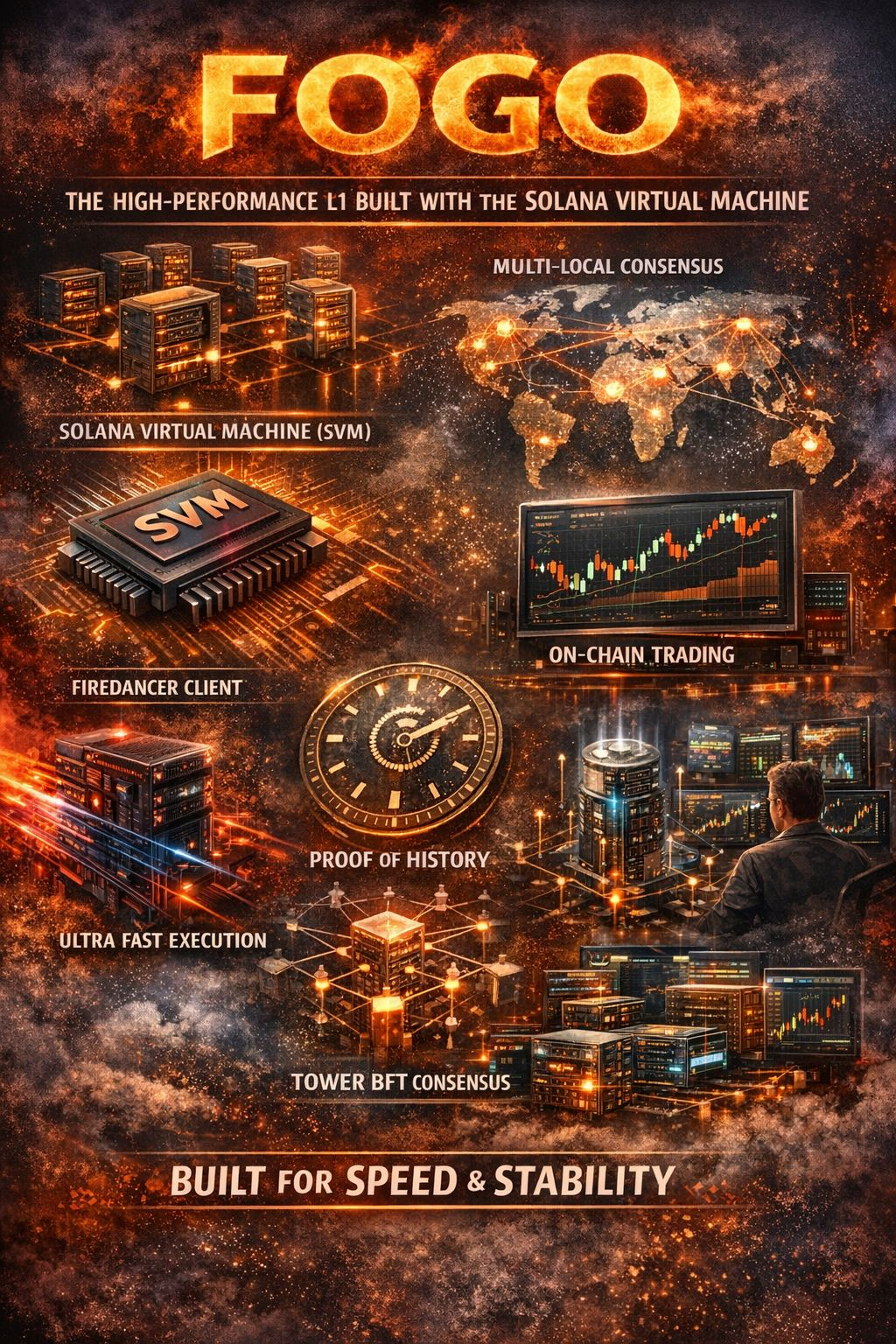
Fogo is best understood as a performance-first L1 that builds around the Solana Virtual Machine, which means it is designed to run SVM programs and use the Solana-style execution model rather than inventing an entirely new virtual machine that developers would have to learn from scratch. The emotional logic behind that choice is simple: ecosystems don’t grow because a chain is new, ecosystems grow because builders can ship quickly, users can trust the experience, and the network doesn’t crumble under pressure. When you inherit an execution environment that already has serious engineering behind it, you can spend your energy on the parts that decide whether users stay or leave, like block propagation speed, validator performance, confirmation latency, stability under congestion, and the operational discipline needed to keep the system smooth. If it becomes easy for existing SVM developers to deploy without rewriting their entire logic, then we’re seeing a path where adoption can happen through practical behavior rather than through hype.
Why the Solana Virtual Machine matters
People sometimes treat “SVM” as a label, but the real meaning is that it is an execution environment built around high-throughput assumptions, including the ability to process transactions in parallel when they do not conflict, which is one of the key reasons Solana-style systems can reach high performance compared to designs that serialize too much work. This matters because parallelism is not just a speed trick, it’s a design philosophy that changes how programs are written, how state is accessed, and how the chain schedules execution. For a new L1, choosing SVM is also a social and economic decision, because it reduces the migration cost for developers and makes it easier for tooling, practices, and knowledge to transfer. In plain terms, Fogo is saying that it wants to win by being a better venue for an already proven execution model, not by forcing the world to start over.
How Fogo works step by step
When a user sends a transaction, the journey looks simple on the surface but there’s a lot happening underneath, and understanding that flow helps you understand what a performance chain is really optimizing. First the user signs a transaction and broadcasts it through an RPC endpoint, then the network’s validators receive it and the current leader for that time window collects a set of transactions to include in the next block. In Solana-style designs, the leader schedule and the notion of time ordering are critical because they reduce coordination overhead and help the network keep moving without constant negotiation, and then consensus and voting mechanisms push the network toward a finalized view of state. After a block is produced, it needs to propagate quickly and reliably across the validator set, then the transactions inside it are executed in the SVM environment, state updates are applied, and the network converges on the result. The practical performance question is never just “How fast can the leader produce a block,” it is “How fast can the whole network receive, validate, execute, and agree on that block, over and over again, even when conditions are stressful.”
The performance mindset behind the design
The most common mistake I see when people evaluate performance chains is they fall in love with a single number like TPS, because it feels clean and easy, but real users don’t experience averages, they experience the worst moments, and in finance the worst moments are usually the moments that matter most. That’s why a chain that is “fast on average” can still feel unreliable if it slows down during volatility, and it’s also why the best way to judge a performance-first L1 is to watch confirmation latency distribution, especially tail latency, because tail latency is where liquidations miss, orders slip, and people lose trust. A chain like Fogo is trying to shape not only the top speed but the stability curve, so it feels smooth and predictable instead of spiky and uncertain, and that is a harder goal than it sounds because it requires discipline across the entire pipeline, from networking to execution to validator operations.
Why a single high-performance client is a big statement
One of the strongest signals in Fogo’s approach is the emphasis on a canonical high-performance validator client aligned with Firedancer-style engineering, because this is not just a technical preference, it is a decision about how the network wants to behave as a system. In many ecosystems, multiple clients exist for diversity and resilience, but performance can become uneven across the network if widely-used clients have different speed characteristics, and that unevenness shows up as propagation delays, missed blocks, and inconsistent confirmation times. By pushing for a high-performance baseline, Fogo is trying to reduce variance, because variance is what makes users feel like the network is unpredictable. The deeper point is that performance comes from low-level work that normal software often avoids, like careful memory layout, efficient packet processing, aggressive parallelization, and networking stacks that are treated like first-class engineering surfaces, and when a chain builds its identity around those choices, it is basically choosing a harder path where it will be judged by real-world uptime and real-world smoothness, not just by theory.
Multi-local consensus and the role of geography
One of the more distinctive ideas often associated with Fogo’s design direction is that geography is not a detail, it’s a performance parameter, because latency is physical and distance creates delay that no amount of branding can erase. The intuition is straightforward: if validators are grouped into zones where they are physically close, coordination becomes faster and more consistent, because messages travel shorter distances with fewer unpredictable hops. This can support extremely low block times and rapid consensus cycles in the active zone, while rotation across epochs can prevent any single location from becoming the permanent center of gravity. If it becomes operationally stable and transparent, then we’re seeing a model that tries to capture near-hardware-limit coordination without permanently sacrificing decentralization to one region. But the honest truth is that adding zones and rotation increases complexity, and complexity demands strong monitoring, clean upgrade processes, and clear rules, otherwise the system can become fragile when it matters most.
Curated validators and the tradeoff it creates
Another part of the performance-first identity is the idea of a curated validator set, and I won’t pretend this is an easy topic because it touches the core emotions people have about permissionlessness. The motivation is practical: a network that pushes for tight performance targets can be dragged down by underpowered validators, misconfigured nodes, or operators who can’t maintain high standards, and the entire user experience suffers because the chain is only as smooth as its weakest links. Curation can function like quality control, keeping the baseline high so the network behaves predictably, but the tradeoff is governance and trust risk, because someone has to define standards and enforce them, and if that process feels unfair or unclear, then confidence can erode even if the chain is technically fast. The long-term success of a curated approach depends on transparency, consistent enforcement, and a credible path for operators to qualify, because without that, performance can come at the cost of legitimacy.
What technical choices matter most
When you boil Fogo down to engineering reality, the choices that matter are not mysterious, they are the same choices that matter in every high-performance distributed system. Networking efficiency matters because block propagation speed sets the tempo of the entire chain. Leader performance matters because a slow leader creates ripple effects across confirmations. Execution efficiency matters because signature verification, instruction scheduling, state reads and writes, and parallelization determine how much useful work can be done per unit time. Memory management matters because unpredictable allocation and cache thrashing can turn a fast design into a jittery design. Operations matter because upgrades, monitoring, incident response, and validator hygiene decide whether the chain stays stable in the wild. In performance systems, the difference between “works” and “works beautifully” is usually a thousand small optimizations and a culture that treats measurement as truth rather than as a nice-to-have.
The metrics that tell the real story
If you want to watch Fogo like a serious system and not like a fan, there are a few measurements that reveal whether the chain is delivering on its purpose. Confirmation latency percentiles matter more than averages because tail behavior is what users remember. Block time distribution matters because a stable chain feels smooth, while a chain that occasionally stalls feels stressful. Skipped slots, missed leadership performance, and validator uptime reveal whether the validator set is truly operating at the required standard. Fork rate and reorganization frequency reveal whether speed is coming with instability, which is dangerous for trading-heavy applications that require deterministic outcomes. Fee behavior under stress reveals how the chain allocates scarce capacity when demand spikes, and the fairness of that allocation becomes part of the user experience. RPC reliability and data availability matter because most users touch the chain through endpoints, and if endpoints fail, users blame the chain even if consensus is technically fine.
Risks Fogo must manage as it grows
Every bold design has a shadow, and Fogo’s shadow is basically the set of risks that come from being performance-first. If the ecosystem standardizes heavily on one main client path, implementation risk can concentrate, meaning bugs or regressions can have wider impact if the network upgrades in a correlated way. If multi-local designs and zone rotation are core to the performance story, operational complexity can increase, and complexity is the place where unexpected failure modes live, especially under volatility and heavy load. If validator curation is part of maintaining speed, governance risk grows, because disputes about inclusion, removal, enforcement, and standards can become reputational stress tests. And beyond the technical risks, there’s adoption risk, because performance only matters if builders and liquidity show up, and a chain that is engineered like a trading venue must prove that the venue actually fills with real activity.
How the future might unfold
If Fogo succeeds, the future it’s pointing toward is surprisingly simple to describe: on-chain trading starts to feel normal. That doesn’t mean perfect, and it doesn’t mean risk-free, but it means the experience becomes responsive, confirmations feel consistent, and the chain stops being the limiting factor that developers constantly apologize for. If it becomes a comfortable home for SVM developers and a reliable venue for latency-sensitive DeFi, then we’re seeing a shift where the market begins to treat high-performance on-chain systems less like experiments and more like infrastructure. But the chain will have to earn that trust in the hardest moments, during volatility, congestion, and unexpected incidents, because a performance chain is judged by its worst day, not by its best benchmark. The most convincing story will not be a headline number, it will be months of smooth operation, transparent communication, and steady improvement that users can feel without needing to read any announcements.
Closing note
I’m not here to pretend any blockchain is guaranteed to win, because the space is too competitive and too unforgiving for guarantees, but I do think there’s something genuinely meaningful about a project that tries to treat speed as a responsibility rather than as a brag, because when a network becomes fast and stable, it doesn’t just make trading easier, it makes building feel possible in a deeper way, like the ground is finally solid enough to create things that last. They’re chasing an experience where the chain fades into the background and the application becomes the focus, and if it becomes real, then we’re seeing a future where on-chain systems stop feeling like waiting rooms and start feeling like living spaces, and that is the kind of progress that quietly changes everything.