
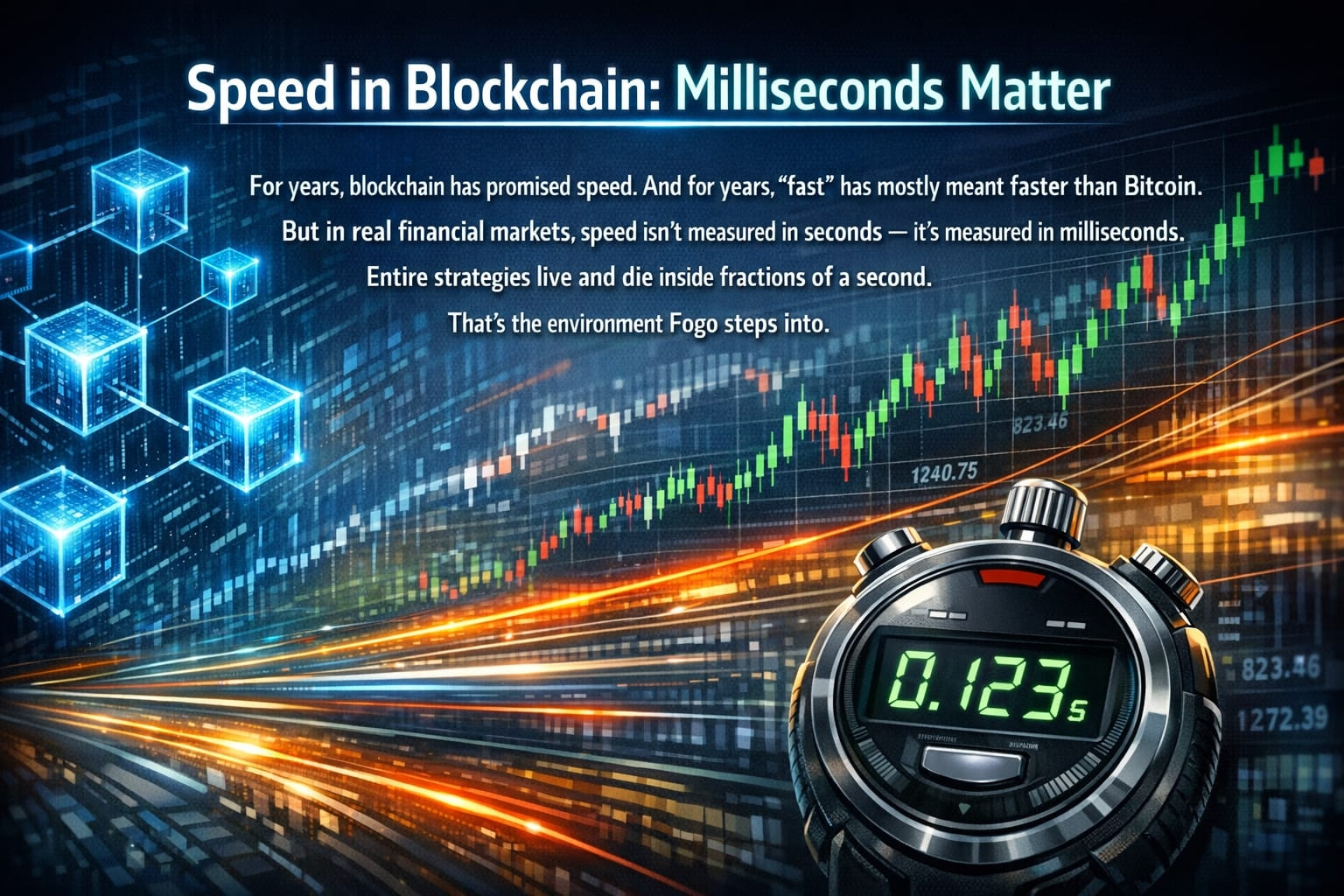
For years, blockchain has promised speed. And for years, “fast” has mostly meant faster than Bitcoin. But in real financial markets, speed isn’t measured in seconds — it’s measured in milliseconds. Entire strategies live and die inside fractions of a second. That’s the environment Fogo steps into.
Fogo is a Layer-1 blockchain built on the Solana Virtual Machine (SVM), the same execution environment known for parallel processing and developer-friendly tooling. But Fogo isn’t trying to reinvent the execution layer. It’s trying to accelerate time itself.
To understand why that matters, you have to understand the quiet frustration inside crypto. Traders want on-chain transparency, composability, and permissionless access. But when markets move fast, delays feel expensive. Even a one-second confirmation window can be an eternity in volatile conditions. Centralized exchanges thrive partly because they move instantly. Blockchains, no matter how powerful, often feel just slightly behind.
Fogo’s thesis is simple but ambitious: what if on-chain execution didn’t feel delayed at all?
By leveraging SVM compatibility, Fogo keeps the advantages developers already know — Rust-based programs, parallel transaction execution, account-based architecture. Builders who have worked in the Solana ecosystem don’t need to relearn everything. The language is familiar. The environment is recognizable. That familiarity lowers friction and makes experimentation easier.
But where Fogo tries to differentiate itself is at the infrastructure level. The network is tuned for extremely short block intervals — measured in tens of milliseconds. That’s not just a technical flex. It changes how the chain behaves economically.
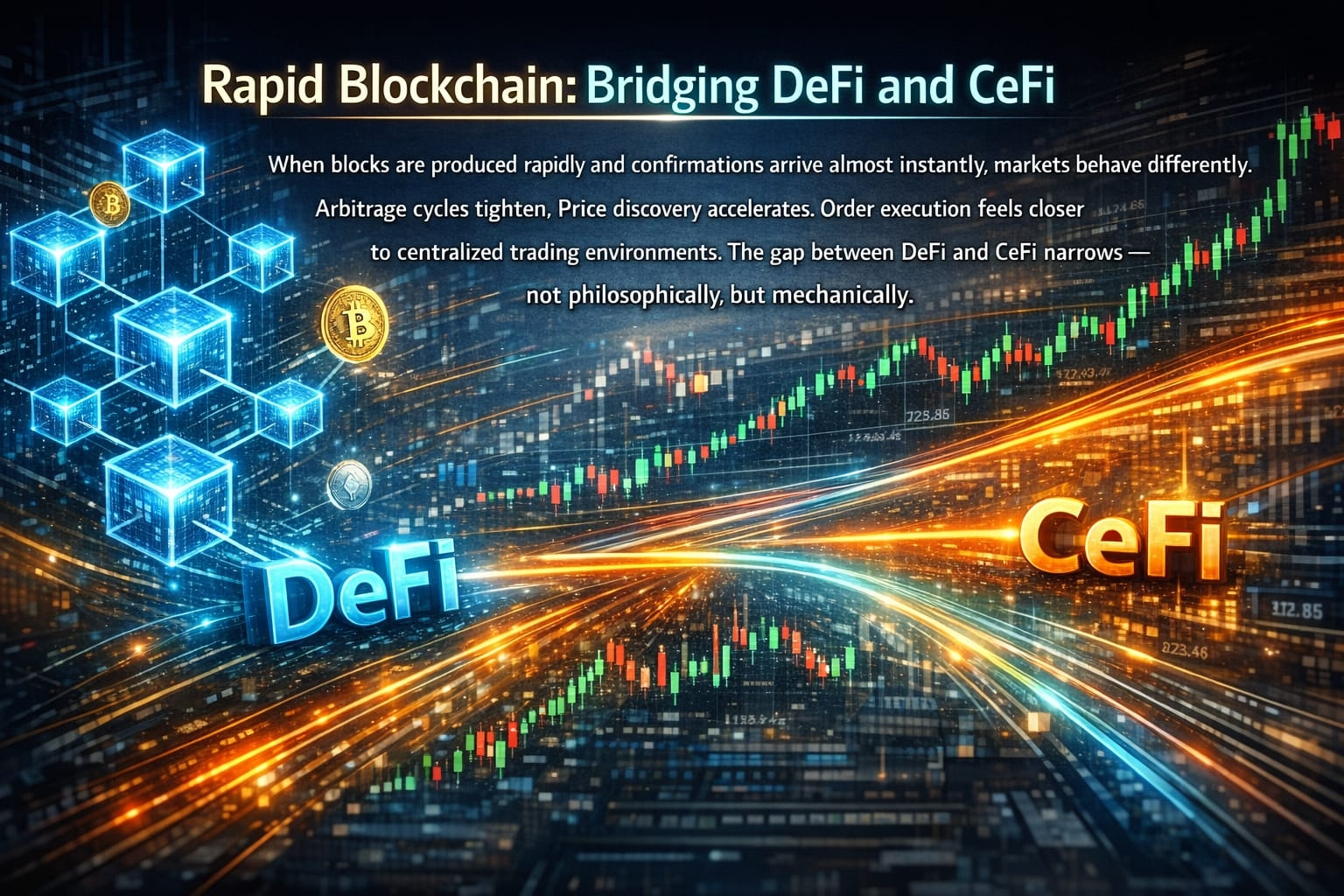
When blocks are produced rapidly and confirmations arrive almost instantly, markets behave differently. Arbitrage cycles tighten. Price discovery accelerates. Order execution feels closer to centralized trading environments. The gap between DeFi and CeFi narrows — not philosophically, but mechanically.
Much of this performance ambition is influenced by high-performance validator engineering inspired by projects like Firedancer, which focus heavily on optimizing networking, reducing overhead, and squeezing inefficiencies out of the system at a low level. The idea is not only to increase throughput, but to reduce tail latency — those occasional spikes where transactions get stuck longer than expected. For serious traders and algorithmic systems, consistency matters more than flashy peak numbers. Predictability builds trust.
But speed always comes with tradeoffs.
Ultra-low latency networks demand robust infrastructure. Validators must communicate quickly and reliably. Poor network connections or weak hardware can introduce instability. The faster a chain moves, the less tolerance it has for friction. This naturally raises questions about decentralization. Can a network maintain broad validator participation while pushing the limits of performance? Or does the race for speed concentrate power among highly optimized operators?
These are not simple technical concerns; they are economic ones. If only the most sophisticated players can fully benefit from sub-second execution, the network risks favoring professionals over everyday users. On the other hand, if designed carefully, faster execution can benefit everyone by reducing slippage, improving price accuracy, and lowering the cost of waiting.
Another subtle impact of chains like Fogo is how they reshape MEV — the phenomenon where transaction ordering can generate extra profit. In slower systems, MEV opportunities stretch across noticeable windows. In ultra-fast systems, they compress. The battleground shifts from seconds to milliseconds. That creates new challenges for fairness and new opportunities for innovation in transaction ordering mechanisms.
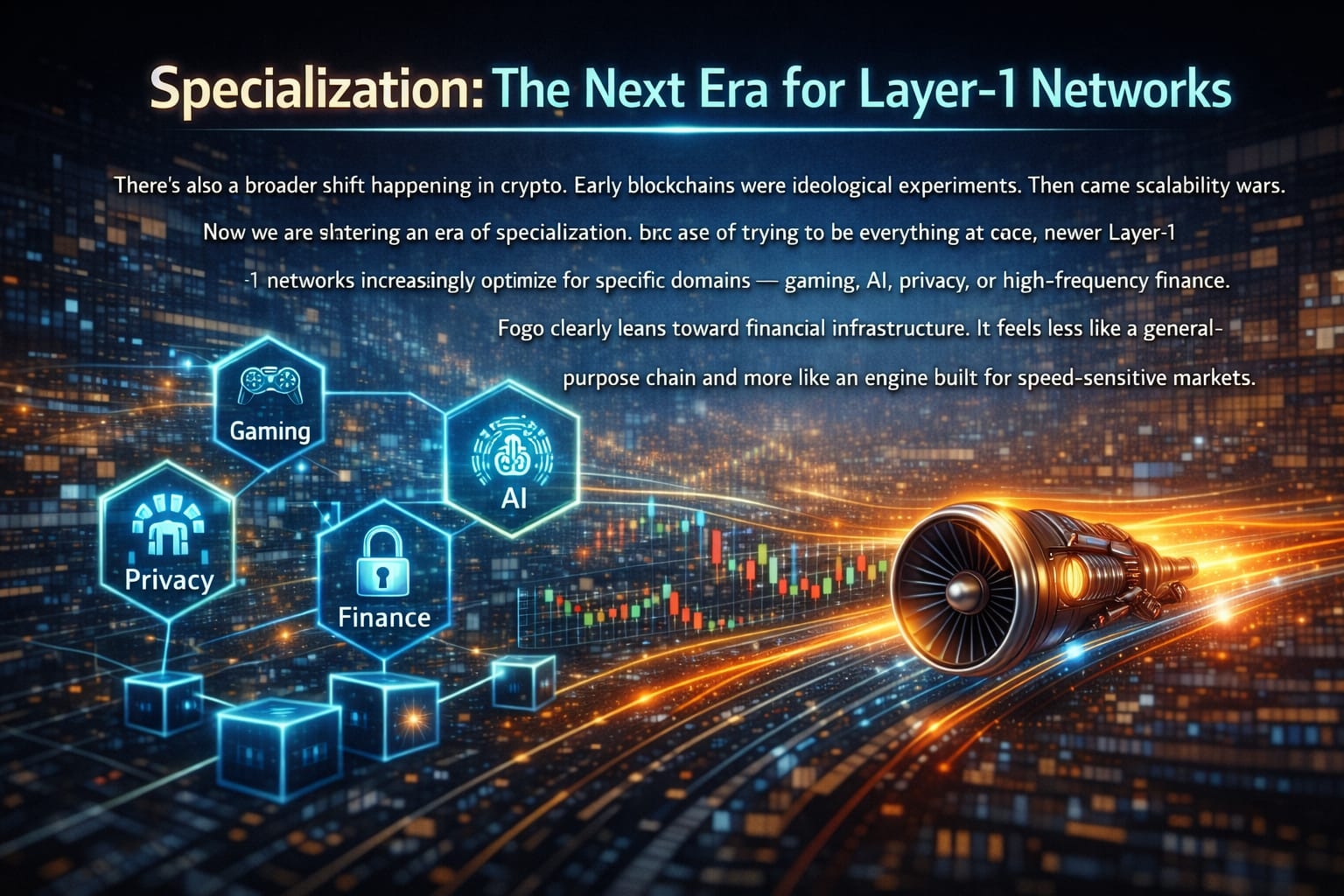
There’s also a broader shift happening in crypto. Early blockchains were ideological experiments. Then came scalability wars. Now we are entering an era of specialization. Instead of trying to be everything at once, newer Layer-1 networks increasingly optimize for specific domains — gaming, AI, privacy, or high-frequency finance. Fogo clearly leans toward financial infrastructure. It feels less like a general-purpose chain and more like an engine built for speed-sensitive markets.
That focus could prove powerful. If on-chain systems can match the responsiveness of centralized exchanges while retaining transparency and composability, a major psychological barrier disappears. Institutions that once dismissed DeFi as too slow might start looking again. Developers who want to build trading protocols may find fewer technical excuses.
Still, real success will not be measured by launch hype or early token activity. It will be measured by durability. Can the network sustain performance under real-world stress? Can it maintain decentralization while chasing speed? Can it attract organic liquidity rather than purely speculative flows?
The FOGO token underpins staking and transaction fees, aligning economic incentives with network security. But long-term strength depends on genuine demand — applications that require the kind of speed Fogo promises. Without that demand, even the fastest infrastructure becomes an empty highway.
In many ways, Fogo represents a mindset shift. Instead of asking how many transactions a blockchain can process in theory, it asks how close a decentralized system can come to real-time finance in practice. It treats milliseconds not as technical trivia, but as competitive advantage.
Whether Fogo becomes a cornerstone of high-speed decentralized markets or simply an ambitious experiment will unfold over time. What is certain is that it pushes the conversation forward. It challenges the assumption that decentralization must always feel slower. And it reminds the industry that in modern finance, time is not just money — time is power.
