

Every proof-of-stake chain claims decentralization. The difference appears in how validator participation is structured.
FOGO’s validator model is not permissionless chaos. It sets clear participation requirements. Validators must meet performance standards and hold a minimum stake to enter the active set. This ensures the network maintains both speed and operational reliability.
That detail matters more than it seems.
When validators must commit capital and maintain uptime standards, consensus becomes economically meaningful. Operators are not symbolic participants. They are financially and technically accountable.
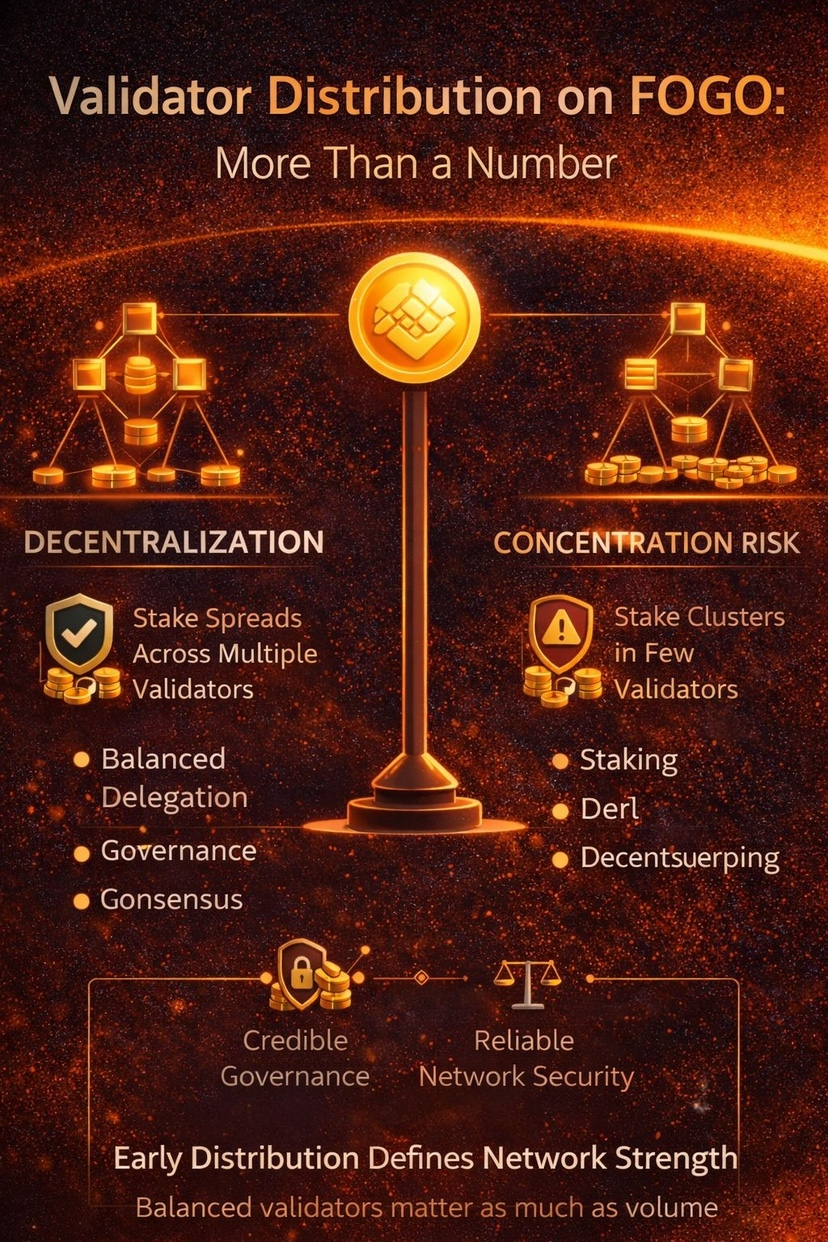
Early staking growth on FOGO signals that participation is not isolated. Tokens moving into validator-backed staking represent distributed trust. The more evenly this stake spreads across capable operators, the stronger the network becomes.
Validator concentration is one of the most underestimated risks in young chains. When too much stake clusters in a small group, governance influence narrows. Upgrades become predictable. Power consolidates. That fragility often surfaces later under stress.
FOGO’s design encourages performance-based distribution. Because rewards correlate with reliability and stake weight, delegators are incentivized to choose validators based on transparent metrics rather than brand visibility alone.
Liquid staking integrations further reduce concentration risk by algorithmically distributing stake across multiple validators instead of funneling it toward a single dominant node. That helps preserve diversity while maintaining efficiency.
This layered approach reflects maturity. Performance standards ensure speed. Economic stake ensures alignment. Distributed delegation ensures resilience.
Together, those elements define decentralization in practice, not theory.
Validator distribution also influences institutional perception. Infrastructure investors do not only examine token price. They evaluate consensus robustness. A network where stake is balanced and validators are accountable is easier to trust.
Trust compounds just like liquidity.
FOGO is still early, which makes this phase critical. Distribution patterns formed now can define governance strength years later. If participation continues expanding while remaining diversified, then the network’s structural integrity improves steadily.
My take is simple. Validator distribution is not background mechanics. It is the credibility layer. FOGO’s combination of staking requirements, performance thresholds, and economic alignment suggests that decentralization is embedded in design rather than added as a slogan.
In the long run, that foundation will matter more than any short-term move.
