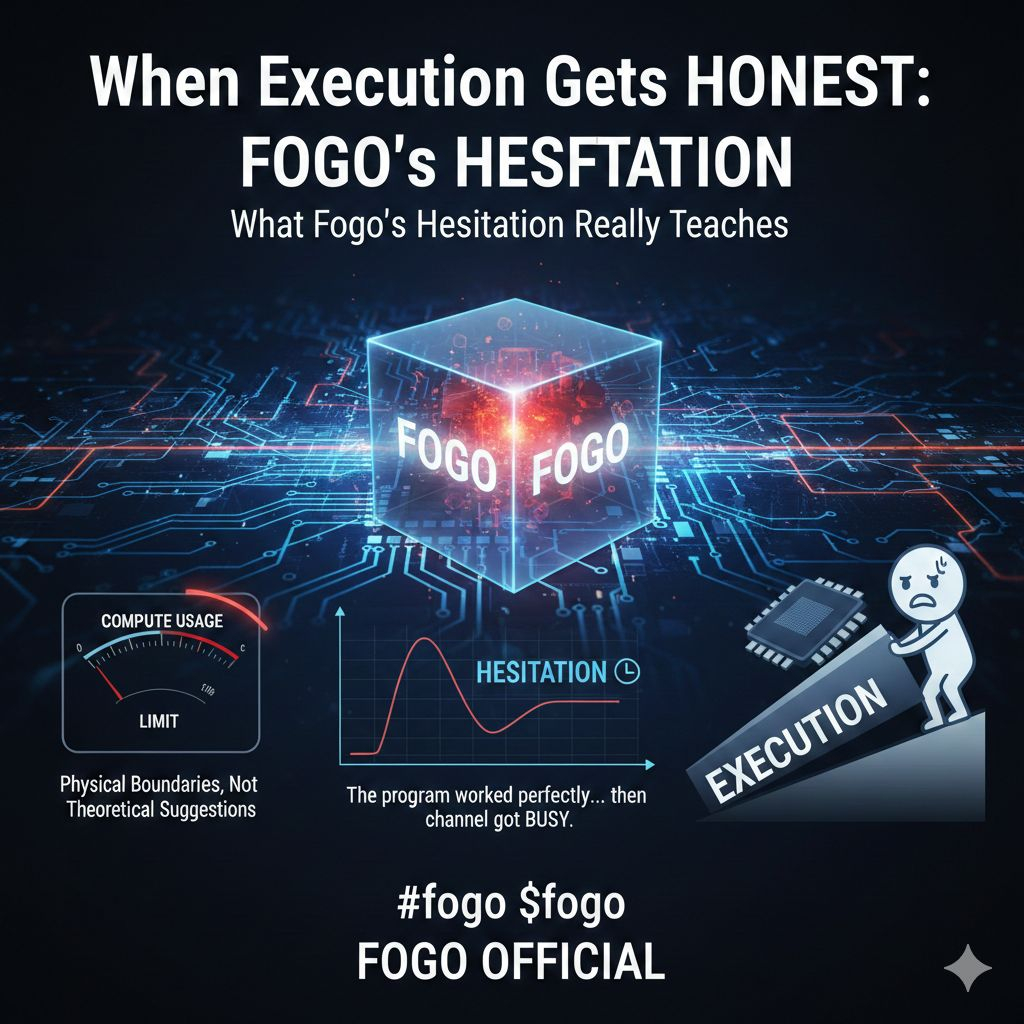
The first signal wasn’t a revert or a crash. It was a hesitation — subtle, brief, but impossible to ignore. Not long enough to throw an error, just long enough to make you question what you thought you understood about execution. The program worked perfectly in isolation. Ten calls, a hundred calls, clean logs, predictable compute usage. In quiet conditions, everything stayed comfortably within budget. Then the channel got busy — not even saturated, just active — and suddenly the same transaction that once had headroom began brushing against its limits.
On Fogo, that shift feels heavier. Compute metering in calm blocks suggests safety, but under validator contention it tells a different story. The same logic, the same accounts, the same instruction flow — yet the meter ticks higher and the ceiling moves closer. At first, it’s tempting to blame the tooling, the RPC node, or the logging. Maybe the metrics are inconsistent. Maybe the network is fluctuating. But the truth is less convenient: the code was written for a theoretical machine, and Fogo keeps exposing the physical one.
On slower chains, inefficiencies hide inside generous block times. Latency cushions absorb waste. Extra CPI depth, redundant account reads, unnecessary branching — they don’t immediately punish you. On Fogo, they don’t necessarily fail either. They drag. And that drag is measurable. Profile-able. Sometimes humbling. What changes isn’t the contract itself, but the scheduling window around it. Early in a slot, execution sails through. Later, under queue pressure, the exact same transaction consumes more effective headroom. The logic hasn’t changed. The environment has.
That’s when optimization stops being cosmetic and becomes archaeological. You dig through profiling traces looking for decorative reads, flatten CPI calls that once felt harmless, trim small instruction costs that seemed insignificant in quiet blocks. The final adjustments might remove only a handful of compute units — nothing dramatic. But those units become the difference between “works in test” and “works when the channel fills.” On Fogo, instruction limits aren’t theoretical suggestions. They’re physical boundaries that arrive without warning if you assume infinite breathing room.
Execution timing becomes its own constraint. Ordering feels deterministic in theory, but in practice it’s negotiable. The same priority and the same fee can produce different outcomes depending on queue depth and contention. The execution window isn’t owned by your contract; it’s shared infrastructure. That realization shifts the mindset from “does it work?” to “when does it stop working?” Optimization becomes less about squeezing instruction cost and more about tolerating timing variance.
The contract may still hesitate in busy slots, but now the hesitation is visible and understood. Not mysterious. Not random. That’s the work — not making it endlessly fast, but making it honest about when it slows down. Fogo doesn’t hide those moments. It makes execution tangible, observable, and real.